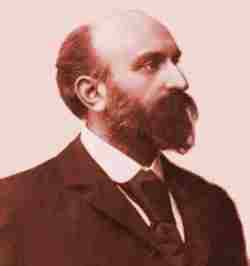
Ernest Chausson was a French Romantic composer who died just as his career was beginning to become established. He was born on 20th January 1855 in Paris, France and died on 10th June 1899 in Limay, France aged 44.
Major Works
Concerto for piano, violin, and string quartet (1889-1891)
Piano Quartet (1897)
Symphony in B flat major (1890)
Poème for violin and orchestra (1896)
Biography Timeline
1855: Amédée-Ernest Chausson was born on 21st January in Paris, France. His father was quite well off having assisted Baron Haussmann in the redevelopment of Paris in the 1850’s. To please his father, he studied law and was appointed a barrister for the Court of Appeals but showed no interest in the work. He spent a lot of time in the Paris Salons where he met people such as Henri Fantin-Latour, Odilon Redon and Vincent d’Indy.
1879: He enters the Paris Conservatoire and studies with Jules Massenet and Cesar Franck and becomes good friends with the latter.
1881: He fails to win the Prix de Rome and becomes dispirited even thinking of giving up altogether however a small inheritance allows him to continue with music composition even after leaving the Conservatoire.
1882: He visits Bayreuth in Germany with Vincent d”Indy to hear the operas of Richard Wagner and sees “Der Fliegende Holländer (The Flying Dutchman), “Tristan und Isolde” and the premiere of “Parsifal”. He composes the symphonic poem “Viviane” in September which is heavily influenced by Wagner. He also begins composing “Poème de l’amour et de la Mer” (Poem of Love and the Sea) which is a song cycle for voice and orchestra but is not completed until 1892.
1883: He takes his new wife Jeanne Escudier on a trip to Bayreuth. The couple go on to have five children.
1886: He becomes secretary of the Societe Nationale de Musique. His home is frequented by famous people such as Gabriel Faure, Claude Debussy, Claude Monet and the Russian novelist Ivan Turgenev and he begins to love Russian literature. He is also an avid collector of paintings. He begins to compose the opera “Le Roi Arthus” (King Arthur) to a libretto written by himself. (Completed 1895, and first performed 1903 after his death).
1888: He writes the incidental music for the French version of “The Tempest” by William Shakespeare. In “La Tempete” he is the first composer to use the celesta in his orchestration.
1889: He begins to compose the Concerto for piano, violin, and string quartet.
1890: He completes his Symphony in B-flat Major.
1891: He conducts the first performance of the Symphony in B-flat major on 18th April at a concert of the Societe Nationale de Musique.
1894: His father dies bringing about a darker period in his music.
1896: He composes the Poème” for solo violin and orchestra which has become a staple of the violin repertoire.
Ernest Chausson died on 10th June 1899, at one of his retreats, the Château de Moussets in Limay, after cycling downhill into a brickwall. Suicide has been suspected but does not seem likely according to his biographer. His funeral was attended by Gabriel Faure, Edgar Degas, Auguste Rodin and Claude Debussy and he was buried in Pere Lachaise cemetery in Paris, France.
Influences
Ernest Chausson’s father was a successful builder who had worked on the construction of Haussmann’s grand boulevards in Paris and although his parents wanted him to become a lawyer, for which he qualified, they were wealthy enough to indulge him in devoting himself to composition. His elder brothers died young which led to his parents to give him what he wanted. He was a sensitive and tortured character who struggled with many self-doubts and could never cope with what he termed “the red spectre” of Richard Wagner. Unable emotionally to take on large scale works he invented strikingly original forms for his own more compact works, such as “Poème”, Op. 25 for violin and orchestra which in effect is a miniature violin concerto. One regular chamber music companion was the artist Odilon Redon, who was fifteen years older but played the violin whilst Chausson took to the piano.
His most significant mentor was César Franck from whom he adopted the use of cyclic form, where material from the first movement recurs throughout the entire piece, dense chromaticism, and a rich sound. He met the so called “Bande à Franck” which included Henri Duparc, and he was inspired by Duparc’s woks such as “L’Invitation au Voyage” and “Le Manoir de Rosamonde”. His first teacher at the Paris Conservatoire was Jules Massenet who heavily influenced his early style and lyricism. Later he would add dramatic harmonies reminiscent of Wagner and he became obsessed with his operas, even traveling to Germany for the 1882 premiere of “Parsifal”.
His style continued to evolve and he went on to include Impressionist elements after being inspired by French Symbolist poetry and Russian literature. He hosted a prominent Parisian salon, where the poetry of Maurice Maeterlinck and Paul Verlaine were read which deeply inspired his vocal and chamber music. Other works were inspired by Russian authors such as Ivan Turgenev, Leo Tolstoy, and Fyodor Dostoevsky. He would also have regular exchanges with Claude Debussy helping to pave the way for French Impressionism.
His most Wagner like work was “Le Roi Arthus” (King Arthur) which he worked on for nine years but sadly its premiere took place in Brussels in 1903, four years after his death in a cycling accident and was completely overshadowed by Claude Debussy’s “Pelléas et Mélisande” of the previous year. It vanished from the repertoire, along with his only Symphony, Op. 20.
As well as entertaining artists and musicians of all kinds at his salons including Gabriel Fauré, Claude Debussy, the poet Stéphane Mallarmé, Russian novelist Ivan Turgenev and Impressionist painter Claude Monet he was an avid collector of art and he amassed a collection of paintings by Eugène Delacroix, Édouard Manet, Paul Gauguin and the Japanese Hiroshige to name but a few.
From 1886 until his death in 1899, he was secretary of the Société Nationale de Musique where he championed the young Debussy and promoted other impressionists like Erik Satie. Debussy described him as an older brother and received money from him but the two later fell out due to the younger man’s extravagant lifestyle.
Chausson significantly influenced the development of French music acting as a crucial bridge between late-Romanticism and nascent Impressionism and the work of Claude Debussy. His harmonic language and promotion of fellow musicians impacted several of his contemporaries including the wide circle of composers centred around César Franck such as Vincent d’Indy and Henri Duparc.
Further Information
List of compositions by Chausson.