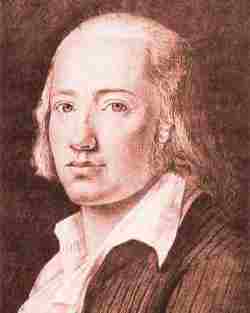
Johann Christian Friedrich Hölderlin was a German poet and philosopher and a key figure in German Romanticism. He was born on 20 March 1770 in Lauffen am Neckar, Wurttemberg, Germany and died on 7 June 1843 in Tubingen, Wurttemberg, Germany aged 73.
Major Works
“The Death of Empedocles” (1797)
“Hyperion” (1797)
“Menons Klagen um Diotima” (1798)
“Andenken” (Remembrance) (1802)
“Der Rhein” (1808)
Biography
1770: Johann Christian Friedrich Hölderlin was born on 20th March in Lauffen am Neckar in Germany. His father was Heinrich Friedrich Hölderlin, the manager of a church estate. His mother was Johanna Christiana Heyn, a parson’s daughter.
1772: His father dies.
1774: His mother Johanna remarries, to Johann Christoph Gok in Nurtingen.
1776: Johann Gok becomes the Burgomeister of Nürtingen and Hölderlin’s half-brother, Karl Christoph Friedrich Gok, is born. Holderlin begins his schooling in Nurtingen and his mother wants him to eventually join the ministry.
1779: Johann Gok dies aged 30 and Holderlin’s mother is left to bring up the family.
1782: In preparation for entrance examinations to join a monastery, he receives additional tuition in Greek, Hebrew, Latin and rhetoric.
1784: He enters the Lower Monastery in Denkendorf and starts his formal training for joining the church where candidates receive free education. He reads the poetry of Friedrich von Schilller and Friedrich Gottlieb Klopstock and begins to write his own verse.
1786: He moves on to the Higher Monastery at Maulbronn where he falls in love with the daughter of the the monastery’s administrator, Luise Nast. His desire to join the ministry begins to wane.
1787: He writes “Mein Vorsatz” (My Resolution), in which he records his intention to reach “Pindar’s Light”, a reference to his new great passion of the Ancient Greek world.
1788: Luise Nast recommends he read Schiller’s “Don Carlos” and later writes to Schiller saying “It won’t be easy to study “Carlos” in a rational way, since he was for so many years the magic cloud in which the good god of my youth enveloped me so that I would not see too soon the pettiness and barbarity of the world.” In October he begins his theological studies at the Tubinger Stift. Fellow students include George Wilhelm Friedrich Hegel and Friedrich Schelling. The latter becomes a friend and he protects him from bullying by the older students. He also begins to learn the piano.
1789: He ends his engagement with Luise Nast as he believes he is too morose for her. He says he will never enter the clergy and wants to convert to the law. Along with many of the students of the time he is a supporter of the French Revolution but is later appalled by “The Reign of Terror”.
1793: He gains his magister degree and Schiller recommends him for a post as a private tutor.
1794: He leaves his tutor’s post and moves to Jena in Germany where he sees Schiller and his friend Johann Wolfgang von Goethe. He begins writing his novel “Hyperion”.
1795: He enrols at the university of Jena and attends classes held by Johnann Gottlieb Fichte. There he meets the poet Novalis. In December he accepts a post in Frankfurt as tutor for J.F. Gontard’s family. Gontard is a wealthy banker and Holderlin then falls in love with Gontard’s beautiful wife Susette.
1796: Susette returns Holderlin’s love and they start an affair.
1797: A manuscript, dated 1797, now known as the “Das Alteste Systemprogramm des Deutschen Idealismus” (The Oldest Systematic Program of German Idealism) has been attributed to Hegel, Schelling and Holderlin as well as an unknown fourth person. Holderlin works on his first version of his Greek tragedy “The Death of Empedocles”. Although he produces three versions they are never finally completed. His Novel “Hyperion” is published.
1798: Jakob Gontard finds out about the affair with his with and dismisses Hölderlin and he is forced to leave Frankfurt in September. Bitterly upset he moves to Bad Homburg but still manages to finish the second volume of “Hyperion”. There he meets Susette in secret. He begins writing his great elegies “Menons Klagen um Diotima” (Menon’s Lament for Diotima) and “Brod und Wein” (“Bread and Wine”). He is now without funds and accepts a small allowance from his mother.
1799: The second volume of “Hyperion” is published (under the Greek name of “Diotima”) and Susette appears in this work as well as in some of his other poems. The poems do not reach a wide audience. He begins writing a periodical “Iduna”.
1800: By now he has been diagnosed with schizophrenia which was then called hypochondrias which gets worse after his final meeting with Susette. He moves to Stuttgart where he works on his translations of the Ancient Greek poet Pindar.
1801: In January he finds employment with a family in Hauptwyl, Switzerland.
1802: He then moves of Bordeaux where he works in the household of the Hamburg Consul. This period is recorded in his poem “Andenken” (Remembrance). After a few months he returns to Nürtingen via Paris on foot arriving in the early winter. He hears that Susette had died of influenza in Frankfurt.
1804: He becomes Court Librarian in Bad Homburg. There he translates Sophocles’ dramas but the critics are not impressed with his attempts at trying to translate Greek Idioms into German. Later critics have reviewed this and now realise their importance.
1805: His boss, von Sinclair, is denounced as a conspirator and tried for treason. Hölderlin is also in danger of being tried but is declared mentally unfit to stand trial.
1806: On 11th September he is sent to Dr Johann Heinrich Ferdinand von Autenrieth’s clinic which is attached to the University of Tübingen. A student, the poet Justinus Kernet, is assigned to look after him.
1807: He is discharged as incurable and given three years to live. He goes to live with Ernst Zimmer, a carpenter and admirer of “Hyperion”, in Tubingen. His room had been a tower in the old city wall with views across river Neckar (now named Holderlinturm) and he is to live there for the next 36 years. He continues to write poetry and tourists come to see him and ask for his autograph. His mother and sister never visit him but receive money from the state for his upkeep.
1808: The hymns “Der Rhein” and “Patmos” are published.
1822: Wilhelm Waiblinger visits Holderlin in his tower and includes him in his novel “Phaëthon”.
1826: At Waiblinger’s suggestion the first collection of his poetry is published by Ludwig Uhland and Christoph Theodor Schwabin. A copy of this is given to Hölderlin, but is later stolen by an autograph-hunter.
1828: Death of his mother.
1842: A second, enlarged edition of the poems with a biographical essay is published.
Johann Christian Friedrich Hölderlin died on 7th June 1843 in Tübingen, Germany and only the Zimmer family attended his funeral in the town’s cemetery. (Unbeknownst to him his inheritance from his father had been kept by his mother and he died rich without even realising it). He became more famous after his death with Robert Schumann and Johannes Brahms setting some of his poems to music and he is now considered one of Germany’s finest poets.
Influences
Friedrich Hölderlin was initially influenced by his devout Christian mother who wanted him to become a theologian. He was always more interested in Greek mythology and tried to mix his Hellenism with Christianity and to unite ancient values with modern life. At the age of eighteen he entered the Tübinger Stift seminary where he shared a room with Georg Wilhelm Friedrich Hegel who became a close friend. He also studied there with his friend from school the philosopher Friedrich Schelling. At the time he was heavily influenced by the writings of Pindar and Empedocles.
He worked as a private tutor in Frankfurt with the help of Friedrich von Schiller and fell in love with one of his pupil’s mother, Susette Gontard who became the inspiration for his novel “Hyperion”. Discovered by her banker husband he was forced to resign. In 1794 he went to Jena, principally to hear Johann Gottlob Fichte who had recently taken over the chair of philosophy at the university. At the time he was a major supporter of the French Revolution along with many other German intellectuals. There he conversed with Schiller and was influenced by Johann Wolfgang von Goethe, Johann Gottfried Herder and Novalis. Schiller claimed that a harmony of duty and inclination represented the highest ideal of morality as opposed to Immanuel Kant who thought inclinations to be worthless. Hölderlin’s work emerged within the context of Kant’s Critical Revolution and was in constant interaction with the German Idealist thought.
His health suffered due to the impossible liaison with Gontard and he became disillusioned with philosophy and the ideas of Fichte and abandoned any plans to become an academic in 1800 and decided to live his life as a poet. In 1802, the news of Susette’s death drove him nearly insane and he finally succumbed in 1807.
Despite being accused of high treason n 1805 as one of a group of Jacobin militants against the Elector of Württemberg he was released on the grounds of diminished mental capacity. He was taken to Tübingen where he lived until his death. His work concerned nature and idealism and, in his elegy, “Brod und Wein” (Bread and Wine), Jesus Christ is described as a follow on from the Greek gods, bringing bread from the earth and wine from Dionysus. Friedrich Nietzsche described him as his favourite poet and his ideas were extremely influential, although his translations of the dramas of Sophocles in 1804 were generally met with derision by critics due to the difficulty of transposing Greek idioms into German.
After a period of neglect after his death he is now widely recognised as one of the most important writers and thinkers of his time and he has been very influential on writers throughout the twentieth century and has had a profound influence on modern literature and critical thought. However, only after the work of Wilhelm Dilthey about his influence on the development of Schelling and Hegel has, he been fully recognised for his importance. In 1913 the literary scholar Norbert von Hellingrath published the first two volumes of what eventually became a six-volume edition of his poems, prose and letters known as the “Berliner Ausgabe” (Berlin Edition) and this led to him posthumously receiving the recognition that had always eluded him during his life and he has since become known as one of the greatest poets ever to write in the German language. The Austrian poet Rainer Maria Rilke composed his first “Duino Elegies” based strongly on the hymns and elegies of Hölderlin.
In 1943 the Berlin Edition was superseded by the “Grosse Stuttgarter Ausgabe” (Stuttgart Edition) only completed in 1986 and another edition “Frankfurter Historisch-kritische Ausgabe” (Frankfurt Critical Edition) began publication in 1975.
He influenced the poetry of Herman Hesse and Paul Celan and had a profound influence on the philosophers Martin Heidegger, Philippe Lacoue-Labarthe, Jacques Derrida and Michel Foucault. In music he has influenced composers such as Ludwig van Beethoven (An die Hoffnung – Opus 32), Robert Schumann’s piano suite “Gesänge der Frühe”, “Schiksalslied” by Johannes Brahms, Rikard Strauss’s “Drei Hymnen” and many many more including Paul Hindemith, Benjamin Britten, Hans Werner Henze, Luigi Nono and Carl Orff.
In cinema “Der Tod des Empedokles” and “Schwarze Sünde” in 1986 and 1988 were both based on his drama “Empedokles”. He also had a major influence on psychology and in particular Carl Jung who was impressed by his sense of the soul’s exile and homelessness in the modern world and for man’s longing for a reunion with the divine and the sacred dimensions of existence. Jung was especially interested in myth and symbol for discovering the depths of the psyche and the spiritual crisis in the modern world and often cited him as a kindred spirit. Hölderlin himself represents the gods not as literal beings but as symbolic expressions of the elemental powers that shape human experience.
Further Information
List of works by Hölderlin.