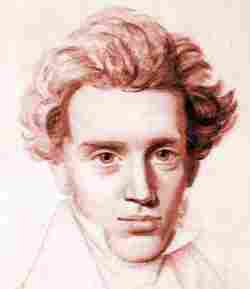
Søren Kierkegaard was a Danish theologian, philosopher, poet, social critic, and religious author widely considered to be the first existentialist philosopher. He was born in Copenhagen, Denmark on 5th May 1813 and died there on 11th November 1855 aged 42.
Major Works
“Fear and Trembling” (1843)
“Philosophical Fragments” (1844)
“The Concept of Anxiety” (1844)
“Sickness unto Death” (1849)
Biography Timeline
1813: Søren Aabye Kierkegaard was born on 5th May in Copenhagen, Denmark. His father was a successful and self made merchant, who was a devout Christian and very strict. His mother, Ane Sørensdatter Lund was orginally a servant and was illiterate although a very kind person. Kierkegaard was educated at the University of Copenhagen.
1821: He attends the Østre Borgerdyd Gymnasium (School of Civic Virtue) where he studied Latin amongst other subjects.
1837: Kierkegaard and Regine Olsen meet on 8th May and he instantly falls in love with her.
1838: Death of his father on 8th August.
1840: He formally proposes to Regina on 8th September.
1841: He breaks off the engagement on 11 August with no explanation although he felt he was not the suitable type to marry. On 29 September defends his masters thesis at the Ubinversity of Copenhagen. It is entitled “On the Concept of Irony with Continual Reference to Socrates“. It deals with irony and Friedrich Schelling’s although the panel thought it was too light hearted to be serious academic work.
1843: On 16th October Kierkegaard publishes his major work “Fear and Trembling” (under the pseudonym Johannes de Silentio).
1844: He also writes other books under an assumed name. “Philosophical Fragments”, “Prefaces”, “The Concept of Anxiety” and “Four Upbuilding Discourses”.
1845: On 22 December “The Corsair”, a satirical magazine, published a bad review of Kierkegaard’s book “Stages on Life’s Way” by Peder Ludvig Moller. He began to fight back in several new articles but this severely damaged his reputation in Denmark.
1846: He publishes “Concluding Unscientific Postscript to Philosophical Fragments” (under the pseudonym Johannes Climacus) which was an attack on the German philosopher Georg Wilhelm Friedrich Hegel and his science of logic. He also published “Two Ages: The Age of Revolution and the Present Age, A Literary Review“.
1847: He publishes “Kjerlighedens Gjerninger” (Works of Love).
1848: He publishes “Christian Discourses“. Much of his writing at this period concerned the dialectic of Christian faith.
1849: He publishes “The Sickness Unto Death“.
1850: He publishes “Practice in Christianity“.
1851: He publishes “Til Selvprøvelse” (For Self-Examination) In “Two Discourses at the Communion on Fridays” he discusses sin, forgiveness and authority. He also writes “Dømmer Selv!” (Judge for Yourselves!).
I1855: In his final years Kierkegaard opposes the Lutheran Church of Denmark and the merging of church and society. In October he collapses in the street in Copenhagen and spends a month in hospital.
Soren Kierkegaard died in the Royal Frederiks Hospital, Copenhagen on 11th November 1855 and was buried in the Assistens Churchyard, Copenhagen, Denmark.
Influences
Søren Kierkegaard’s earliest memories were influenced by his father who was prone to melancholy and profound guilt which affected him deeply. He read widely in philosophy and was particularly influenced by Immanuel Kant and his analysis of the existence of evil in religion. He was well aware of the work of all the ancients including Plato and Aristotle and chiefly Socrates, whom he saw as a particular mentor and admired for his emphasis on self-examination, subjectivity and the pursuit of wisdom.
His theological views were very much based on Martin Luther but also in debate with his Danish contemporaries N.F.S. Grundtvig and H.L. Martensen. In religion Kierkegaard was a fideist, i.e one who takes religion mostly or entirely on faith, and relies on their own subjective experience of God. He was however shaped by the Romantic movement which emphasised individualism, emotion and the importance of subjective experience.
Other more recent philosophers he admired or engaged with were Gottfried Wilhelm Leibniz, Georg Wilhelm Friedrich Hegel, (he appreciated Hegel’s emphasis on the development of self-consciousness but criticised his system-building concept), Arthur Schopenhauer, Friedrich Schelling and Johann Wolfgang von Goethe. As a philosopher Kierkegaard is best known for his stages of existence, truth as subjectivity, faith in the absurd and analyses of existential anxiety and despair. Many scholars have described him as the father of existentialism although he never knew the term himself. There is no actual proof that Friedrich Nietzsche knew about Kierkegaard’s writings however the two philosophers are often linked.
His influence on later writers has been immense and his reception amongst scholars has differed widely and, not surprisingly, he was not revered by the Danish or other Christian churches. After his death his original manuscripts were bequeathed by his fiancée Regine Olsen to the Danish Royal Library but his thought gained much wider traction when they were translated into German, French and English. The first translation of Kierkegaard into French was published in 1886 by Johannes Gøtzsche and his work continued to be translated into French well into the 1940’s. Early translations of Kierkegaard into German were restricted to his post-1850 material.
Many twentieth century philosophers have been inspired by Kierkegaard due to his ideas of angst, despair and the importance of the individual and his fame grew in the 1930’s, largely due to the rise of the Existentialist movement. People influenced by him include Ludwig Wittgenstein (who declared “he is far too deep for me”), Karl Popper, Karl Barth, Niels Bohr, Dietrich Bonhoeffer, Martin Heidegger, Karl Jaspers, Maurice Merleau-Ponty and Jean-Paul Sartre.
He also had a major influence on writers such as August Strindberg, Henrik Ibsen, Albert Camus, Simone de Beauvoir, Rainer Maria Rilke, W. H. Auden, Jorge Luis Borges, Hermann Hesse, Franz Kafka, and more recent writers such as J.D. Salinger, John Updike and David Lodge.
His influence can be clearly seen in the work of the painter Edvard Munch and he is widely regarded as the founder of Christian psychology and psychologists and therapists he influenced include Ludwig Binswanger, Viktor Frankl and Erich Fromm. He is also seen as an important precursor of postmodernism.
Kierkegaard predicted his posthumous fame and foresaw that his work would become the subject of intense study and research and in 1964 UNESCO held a colloquium in Paris on his work and ideas where Jean Paul Sartre was the keynote speaker. In America, interest in Kierkegaard was revived from the 1980s onwards, particularly by the philosopher Gordon Marino, curator of the Kierkegaard Library at St. Olaf College, Minnesota.
Further Information
Complete list of writings by Kierkegaard.