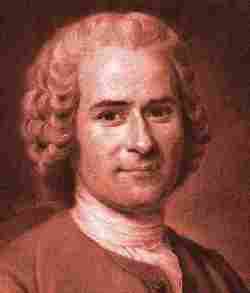
Jean-Jacques Rousseau was a Swiss philosopher, writer, and composer who was a major influence on the Age of Enlightenment. His work played a major part in later political, economic and educational thought. He was born in Geneva, Switzerland on 28th June 1712 and died in Ermenonville, France on 2nd July 1778 aged 66.
Major Works
“A Discourse on the Origins of Inequality” (1755)
“The Social Contract”. “Émile; or, On Education” (1762)
“Confessions” (1782-89)
Biography
1712: Jean-Jacques Rousseau was born on 28th June in Geneva, Switzerland then a Protestant City-State in its own right of the Swiss Federation. His father, Isaac Rousseau, was in the family watchmaking business and also taught dance. His mother, Suzanne Bernard Rousseau was from a high-class Calvinist family and had been brought up by her uncle the preacher Samuel Bernard. Sadly, his mother died shortly afterwards of puerperal fever and he and his brother were cared for by his father’s sister, also called Suzanne.
1718: His father sells the family house and they move to a smaller place nearer the watchmaking artisans. His father encourages his love of reading.
1723: His father is caught trespassing on a wealthy landowner land while hunting and he moves to avoid prosecution to Nyon near Berm with Suzanne. Rousseau is left with his maternal uncle who sends him and his own son to live with a Calvinist minister in a small town outside Geneva. Here they learn mathematics and drawing and Rousseau even contemplates becoming a religious minister himself.
1728: On 14th March Rousseau returns home too late after the curfew and finds the city gates locked. He seeks shelter in the nearby town of Savoy with a Roman Catholic priest who introduces him to Francoise-Louise de Warens a 29-year-old Protestant noblewoman. Francoise is being paid by the King of Piedmont to help convert Protestants to Catholicism. Rousseau is sent to Turin to complete his conversion. Now on his own the teenager supports himself by working as a servant or a secretary in various parts of Italy and France.
1732: Francoise-Louise de Warens takes Rousseau as her lover and although she was officially with the steward of the house Rousseau always considered her to be the greatest love of his life.
1737: He receives a small inheritance held for him from his mother and repays Francoise for her financial support of him.
1738: He takes up a job as a tutor in Lyon, France.
1742: He moves to Paris and presents the Academie des Sciences with a new system of numbered musical notation believing it will make his fortune, however the Academy rejected it as impractical. He meets Denis Diderot the compiler of the famous Encylopedie.
1743: He works as secretary to the Comte de Montaigue, the French ambassador to Venice. It paid little but engendered in him a love of Italian opera.
1744: Penniless he returns to Paris and becomes the lover of the seamstress Therese Levasseur. He takes her and her mother and other members of his family into his home as servants and looks after the family. It is reported that Therese bore him up to five children but there is no official record of this.
1749: He writes some articles on music to Diderot and D’Alembert’s Encylopedie and pays daily visits to see Diderot who has been imprisoned in the fortress of Vincennes for ideas that suggested atoms and natural selection which were contrary to existing religious beliefs.
1750: He writes “Discourse on the Arts and Sciences” which is awarded a prize and gains him fame for the first time. He also writes the words and music for an opera “Le Devin du Vilage” (the Village Soothsayer). This is performed in front of King Louis the Fifteenth who is so impressed he awards him a lifelong pension. To the surprise of his friends and compatriots he turns down the money and becomes known as “the man who had refused a king’s pension”.
1754: He returns to Geneva where he has to reconvert to Calvinism in order to regain his official Genevan citizenship. He completes his second major work “Discourse on the Origin and Basis of Inequality Among Men”. He contributes an article on political economy to the Encylopedie and forms a romantic attachment to Sophie d’Houdetot who inspires his novel “Julie, Ou la Nouvelle Heloise”.
1761: “Julie, Ou la Nouvelle Heloise” is finally published and despite being 800 pages long it is a great success.
1762: He publishes “Du Contrat Social, Principes du Droit Politique” in April. (now normally abbreviated to The Social Contract). This is controversial as he implied that a Christian Republic is a paradox as Christianity teaches submission rather than participation in state affairs. In May he publishes “Emile, or On Education” which states that if all religions lead people to virtue then they are all equally worthy. These views are also incredibly controversial and Rousseau is condemned from the pulpit by the Archbishop of Paris, his books are burned and a warrant is put out for his arrest. In July he leaves Bern and moves to Prussian controlled Neuchatel under the protection of Frederick the Great. He subsequently moves to Motiers 15 miles from Neuchatel.
1764: James Boswell, the biographer of Samuel Johnson visits him at Motiers.
1765: However, he is not safe from the locals in Motiers and on the night of 6th September they pelt his house with stones and he is advised to leave town. He moves to the small island of Ile de St-Pierre in the province of Bern. He is assured that he can stay there despite being banned from Bern. He receives so many visitors that in October the senate of Bern order him to leave. On 29th October he goes to Strasbourg and takes up the Scottish philosopher David Hume’s offer for him to visit England he meets Hume in Paris in December.
1766: In January Baron Grimm writes of a fictitious letter from Frederick the Great to Rousseau. In reality it has been written by Horace Walpole as a hoax with the knowledge of Hume. On 13th January Hume and Rousseau arrive in London and they lodge in the house of Madam Adams. Rousseau meets David Garrick at the Drury Lane Theatre. Again, Rousseau has so many visitors that he is forced to move again this time to Chiswick and asks Therese Levasseur to rejoin him. However Richard Davenport offers to give them accommodation at Wootton Hall in Staffordshire and on 22nd March they set off for Wootton, against Hume’s advice. On 3rd April the Horace Walpole hoax letter is published in a national newspaper and Rousseau is mortified and attacks Hume verbally. When Hume realises that Rousseau is writing the “Confessions” he makes the public aware of the quarrel to get his retaliation in first.
1767: He maintains a public silence but returns to France with Therese arriving on 22nd May under an assumed name as there is still a warrant out for his arrest. In June he finds shelter at the Chateau of the Prince of Conti in Trie.
1768: On 29th January the theatre at Geneva burns down and Voltaire accuses Rousseau of being the culprit even though he wasn’t there. He leaves Trie and goes to Lyon and then Bourgoin. He marries Therese there on 30th August in a civil ceremony under his assumed name of Renou.
1769: In January Rousseau and Thérèse go to live in a farmhouse near Grenoble where he completes his “Confessions”. (published after his death in 1782).
1770: On 10th April Rousseau and Thérèse move to Lyon where he befriends Horace Coignet, a fabric designer and musician. Coignet composes musical interludes for Rousseau’s prose poem “Pygmalion”. In June, Rousseau and Thérèse leave for Paris and lodge in a cheap area of town. He supports them by copying music and studying botany and writes “Letters on the Elements of Botany”. (published after his death).
1772: He is invited to present recommendations for a new constitution for the Polish-Lithuanian Commonwealth which results in his work the “Considerations on the Government of Poland”. He also begins writing “Dialogues Rousseau Judge of Jean-Jacques” as an attempt to reply to his critics.
1776: He finishes “Dialogues Rousseau Judge of Jean-Jacques”. On 24th October he avoids a speeding carriage in a narrow Parisian street and is knocked over by a large Great Dane dog. He sustains concussion and from that point his health begins to decline.
1777: The Holy Roman Emperor Joseph the Second comes to meet him. He starts writing, the “Reveries of the Solitary Walker”.
1778: In the spring, the Marquis Girardin invites him to live in a cottage in his château at Ermenonville where he continues his botanical studies. There he plans to complete his unfinished “Emile and Sophie” and “Daphnis and Chloe”.
Jean-Jacques Rousseau suffers a cerebral haemorrhage and stroke as he was about to teach music to Girardin’s daughter on 2nd July 1778. False rumours are spread by Grimm and others that he had committed suicide and was insane when he died. He was buried on 4th July on the Île des Peupliers, at Ermenonville. On 11th October 1794 he was re-interred at the Pantheon in Paris near Voltaire.
Influences
Jean-Jacques Rousseau is often considered the father of Romanticism. He was well versed in the philosophers of the ancient world including Socrates, Plato and Aristotle and writers such as Plutarch and Seneca the Younger. In his own works he often directly responded to some of Plato’s ideas. Much of his political writing, especially “The Social Contract” shows the influence of Aristotle’s own Politics where citizenship is more important than the individuality of man.
Major influences were writers of the seventeenth century such as Thomas Hobbes, John Locke, Baruch Spinoza, and Renee Descartes. He based much of his political philosophy on contract theory and his reading of Hobbes and his ideas on equality, legislative supremacy, and early childhood education are based on Lockeian principles. Other writers he admired were Montesquieu, Voltaire, Michel de Montaigne, the German philosopher Samuel von Pufendorf and Niccolo Machiavelli. He also owed a great deal to his former teacher Friar Nicolas.
Rousseau believed that humans were born pure until interactions with the environment and society caused negative effects in their development. They move from the independent state of nature to an oppressed society and then form a Social Contract with the state where they become free again through obligation. He believed nature was the master and that children needed protection from forced work or negative influences in civilisation. He taught parents and people in general the value of music and the arts and why it was necessary to educate their children in such things and that they should be in touch with their emotions. He also believed citizens will follow the law if they believe that they have some input into the making of those laws and that liberty and equality are innate natural rights that are an intrinsic part of human nature.
In works such as “Discourse on Inequality”, “Reveries of the Solitary Walker” and “Emile” many of his aesthetic and philosophical ideas anticipated the Romantic movement. He advocated turning towards nature, emotion and the individual soul for meaning. He believed that humans are mostly good and that it was society that corrupts and their organisations that oppress man and lead to evil.
However his ideas on political egalitarianism, human nature, and citizenship have been considered the primary influence on the French Revolution. Both Robespierre and Louis Antoine de Saint-Just saw themselves as principled republicans removing corruption and submitting to the General Will even during the Reign of Terror and in this way saw themselves as disciples of Rousseau. They also introduced his idea of Deism as the new official religion of France. Edmund Burke noted these concepts in “Reflections on the Revolution in France” which was circulated throughout Europe leading Catherine the Great of Russia to ban Rousseau’s works.
The founding fathers of the American Revolution believed “all men are created equal” and that citizens should be educated at the state’s expense but Rousseau’s influence has been played down largely because he has been seen as a controversial figure throughout history. Instead they claimed a link to John Locke and Montesquieu, however Thomas Jefferson, a former Ambassador to France, derived a lgreat deal from Rousseau when the Declaration of Independence was drawn up.
Immanuel Kant was also greatly influenced, particularly on his work on ethics. Other philosophers such as Georg Wilhelm Friedrich Hegel, Arthur Schopenhauer, John Dewey and Jacques Derrida owe him a great deal as do writers as diverse as Adam Smith, William Wordsworth, Thomas Paine, Ralph Waldo Emerson, Noam Chomsky and the psychologist B.F. Skinner.
One of his most important American followers was school textbook writer Noah Webster during the nineteenth century who was influenced by his ideas on pedagogy as exhibited in “Emile”. Johann Wolfgang von Goethe, Friedrich Schiller and Johann Gottfried von Herder have all stated they were inspired by him with Schiller comparing him with Socrates and Herder regarding him as his guide. Robert Southey, Samuel Taylor Coleridge, Lord Byron, John Keats, William Godwin and Percy Bysshe Shelley have been similarly inspired along with Henry David Thoreau in America and Leo Tolstoy and Alexander Pushkin in Russia and he influenced the thoughts of Karl Marx and Claude Levi-Strauss.
It has been stated that he was a controversial figure and criticism came from the beginning from people such as Voltaire who declared on reading the second discourse that Rousseau would like the reader to “walk on all fours” as befitting a savage. Madame de Staël published her “Letters on the Works and Character of J.-J. Rousseau” in 1788. Samuel Johnson thought him “one of the worst of men; a rascal, who ought to be hunted out of society, as he has been” and Mary Wollstonecraft criticised him for denying women the possibility to develop their reason. His Catholic opponent Jean-Baptiste Blanchard rejected Rousseau’s negative education and said that one must wait until a child has grown to develop reason. In 1791 the Marquis de Sade parodied the “Discourse on the Origin and Basis of Inequality Among Men” and The Social Contract” in his novel “Justine, or the Misfortunes of Virtue”. The French economist Claude-Frederic Bastiat criticised him in several of his works declaring that people have become machines in his theories.
Edmund Burke disliked the man himself when he met him on a visit to see David Hume describing him as vain and egotistical. Hume and Rousseau had a violent disagreement and Rousseau left Scotland swiftly afterwards. Thomas Carlyle was no less unflattering saying he had “the face of what is called a fanatic”. The American novelist Mark Twain insisted in his work “Equality” that Rousseau borrowed from Thomas Hobbes and John Locke and was not original. Such criticisms continued into the twentieth century when the political philosopher Hannah Arendt stated that General Will was just the same as sovereignty.
All in all he has been one of the most influential writers that have ever lived.
Further Information
List of works by Rousseau.