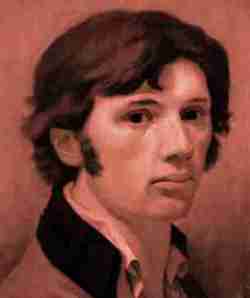
Phillipp Otto Runge was a German painter, and colour theorist. He was born on 23rd July 1777 in Wolgast, Germany and died on 2nd December 1810 in Hamburg, Germany aged 33.
Major Works
“Times of Day” (1805)
“We Three”, “The Hülsenbeck Children” (1805)
“Rest on the Flight into Egypt (1806)
Portrait of Wilhelmina Sophia Helwig (1807)
“The Morning” (1808)
“Lily of Light and Morning Star” (1808)
“Der Maler Und Schriftsteller Friedrich August Von Klinkowström” (1808)
Biography Timeline
1777: Phillipp Otto Runge was born on 23rd July in Wolgast, West Pomerania, Germany then under Swedish rule. He was the ninth of eleven children. His father was a shipbuilder. Often sick as child he would frequently miss school. His mother taught him scissor cutting artwork which he practiced for the rest of his life.
1795: He begins working as a commercial apprentice in his older brother Daniel’s shipping company in Hamburg.
1797: He begins taking private drawing classes in Hamburg.
1799: His brother pays for him to go to the Royal Danish Painting, Sculpture, and Architecture Academy in Copenhagen, Denmark and he studies under Jens Juel.
1801: He moves on to the Academy of Art in Dresden, Germany). There he meets a fellow painter Casper David Friedrich and the writers Ludwig Tieck and Friedrich von Schlegel. He is particularly interested in Tieck’s ideas on mysticism and the divine energy found in nature. He also meets his future wife Pauline Bassenge.
1803: He moves back to Hamburg and begins working on his cycle of drawings called “Times of Day”. On a visit to Weimar he bumps intoJohann Wolfgang von Goethe and the two discuss colour and art. He donates large-format engravings of the “Times of the Day” series to Goethe.
1804: On 3rd April he marries the sixteen-year-old Pauline in Dresden and the couple move to Hamburg. They go on to have four children.
1805: Due to the siege of Hamburg by Napoleon Bonaparte’s troops they escape and live with his parents in Wolgast. He publishes a limited edition set of “Times of Day”. He paints “We Three” and “The Hülsenbeck Children.
1806: He paints “The Artist’s Parents with Their Grandchildren” and finishes “Rest on the Flight into Egypt”. In July in a letter to Goethe he states there are only three colours, yellow, red, and blue.
1807: He returns to Hamburg and forms a new company with his brother Daniel. He develops the concept of the colour sphere by expanding the hue circle into a sphere. White and black form the two opposing poles.
1808: Although he wanted to reproduce the “Times of Day” series as oil paintings he only completes one, “Morning” (second version 1810). He also concentrates on religious landscapes and portraits. He publishes two of local fairy tales “The Fisherman and his Wife” and The Almond Tree” which are later included in Jacob and Wilhelm Grimm’s book. He continues to experiment with colour disks.
1809: He completes the manuscript of “Farben-Kugel” (Colour Sphere). He paints a self-portrait and portraits of members of his family. He becomes ill with tuberculosis.
1810: “Farben-Kugel”, about his three-dimensional colour system, is published in Hamburg.
Phillipp Otto Runge died of tuberculosis on 2nd December 1810 in Hamburg, Germany. The last of his children was born on the day after his death. He was buried in the churchyard of Saint Peter in Hamburg but in 1935 his remains were moved to Ohlsdorf Cemetery in Hamburg.
Influences
Philipp Otto Runge was educated at the Copenhagen Academy under Jens Juel and Nicolai Abildgaard, and later by Anton Graff at the Dresden Academy of Fine Arts, although his upbringing in Western Pomerania near the Baltic coast may well have given him a taste for nature and wild landscapes. Although he was trained in the Neoclassical style, he moved away from its rational approach to embrace the Romantic ideals of emotional expression. Neoclassicism can however be seen in his use of ideal figures and symbolism such as in his “Times of the Day” series. Runge was one of the first artists to consider the Gesamtkunstwerk, or total work of art, and he originally set out in this series to combine painting, poetry, music, and architecture into a single, cohesive spiritual experience.
He had an important artistic friendship with the fellow German Romantic painter Caspar David Friedrich and they shared a love of nature and spiritual matters, influenced each other’s work and were major members of “North German Romanticism”.
His time as an apprentice in Hamburg meant he met a wide number of writers, publishers, and art collectors who encouraged his interest in art and philosophy. He became influenced by the mystical and philosophical ideas and concept of a universal harmony of the Christian Jakob Böhme and Novalis after being introduced to their work by Ludwig Tieck. He was also drawn to the poetry of Friedrich Gottlieb Klopstock and his friend Matthias Claudius, especially the latter’s journals which contained his philosophical theories. Friedrich Schelling’s philosophical writings had a great influence on him especially his ideas on human freedom through aesthetics.
His approach to colour was heavily influenced by the work of Johann Wolfgang von Goethe’s theories on the emotional resonance of colours. The two corresponded and Goethe encouraged the publication of Runge’s 1810 treatise “Farben-Kugel” (Colour Sphere). The etcher Carl Wilhelm Kolbe’s exaggerated portrayals of vegetation inspired his dramatic versions of plant life in paintings such as “The Hülsenbeck Children”.
He left behind a great number of impressive paintings, his most famous being “The Morning”, “The Evening” and “The Day”, which show a vast variety of nature and moods. The influence of Jean-Jacques Rousseau’s ideas on childhood innocence and natural development, and Johann Gottfried Herder’s theories on Bildung (self-formation), can be seen in his innovative child portraits. He also used paper cutting techniques which created a combination of light and shadow and enabled him to capture emotions and moods in a unique way. He sent Goethe numerous paper cuttings of flowers to decorate his rooms.
Although he never met William Blake, and its is unlikely that they knew each other’s work, some critics such as Robert Hughes have drawn parallels between the two artists.
The mutual exchange of ideas between Runge and Friedrich have had a lasting influence on art history to this day and his “Colour Sphere” has had a profound influence on more modern painters. His paintings of amaryllises and lilies in “Times of Day” have been described as a predecessor to similar works created by the Art Nouveau movement although the four paintings, which were to be installed in a Gothic chapel accompanied by music and poetry, and which Runge hoped would be a nucleus for a new religion, never materialised. He has however been included in many major retrospective exhibitions including at the Metropolitan Museum of Art in New York City and at the Hamburg Kunsthalle.
Further Information
List of artworks by Runge.