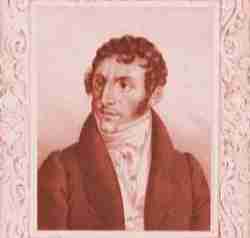
Allessandro Francesco Tommaso Antonio Manzoni was an Italian poet, novelist and philosopher. He was born in Milan, Italy on 7th March 1785 and died there on 22nd May 1873 aged 88.
Major Works
“Inni Sacri” (The Sacred Hymns) (1815)
“Il Cinque Maggio” (The Fifth of May) (1821)
“Adelchi” (1822)
“I Promessi Sposi” (The Betrothed”) (1825-7)
Biography Timeline
1785: Allessandro Manzoni was born on 7th March in Milan, Italy. His father Pietro came from an old family in Lecco. His mother Giulia had literary leanings inherited from her father Cesare Beccaria who was an author and philosopher. Allessandro spent his first two years in Galbiate.
1792: His parents separate when his mother has an affair with the writer Carlo Imbonati and moves to England and then Paris. He spends much of his childhood in religious schools.
1800: He develops a passion for poetry aged fifteen and writes two sonnets.
1805: He joins his mother in Paris and joins the radical Voltairian skeptics. He writes the poem “Il trionfo della libertà” (The Triumph of Liberty).
1806: In Auteuil he first comes to public attention as a poet, with “Urania”, written in the classical style and the blank verse elegy on the death of Count Carlo Imbonati. When his mother’s lover Imbonati dies, he leaves him a considerable amount of money and property including the village of Brusuglio where he moves.
1807: His father dies and with his mother in Auteuil, he develops a lifelong interest in Liberalism.
1808: He marries the Calvinist Henriette Blondel, daughter of a banker from Geneva, Switzerland.
1810: His wife converts to Catholicism and he himself renews his faith.
1812: He retires to life in Milan and his villa in Brusuglio where he can write poetry.
1815: He writes “Inni Sacri” (The Sacred Hymns) about the feast of Christmas and Easter and about the Virgin Mary.
1818: The crimes of a dishonest agent force him to sell his father’s inheritance. He cancels the money owed to him by the peasants on his former land.
1819: He writes the treatise “Osservazioni Sulla Morale Cattolica (Observations on Catholic Ethics).
1820: He writes his first tragic play “Il Conte di Carmagnola” which is about a 15th-century conflict between Milan and Venice. It is controversial as it violates all the classical conventions, however, Johann Wolfgang von Goethe comes to his defence describing it as a work of genius.
1821: He writes “Marzo 1821”, an ode on the Piedmontese revolution. The death of Napoleon Bonaparte inspires him to write “Il Cinque Maggio” (The Fifth of May) and it is praised by Goethe as the greatest of many works written to commemorate the event. He begins work on his novel “Fermo e Lucia” in April after reading the novels of Walter Scott.
1822: He publishes the poem “La Pentecoste” and the play “Adelchi” about Charlemagne’s conquest of Italy.
1823: In September he completes the novel “I Promessi Sposi” (The Betrothed).
1825: The first of three volumes of “I Promessi Sposi” is finally published, after a reworking by the author and it is an immediate success. A new volume comes out each year and makes him an internationally known writer. It is set in the seventeenth century in Lombardy during the Milanese insurrection and is the story of two peasant lovers whose wish to marry is prevented by a local tyrant and the cowardice of the parish priest.
1833: His wife dies.
1835: He attends the “Salotto Maffei”, a salon hosted by Clara Mattfei in Milan.
1837: He marries for the second time to Teresa Borri, widow of Count Stampa. (She also dies before him as do seven of his nine children).
1840: The final edition of “I Promessi Sposi” is published in an updated Tuscan-Italian form. He also writes “Storia Della Colonna Infame” about the seventeenth century plague in Milan.
1860: He is appointed a Senator by King Victor Emmanuel the Second and is on record as favouring Italian unification.
1873: On 6th January he falls over leaving the San Fedele church and hits his head on the steps. His eldest son Pier Luigi dies on 28th April and it is a final blow to his health.
Allessandro Manzoni died of cerebral meningitis on 22nd May 1873 in Milan, Italy. After lying in state he received a state funeral in Milan Cathedral, for which Giuseppe Verdi wrote his “Requiem”. The ceremony was attended by nobility and government officials. He was buried in the Cimitero Monumentale in the city.
Influences
Alessandro Manzoni’s maternal grandfather, Cesare Beccaria, was a well-known philosopher figure during the Enlightenment and helped shape his grandson’s liberal outlook and moral philosophy. He also studied the law and instilled in the young Manzoni a lifelong passion for justice, social reform, and a critical outlook on social institutions.
His parents separated in 1792 and he spent much of his childhood in religious schools. In 1805 he joined his mother and her lover in Paris and was introduced to several radicals and became a convert to Voltairean scepticism. When his mother’s lover died the pair were left with a comfortable income which allowed him to write. His early introduction to the intellectual circles in Milan and Paris exposed him to eighteenth century rationalism and the classical world, but also exposure to the key intellectual French and German thinkers and historical novelists.
Influenced by his close friend Claude Fauriel the French historian he developed an admiration for the works of William Shakespeare, Johann Wolfgang von Goethe, and Friedrich Schiller. He departed from strict classical theatre rules to pursue psychological realism and historical truth in his tragedies. He was an avid reader of Sir Walter Scott’s novels and their influence can be seen in his major work “I Promessi Sposi” (The Betrothed) set in early seventeenth century Lombardy which blends authentic history with a narrative fiction. He was also influenced by Miguel de Cervantes and elements of “Don Quixote” can be seen in the way he formed his narratives. Two of his historical tragedies were highly influenced by Shakespeare “Il Conte di Carmagnola” of 1820 about conflict between Venice and Milan and “Adelchi” of 1822 about Charlemagne’s conquest of Italy. “Il Cinque Maggio”, an ode written in 1821 on the death of Napoleon Bonaparte, was considered by Goethe as the greatest tribute to that event.
He and his wife also converted to a rigorous form of Catholicism around 1810 called Jansenism, influenced by their mentors, the priests, Eustachio Degola and Luigi Tosi. This theory focused on divine providence, human weakness, and the problem of evil. Spirituality became a major part of his output, although his anticlerical poem “Il trionfo della libertà” (The Triumph of Freedom) shows his independent thought.
“I Promessi Sposi” (The Betrothed) was conceived in 1821 when he read a 1627 Italian edict that specified penalties for any priest who refused to perform a marriage when requested to do so. He supplemented the idea with material from Giuseppe Ripamonti’s Milanese Chronicles. The novel had an immense patriotic appeal for Italians of the nationalistic Risogimento period (Italian Unification) the moreso as he deliberately wrote in in everyday language which appealed to a wide audience. Nowadays it is generally thought of as amongst the masterpieces of world literature. It brought him fame in Italy and elsewhere.
His two wives and most of his children died before him but this did little to destroy his faith. He wrote a series of religious poems such as “Inni Sacri” (The Sacred Hymns) in 1815, and what critics thought his finest of the series, “La Pentecoste” published in 1822
In 1860, King Victor Emmanuel the Second made him a senator. He was appointed chairman of a commission dealing with the Italian language by the minister of public education, Emilio Broglio and in 1868 he wrote the report “Dell’unità Della Lingua e Dei Mezzi Per Diffonderla” (On the Unity of the Language and on the Means for Achieving It). His proposal was that Florentine should be taught in schools, and a modern Florentine dictionary published and as a result the “Nuovo Vocabolario della Lingua Italiana” was begun in accordance with his criterion. He also engaged in a dialogue with the Philosopher Antonio Rosmini that refined Rosmini’s own theories on language and theology and advanced the intellectual movement seeking to reconcile faith with civic liberty and social progress. Manzoni’s literary philosophy was summed up a “poetica del vero, utile e interessante” (truthful, useful, and interesting) and he expected literature to serve a civic and moral purpose, be based on facts, but still captivate readers. He rejected gothic or supernatural elements in favour of realism in contrast to many contemporary Romantic novels.
After his death the popular historical novel continued to trend across Italy and influenced European romantic literature standards, however some Catholic writers considered him a liberal in religion. Davide Albertario wrote in the Scuola Cattolica in 1873 “Manzoni had two faiths and two loves: “one in God and in the Church, the other in the revolution, enemy of God and the Church”. Since then, he has been revered as one of the most important modern Catholic authors. Pope Pius the Eleventh quoted his “Osservazioni Sulla Morale Cattolica” in his encyclical on Christian Education “Divini Illius Magistri”.
Pope Francis loved “The Betrothed” and read it several times and asked engaged couples to read it before marriage. Often dreaded by contemporary school students, for whom it is a set book, due to the complexity of the ideas, it offers insights into literature, history, and human nature and explores social themes such as human weakness, the possibility of redemption, and the mysterious workings of divine providence. Sir Walter Scott thought it the greatest romance of modern times and it has been adapted numerous times for opera (Amilcare Ponchielli in 1856), film, and television.
Giuseppe Verdi was great admirer of Manzoni and composed the “Messa da Requiem” in 1874 as a memorial to him.
Further Information
List of works by Manzoni.