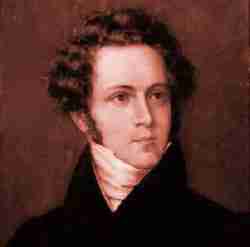
Vincenzo Bellini was an Italian opera composer, known as the “the Swan of Catania”. He was born on 3rd November 1801 in Catania, Italy and died on 23rd September 1835 in Puteaux, France aged 33.
Major Works
“I Capuleti e i Montecchi” (The Capulets and Montagues) (1830)
“La Sonnambula” (The Sleepwalker) (1831)
“Norma” (1831)
Biography Timeline
1801: Vincenzo Salvatore Carmelo Francesco Bellini was born on 3rd November in Catania, Sicily, Italy. Both his grandfather Vincenzo Tobia Bellini and his father Rosario were musicians. His mother was Donna Agata Ferlito. Bellini was the eldest of seven children.
1804: At three years old his father begins teaching him to play the piano.
1807: At six years old he begins studying composition with his grandfather Vincenzo.
1816: He moves to live with his grandfather. His first proper compositions are the nine “Versetti da Cantarsi il Venerdi Santo”.
1818: He completes several orchestral pieces and at least two settings of the Mass.
1819: In May he obtains a scholarship to the Royal College of Music in San Sebastian, Naples with the help of Stefano Notabartolo, the new Duca di San Martino e Montalbo. He is taught by the opera composer Nicola Antonio Zingarelli. Bellini mainly composes sacred music and arias for voice and orchestra whilst a student. He meets Gaetano Donizetti. Another student Francesco Florimo would be a friend for life and they correspond when not together.
1820: In January he passes his theory examinations and is successful in gaining an annual scholarship. During the 1820 revolution, Bellini and Florimo join a secret society called the Carboneria.
1821: As part of the scholarship he has to write music for Catania and composes “Messa di Gloria” in A Minor for soloists, choir and orchestra.
1823: He writes two other settings for the Mass and an Oboe Concerto in E-flat.
1824: Again doing well in his examinations he is given the title of primo maestrino and he begins to tutor other students including Maddalena Fumarolis whom he falls in love with much against the wishes of her parents. He sees his first opera by Gioachino Rossini,“Semiramide”. Still wanting to impress Maddalena and her family he writes his first opera. “Adelson e Salvini”.
1825: “Adelson e Salvini” is performed at the Institute’s Teatrino in January with great success and is a particular hit with the students. During the summer he begins work on his first professional opera “Bianca e Fernando” which is set in Sicily.
1826: The opera is renamed “Bianca e Gernando” due to it being illegal to use the name of a royal prince and receives its premiere at the Teatro di San Carlo on 30th May. The work proves popular with the King and Donizetti.
1827: Domenico Barbaja commissions an opera for the Teatro alla Scala in Milan. Bellini leaves Naples and Maddalena Fumaroli. “Il Pirate”, (The Pirates) in conjunction with the librettist Felice Romani, is a great success at La Scala at its premiere on 17th October and critics hail Bellini as the only rival to Gioacchino Rossini. He lives in Milan for the next three years existing on his income from his compositions.
1828: During April he has an affair with Giuditta Turina, a young married woman when both were in Genoa for the production of “Bianca e Fernando”. Bellini returns to Milan on 30th April and signs a contract to write a new opera for the Carnival season there.
1829: “La Straniera” (The Female Stranger) receives its premiere at La Scala on 14th February and “Zaira”, based on a book by Voltaire, is premiered there on 16th May. Both are rapturously received but “Zaira” is not so successful in Parma when Bellini stays with Ferdinando and Giuditta Turina’s family in May. In June he returns to Milan to find out his grandfather has died in Catania. Gioacchino Rossini visits Milan on his way to Bologna and is present at a production of “Il Pirata” and the two composers meet afterwards.
1830: He composes two operas for the Teatro La Fenice in Venice including “I Capuleti e i Montecchi” which receives its premiere on 11th March.
1831: “La Sonnambula” (The Sleepwalker) is staged at La Scala in Milan on 6th March and is highly praised by the Russian Composer Mikhail Glinka who is in the audience. Bellini experiences a re-occurrence of his gastric illness in Venice for a performance of “Beatrice di Tenda” due to pressure of work and poor weather. He recovers in the summer and visits Lake Como. “Norma” is completed by the end of November and performed at La Scala in December.
1832: He leaves Milan Sicily and Naples on 5th January. He arrives in Messina on 27th February and meets his father and other members of his family. He receives a civic welcome in Catania and then moves to Naples on 25th April where he is reunited with Turina.
1833: He composes “Beatrice di Tenda” (Beatrice of Tenda) based on the play by Carlo Tedaldi-Fores after some deliberation on what would be his next project. The opening night is on 16th March in Venice is not warmly received and letters appear in the local press deriding the opera with comments in return by the composer himself. Bellini and his troupe arrive in London by 27th April. The “Morning Chronicle” newspaper writes on the 29th that Bellini is in attendance at a performance of Rossini’s “La Cenerentola” along with Felix Mendelssohn and Niccolo Paganini. “La Sonnambula” receives its London debut on 1st May at the Theatre Royal, Drury Lane. While he is in London Giuditta’s Turina’s husband discovers a compromising letter from Bellini and asks for a legal separation. The thought of having to take responsibility for Giuditta fills him with dread as he no longer has feelings for her. In July “I Capuleti e i Montecchi” is performed and then Bellini leaves for Paris in August. Only wanting to stay for three weeks he is seduced by the fashionable salons there of Princess Belgiojoso, whom he had known in Milan, and he stays much longer. He meets many of the Italian Revolutionaries as well as Victor Hugo, George Sand, Alexandre Dumas and Heinrich Heine at various soirees.
1834: In January he signs a contract to write a new opera for the Théâtre-Italien to be presented at the end of the year. At the same time, he has also been commissioned to write a new opera for the San Carlo in Naples so has to decline. The result is “Il Puritani”.
1835: The premiere of “Il Puritani” (The Puritans) takes place on 24th January to enthusiastic applause. Bellini is awarded the Chevalier of the Legion d’Honneur by King Louis-Phillippe in France and the “Order of Francesco I” by King Ferdinand the Second in Naples. During the summer he meets Heinrich Heine again who said “You are a genius, Bellini, but you will pay for your great gift with a premature death. All the great geniuses died very young, like Raphael and like Mozart”. The superstitious Bellini is horrified.
Vincenzo Salvatore Carmelo Francesco Bellini died on 23rd September 1835 of an intestinal infection in Puteaux near Paris, France. He was buried in the Père Lachaise cemetery near to Frederick Chopin and Cherubini. Rossini planned Bellini’s funeral and burial and looked after his estate. Francesco Florimo became his literary executor. In 1876 Bellini’s body was moved to the Cathedral of Catania in Sicily with a funeral attended by thousands including two of his brothers.
Influences
Vincenzo Bellini was a child prodigy and it is said he could sing an aria by the age of eighteen months. He studied musical theory at the age of two, the piano aged three and began writing sacred music at six. His first teacher was Giovanni Furno who taught him harmony and he studied counterpoint with the opera composer Giacomo Tritto. He studied composition with Niccolo Zingarelli who encouraged him to study the simpler style of earlier Italian composers such as Giovanni Battista Pergolesi and Giovanni Paisiello.
He was influenced by the work of Joseph Haydn, Wolfgang Amadeus Mozart and Gioachino Rossini and attended many of the last mentioned composer’s operas. He also met Gaetano Donizetti in Naples. He took Italian opera into the Romantic period and pioneered the Bel Canto style (literally beautiful singing) with the orchestra often subservient to the voice. During his short life he produced many masterpieces and his new works were received with either rapturous acclaim or downright disapproval. He chose subjects that interested him based on contemporary French and Italian literature.
His last opera “I Puritani” (The Puritans) of 1835 is perhaps his most ambitious work despite its shaky libretto. In 1844 the philosopher Arthur Schopenhauer wrote in “On the Aesthetics of Poetry” that the opera “Norma” based on Medea of ancient Greek tragedy, is “a tragedy of extraordinary perfection, a true model for the tragic design of a theme, the tragic development of its plot, and its tragic resolution. In addition, it succeeds in elevating the heroine above the earthly, which is also transmitted to the listener”.
He influenced many other later composers not least of whom was Richard Wagner who liked his ability to match music with text and psychological drama. Frédéric Chopin knew Bellini’s operas intimately and valued them extremely highly. In 1837 he composed “Variations in E major” on an air from Bellini’s “I Puritani” to honour his memory. Franz Liszt and Pyotr Tchaikovsky were both admirers of Bellini and Giuseppe Verdi praised his expansive melodies as unequalled by any other composer.
Not all composers were quite so keen however. Hector Berlioz was less than enthusiastic about his work and Robert Schumann dismissed Bellini as “a butterfly fluttering around the German oak”.
Further Information
List of works by Bellini.