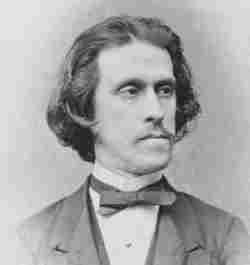
Josef Strauss was an Austrian composer and the brother of Johann Strauss 11 and son of Johann Strauss 1. He was born on 20th August 1827 in Vienna, Austria and died there on 22nd July 1870 aged 42.
Major Works
“Dorfschwalben aus Osterreich” (Village Swallows from Austria), “Frauenherz” (A Woman’s Heart) (1864)
“Dynamiden” (or “Geheimne Anziehungskräfte”) (Mysterious Powers of Magnetism) (1865)
“Die Libelle” (The Dragonfly) (1866)
“Feuerfest” (Fireproof!), “Pizzicato-Polka” with his bother Johann. (1869).
“Hesperusbahnen” (Hesperus’ Path) (1870)
Biography Timeline
1827: Josef Strauss was born on 20th August 1827 in Mariahilf, now a part of Vienna, Austria. His father was the composer Johann Strauss the Elder and he was the second son to his older, more famous, brother Johann Strauss the Younger. His mother was Maria Anna Streim. He studied music with Franz Dolleschal and learned the violin with Franz Anton Ries. After finishing school his father wanted him join the Austrian army but instead he studied mechanical engineering and then worked for the city of Vienna as an engineer, architectural draughtsman and designer. He was also a talented inventor and published two textbooks on mathematics. He was known as “Pepi” in the family.
1852: His brother Johann is taken ill in December and he has to join the family orchestra at short notice.
1853: Doctors recommend a lengthy rest cure and Josef steps in to conducting duties on 23rd July even though he is a shy individual. Although he hopes to return to engineering after his brother’s return, he eventually gives it up and joins the family business full time with brothers Eduard and Johann.
1854: His first composition, written about this time, is the set of waltzes “Die Ersten nach den Letzten” (The First after the Last) which is given in concert during the year and published in 1856.
1856: He composes “Die Guten, Alten Zeiten” (The Good Old Times) waltz.
1857: He marries Caroline Pruckmayer in St. Johann Nepomuk church in Vienna on 8th June. He composes “Mai-Rosen” (May-Rose) “Liechtenstein-Marsch”, “Perlen der Liebe” (Pearls of Love) and the “Wallonen-Marsch” (Walloon March) during the year. He spends much of his spare time writing poetry and painting as well as composing music and became a habitual cigar smoker.
1858: His daughter Karolina Anna is born on 27th March. He composes “Moulinet-Polka” (Little Mill Pond). “Polka Francaise” (French Polka) and the “Laxenburger-Polka”.
1859: He composes “Sympathie” (Sympathy) polka-mazurka.
1860: He composes “Lustschwärmer” (Joy Seeker) waltz.
1861: He composes “Wiener Bonmots” (Viennese Bon-mots) waltz.
1862: He composes “Winterlust” (Winter Joy) polka and the “Brennende Liebe” polka-mazurka.
1863: He composes “Auf Ferienreisen!” (On a Holiday!) polka, “Die Schwätzerin” (The Gossip) polka-mazurka and “Wiener Couplets” (Viennese Couplets) waltz. His elder bother Johann is appointed Imperial and Royal Hofballmusikdirektor, which requires Josef to take on touring engagements which he begins to hate.
1864: He composes “Dorfschwalben aus Österreich” (Village Swallows from Austria), “Frauenherz” (A Woman’s Heart) polka-mazurka and the “Sport-Polka”.
1865: He composes “Geheime Anziehungskräfte, Dynamiden” (The Mysterious Powers of Magnetism) waltz, “Stiefmütterchen” (Pansies) polka-mazurka and “Transaktionen” (Transactions) waltz.
1866: He composes “Die Marketenderin” (The Camp Follower) polka and “Die Libelle” (The Dragonfly) polka-mazurka.
1867: He composes “Deliriem” (Deliriums) waltz and “Herbstrosen” (Autumn Rose) waltz.
1868: He composes “Sphären-Klänge” (Music of the Spheres) waltz and “Eingesendet” (Letters to the Editor) polka.
1869: He composes “Aquarellen” (Watercolurs) waltz, “Eislauf” (Ice-Skating) polka, “Mein Lebenslauf ist Lie und Lust” (My Character is Love and Joy) waltz, “Die Tanzende Muse” (The Dancing Muse) polka-mazurka, “Feuerfest!” (Fireproof!’) polka française, “Aus der Ferne Polka Mazur” and “Ohne Sorgen!” (Without a Care!) polka. He co-writes the famous “Pizzicato-Polka” with his bother Johann.
1870: He composes “Nilfluthen” (Nile’s Waters) waltz, “Frauenwürde” waltz, “Jokey-Polka” (Jockey), “Hesperusbahnen” (Hesperus’ Path) waltz, “Die Emancipierte” (The Emancipated Woman’ polka-mazurka. During a tour in Warsaw in Poland he falls of the conductor’s rostrum striking his head and rendering himself unconscious whilst conducting his “Musical Potpourri”. It is not known why but he was prone to fainting and headaches throughout his life. His wife brings him back to his home in Vienna.
Josef Strauss died on 22nd July 1870 in Vienna diagnosed with decomposed blood. He was originally buried in the St Marx cemetery in Vienna near the unmarked grave of Wolfgang Amadeus Mozart but his remains were later taken to the Central Cemetery in the city and placed next to his mother, Anna. Rumours that he had been severely beaten by drunken Russian soldiers after refusing to perform for them one night have never been proven.
Influences
Although Josef Strauss had not intended to become a musician like his older brother Johann and his father, he later succumbed after studying mechanical engineering. That he was influenced in producing waltz music for the family firm is clearly evident but as a composer he was influenced himself by the works of Franz Schubert in particular, as well as Frédéric Chopin, Franz Liszt and Richard Wagner. He was known for his poetic qualities and was the best all round musician in the family according to his elder brother who said “Pepi” (his nickname) is the more gifted of us two, I am merely the more popular”. He unusually allowed Johann to claim some of his waltzes as his own. Some of Josef’s polka-mazurkas show stylistic aspects of the new German school as begun by Liszt and he also wrote a symphonic poem called “Ode to the Night” which was highly praised by critics at the time but has since been lost.
He joined the family orchestra with his brothers, including the youngest Eduard, in the 1850s. His first published work was called “Die Ersten und Letzten” (The First and the Last) in 1853, which, as the name suggested, was to be his only piece however his elder brother Johann became seriously ill at the time and Josef took up conducting and writing other works when the Viennese public demanded more. In all he wrote 283 works with opus numbers with his most famous one “Pizzicato Polka” in 1869 being a joint effort with Johann. All this despite being sick most of his later life. He suffered from intense headaches and in 1879 he fell from the conductor’s podium in Warsaw, Poland badly striking his head which led to his eventual death later that year.
Besides music he spent time being a painter, poet, playwright and amateur inventor. For example he designed a horse drawn mechanical road sweeping machine which the city of Vienna adopted for use and also published two books on mathematics.
Without the work of his younger brother Eduard Strauss in publishing items much of the Viennese dance music would have been forgotten before the end of the nineteenth century.
Further Information
Alphabetical list of compositions by Josef Strauss.