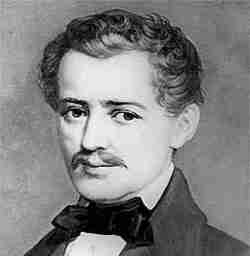
Major Works
“Dobling Reunion Waltz” (1826)
“Little Doves Waltz” (1827)
“Vienna Fancies Waltz) (1827
“Viennese Carnival” (1828)”
“Suspension Bridge Waltz” (1828)
“Radetzky March” (1848)
Biography Timeline
1804: Johann Strauss the Father was born on 14th March in Leopoldstadt, now a part of Vienna, Austria. His father was Franz Borgias Strauss and his mother was Barbara Dollmann and they were both innkeepers and Roman Catholics.
1811: His mother dies of undulant fever.
1816: His father drowns, possibly by suicide, in the Danube River and Strauss is looked after by his guardian Anton Müller. He is apprenticed to the bookbinder Johann Lichtscheidl but also has lessons in the viola and the violin with Johann Polischansky.
1822: He successfully completes his apprenticeship and gains a place in a local orchestra, led by Michael Palmer. He then leaves the orchestra to join the Lanner Quartet with Joseph Lanner and Karl and Johann Drahanek.
1824: The string quartet expands into a small orchestra and plays Viennese waltzes and German dances and Strauss is the deputy conductor to Lanner. They are so popular after the Carnival that a second smaller orchestra is formed headed by Strauss.
1825: He forms his own orchestra and begins to write music and therefore becomes a rival to Lanner. Strauss marries Maria Anna Streim in the Lichtental Parish Church in Vienna and later his son Johann is born.
1826: His popularity soars after he plays during the Carnival at the Schwan in the suburb of Rossau and he plays his first piece, the “Tauberl Waltzer” in the gardens of the “Zwei Tauben”.
1827: His son Josef is born.
1829: His daughter Anna is born. He becomes musical director at the Sperl, a famous establishment in the Leopoldstadt suburb of Vienna.
1830: By now he is conducting at the “Sperl,” a dance hall in Leopoldstadt and he becomes known as “the Austrian Napoleon” amongst musicians.
1831: His daughter Therese is born.
1833: He begins tours of Germany, the Netherlands, Belgium and Great Britain leaving behind his wife and children.
1834: His son Ferdinand is born but only lives for ten months. He is appointed bandmaster to the 1st Vienna Militia Regiment. By now he has taken a mistress, Emilie Trampusch, and they would later go on to have eight children together. He organises a large-scale spectacle “A Night in Venice” in the Augarten park in Vienna.
1835: His son Eduard is born. He is created director of the Imperial Court balls and begins to write a series of marches.
1837: In France on his first trip to Paris he hears the quadrille for the first time and begins to use the form himself. This trip introduces him to a wider audience. His concerts were attend by other composers such as In Paris they included famous contemporary musicians such as Adolphe Adam, Daniel Auber, Luigi Cherubini, Fromental Halévy, Giacomo Meyerbeer and Hector Berlioz.
1838: Besides adapting popular melodies of the day into his works he also incorporates Weber’s “Oberon Overture” into his waltz “Wiener Carneval” and “La Marseillaise” into his “Paris Walzer” in order to gain favour outside Austria. He also has an ambition to play at the Coronation of Queen Victoria whilst in London. Despite all this he also manages to write music for many charities in Vienna.
1844: He openly acknowledges the paternity of a daughter born to Emilie and his wife Maria Anna sues for divorce. Now free Maria Anna is determined to further her son Johann’s musical career.
1846: He is awarded the honorary title of Kaiserlich-Königlicher Hofballmusik-Direktor’ (Director of Music for the Imperial and Royal Court Balls) by Emperor Ferdinand the First.
1848: After the Battle of Custoza, where the Austrian Field Marshal Joseph Radetzky von Radetz is victorious against the Italians, Strauss is commissioned to write a piece of music. The famous “Radetzky March” opus 228 is the result and it proves wildly popular when it is first performed on 31st August in Vienna.
Johann Strauss the Father died in Vienna on 24th September 1849 of Scarlet fever which he contracted from one of his illegitimate children. He was buried at the Döblinger Cemetery beside his friend Joseph Lanner. (In 1904, Strauss and Lanner were transferred to the Zentralfriedhof in Vienna to be amongst other great composers).
Influences
Johann Strauss the Father lost his mother at the age of seven. His innkeeper father, Franz Borgias Strauss remarried, but five years later he was found drowned in a tributary of the River Danube. Young Johann was therefore orphaned at the age of twelve. He qualified as a bookbinder in 1822, although he never practised the trade. Not much is known about his musical education or how he became a musician.
In 1823 the nineteen-year-old Strauss, played in the string quartet of Joseph Lanner who was three years his senior. He learnt a great deal from Lanner who became a friend and later a rival as in 1827, when he was twenty-three, he left the group to set up his own orchestra, hoping that he would make more money as an independent. He married Anna Streim an innkeeper’s daughter, two years later and in October his famous son, also christened Johann, was born.
Lanner’s style of enlarging simple rustic German dance music into artistic movements directly influenced Strauss’s own approach to composition. Local Viennese dance music traditions, ländler tunes and popular outdoor public concert spaces became immensely popular during the period in Vienna and led to the foundation of his waltzes, galops, and polkas. The pleasure-seeking atmosphere of Imperial Vienna in its popular dance halls and large cafe-theatres demanded energetic and lively music to entertain the crowds.
The standard small-scale local entertainment bands of Vienna gave Strauss the basis on which to develop his later touring orchestra which did much to bring Viennese dance music to international recognition. His style was defined by intense rhythmic drive, fiery energy, catchy melodies and a faster tempo than that of Lanner who was known for his slower, gentle, poetic lyricism. He also added syncopation, brass instruments and percussion to increase the overall effect. The paying public divided into two camps those who were for Lanner and those who were for Strauss and a famous “waltz war” rivalry eventually broke out between them in Viennese press.
He gained the nickname the orchestral “Napoleon” and “The Tyrant of Waltz.” for his fiery music, showmanship and international touring. When Richard Wagner heard him perform in 1838, he described him as a “magic fiddler and the genius of Vienna’s innate musical spirit”. His tours were hectic affairs ceaselessly playing in front of sold-out audiences in Germany and France. He was even invited to play during Queen Victoria’s coronation, composing his waltz “Homage to Queen Victoria of Great Britain” for the occasion. Typical tours could for fourteen months or more and the orchestra was to endure bad weather, hotel fires, floods, theft, illness and disease. In 1838, he caught influenza in Scotland but continued his tour to the English cities of Newcastle, Leeds, Hull, Wakefield, and Derby. Completely exhausted he collapsed on the podium at the end of the tour.
After a long journey back to Vienna, it took him almost four months to recover. When he returned to the podium for a benefit concert thousands of people made the pilgrimage to see and hear their hero. Although he had earned a lot of money on his trips abroad, he spent it just as quickly.
He then had an affair with Emilie Trampusch a young seamstress who soon had a son by him. His wife filed for divorce as this was the last straw. Emilie and he would go one to have eight more children and the financial strain forced him back into touring. Ironically it would be one of Emilie’s children who infected him with Scarlet Fever which caused his eventual death at the young age of forty-five. Over 100,000 people lined the route of his funeral and Hector Berlioz summed up his enormous influence and importance of by declaring “Vienna without Strauss is like Austria without the Danube”. He left behind more than 280 pieces of dance-music.
His influenced on other composers was immense including Joseph Lanner himself. The most obvious next would be his natural sons Johann the Son (the “Waltz King”) who had to learn music in secret as his father forbid him from being a musician, Josef and Eduard who all went on to expand the musical dynasty. Richard Wagner who was famous for being critical of other musicians admired his music and ability with the violin famously calling him the “musical spirit of Vienna” after hearing him perform in 1838.
Further Information
List of compositions by Strauss the Elder.