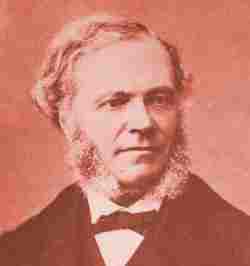
César-Auguste Jean-Guillaume Hubert Franck was a French Romantic composer, pianist, organist, and music teacher. He was born on 10th December 1822 in Liège Belgium and died on 8th November 1890 in Paris, France aged 67.
Major Works
Piano Quintet in F Minor (1879)
“Variations Symphoniques” (1885)
Sonata in A Major for Violin and Piano (1886)
Symphony in D Minor (1888)
String Quartet in D Major (1889)
Biography Timeline
1822: Cesar-Auguste Franck was born on 10th December in Liege, then part of the Netherlands (now Belgium). His father was Nicolas-Joseph Franck, a bank clerk from the German-Belgian border. His mother was Marie-Catherine-Barbe Franck (née Frings) and was German.
1830: His father enters him into the Liège Conservatory aged eight due to his talent. He studies piano, organ, and harmony under Joseph Daussoigne-Mehul.
1834: He gives his first concerts, one being in front of Leopold the First the King of the newly formed country of Belgium. However, there is no patronage from the Royal Court nor future money to be made so his father takes him on tour. His first compositions are a set of piano trios (which Franz Liszt admired and played himself in Weimar in later years).
1835: His father sends him and his younger brother Joseph to Paris, where he works with the composer Anton Reicha, a professor at the Paris Conservatory, and Pierre Zimmerman who teaches him piano. The Paris Conservatory does not except foreigners so his father seeks French citizenship which is granted in 1837.
1837: He is now able to enter the Paris Conservatory in October and he wins a Grand Prix d’Honneur for transposition in the sight-reading test.
1838: He wins first prize in piano at the end of his first year.
1840: He wins first prize for fugue.
1841: He wins second prize for organ. Although he now qualifies to enter for the Prix de Rome his father is determined to make him a touring virtuoso.
1842: On 22nd April he retires from the Conservatory at his father’s request.
1843: He begins work on the oratorio “Ruth”.
1845: “Ruth” is premiered privately with Liszt and Giacomo Meyerbeer in the audience who seem to like the performance.
1846: “Ruth” is given its first public performance on 4th January at the Conservatory but it is not popular with the audience and is not revived again until 1872. His father finds a secret note that the work is dedicated to Mlle. F. Desmousseaux, the stage name of the actress Eugénie-Félicité-Caroline Saillot and her actor parents. He is furious and forbids the two to see each other again. In July he leaves the house for good carrying his worldly possessions under his arm and moves in with the Desmousseaux family. From then on he signs himself simply as Cesar Franck.
1847: He is appointed assistant organist at the church of Notre-Dame-de-Lorette.
1848: He marries Eugénie-Félicité on 22nd February at Notre-Dame-de-Lorette having had to wait to be old enough in French law so that he didn’t need his father’s permission anymore. The Paris Revolt is going on and the wedding party have to climb over the revolutionary barricades to enter the church. He then earns his living as an organist and teacher. His compositions to celebrate the new Second Republic fall out of favour after the rise of Louis-Napoleon.
1851: He is appointed organist at the church of Saint-Jean-Saint-François-au-Marais which has a newly built Cavaillé-Coll organ. He becomes famous for his improvisations on the organ during services and works with the Cavaillé-Coll company to demonstrate their instruments in towns throughout France. He begins writing an opera “Le Valet de Ferme” but it comes to nothing.
1854: He admires the new organ pedal work popularised by Lemmens and sets about practising the technique himself.
1858: On 22nd January he becomes organist and Maître de Chapelle at the newly consecrated church of Sainte-Clothilde and later in the year they install a new three-manual Cavaillé-Coll instrument which has been described as one of the manufacturer’s best.
1859: He composes the “Messe à Trois Voix“.
1860: He begins to compose the set of “Six Pièces for Organ” (completed 1862, published 1868) which include the “Prélude, Fugue et Variation” and the “Grande Piece Symphonique”.
1866: In April Franz Liszt sits in the choir to listen to Franck’s improvisations.
1869: He hears Anton Bruckner play the organ at Notre Dame in Paris and is deeply impressed. He begins work on the choral piece “Les Beatitiudes”.
1870: Due to the Franco-Prussian War the Conservatory is closed for the academic year.
1871: The Societe Nationale de Musique (National Society of Music) is founded on 25th February by Franck and his pupils and it’s first concert is held in November.
1872: He is appointed Professor of Organ at the Paris Conservatory but finds out his French Citizenship ended when he was 21 as he had unwittingly not declared his allegiance to France at that time and therefore, he was not strictly eligible. However, he is allowed to take up the post in February and officially becomes a French citizen again in 1873. He interrupts work on “Les Beatitudes” to write the oratorio “Redemption”.
1876: He composes the symphonic poem “Les Eolides”.
1878: He composes “Trois Pièces for Organ”.
1879: He composes the Piano Quintet in F Minor. “Les Béatitudes” is finally given its premiere. He works on his next opera “Hulda”, which is set in eleventh century Norway.
1882: He composes the symphonic poem “Le Chasseur Maudit” (The Accursed Hunter) based on a work by the German Gottfried August Bürger.
1884: He composes the symphonic poem “Les Djinn”s” and the “Prelude, Chorale and Fugue” for piano.
1885: He is made a Chevalier of the French Legion d’Honneur for services to organ playing on 4th August. He composes “Variations Symphoniques”.
1886: He composes “Sonata in A Major for Violin and Piano” as a wedding present for the Belgian violinist Eugene Ysaye, which proves to be very popular, and the symphonic poem “Psyché” based on the Greek myth.
1887: He completes “Prélude, Aria et Final” for piano.
1888: He composes “Symphony in D Minor” which is received coldly by the audience at its first performance at the Conservatory on 17th February. It receives mixed reviews from the critics. He sets out to write another opera “Ghiselle” but it is never completed.
1890: He composes “String Quartet in D Major” which is first performed in April. In July he is riding in a taxi which is struck by a horse drawn goods vehicle. He is hit on the head and has a fainting fit. Afterwards he continues on his way thinking nothing more of it, however he begins to experience pains and cancels concerts and lessons at the Conservatory. He goes on holiday to Nemours to recover and plans to write some commissioned pieces for the harmonium. He starts the new term in October but catches a cold which develops into pleurisy.
Cesar-Auguste Franck died of pericarditis (possibly brought on by the accident) on 8th November 1890 in Paris, France. His funeral was held at Sainte-Clotilde with Leo Delibes, Camille Saint-Saens, Gabriel Faure and Emmanuel Chabrier present. He was buried at Montrouge but later interred in Montparnasse Cemetery in Paris.
Influences
Cesar Franck was a gifted musical child and entered the Liège Conservatory at the age of eight. In 1837 he progressed to the Paris Conservatory where he won several prizes including a Grand Prix d’Honneur by transposing music at sight. His father made him give concerts to earn the family much needed money but this helped establish his technique. After 1840 he concentrated on the organ.
He was particularly influenced by the work of Ludwig van Beethoven, Franz Liszt and Richard Wagner and admired their structural innovations and adventurous harmonies but added his own style of lyricism to their approach. He particularly admired the chromaticism of Wagner’s opera “Tristan und Isolde”. He was a deeply committed Catholic and his later work as an organist at the church of Sainte-Clotilde provided foundational experiences and inspiration for many of his compositions, including his sacred works, with a particularly French flavour. The large Cavaillé-Coll organ at Sainte-Clotilde was very extensive and flexible and helped him express his new ideas both in his composition and as a teacher. His personal style fused old classical forms with a new romantic harmony and cyclical structure, the latter highly influenced by Liszt. As an organist and contrapuntist, he extensively studied the music of Johann Sebastian Bach and he is often considered by many the greatest composer of organ music after the great German. Beethoven’s influence, particularly through the late string quartets, can be seen in his “Trois Chorals” for organ.
Earlier French organists and piano virtuosos such as Alexis Chauvet Jacques Lemmens, and Édouard Batisteand Charles-Valentin Alkan also acted as inspiration for his own keyboard compositions and his “Grande Pièce Symphonique” is dedicated to Alkan.
Later on, he was also influenced by the Symbolism movement in pieces such as “Les Beatitudes” which aimed to include profound thematic and symbolic meaning in artistic works. Works such as his Symphony in D minor show a blend of the German symphonic approach with a French compositional style.
In 1871 he was granted membership of the Société Nationale de Musique who acknowledged his leading status as a composer and he began to compose anew. In 1872 he gained the position of Professor at the Paris Conservatoire which was a turning point in his career and led to most of his major compositions. His organ classes soon covered composition and his pupils often proved superior to the work put out by the conventional composition professors, thus causing a fair degree of animosity.
A “Franck circle” of gifted students formed around him, despite his quiet and unassuming demeanour. These included Vincent d’Indy, Ernest Chausson, Henri Duparc, Guillaume Lekeu, and Louis Vierne who went on to further develop the harmonic form. D’Indy himself claimed in his autobiography that Franck was “a creation of his own pupils”. His Symphony was especially admired amongst the younger generation of French composers and was largely responsible for reinvigorating the French symphonic tradition after many years of decline.
The twenty-five-minute work “Grande Pièce Symphonique” inspired the organ symphonies of Charles-Marie Widor, Louis Vierne, and Marcel Dupré and his open support of Liszt’s cyclic forms would later influence Claude Debussy and Maurice Ravel. He also helped revive chamber music as a form in France. His indirect influence can also be seen in the works of Camille Saint-Saëns, Les Six in 1920’s Paris, such as Arthur Honegger, Darius Milhaud and Francis Poulenc and later Olivier Messiaen.
Further Information
List of compositions by Franck.