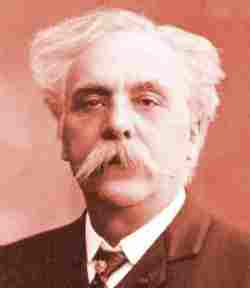
Gabriel Fauré was a French composer, organist, pianist and teacher. He was born on 12th May 1845 in Pamiers, France and died on 4th November 1924 in Paris, France aged 79.
Major Works
“Élégie” (1880)
“Pavane” (1887)
Requiem (1890)
“Sicilienne” (1893)
“Pénélope” (1913)
Biography Timeline
1845: Gabriel Faure was born on 12th May in Pamiers, Ariege in the South of France. His father was Toussaint-Honoré Fauré, a school teacher and his mother was Marie-Antoinette-Hélène Lalène-Laprade who was a member of the minor nobility. Faure was the youngest of six children and the only one to be interested in music. He was sent to live with a foster mother until he was four years old.
1849: His father is appointed Director of the École Normale d’Instituteurs in Montgauzy which was a teacher’s training college. The young Faure returns to live with his parents. He consoles himself by playing the harmonium in the local chapel.
1853: Simon-Lucien Dufaur de Saubiac, a member of the National Assembly, hears Fauré play and advises his father to send him to the École de Musique Classique et Religieuse (School of Classical and Religious Music).
1854: With the help of scholarship from the local bishop, his father takes the nine-year-old boy to Paris in October to join the school where he becomes a boarder. The school concentrates on producing organists for the church. Louis Niedermeyer, the principal of the school and a composer in his own right teaches him piano, plainsong and composition.
1861: Niedermeyer dies in March and Camille Saint-Saens takes charge of piano studies introducing the young student to the music of Robert Schumann and Franz Liszt. He wins several prizes whilst still at school including premier prix in composition for the “Cantique de Jean Racine”.
1865: He leaves school in July with a distinction.
1866: He has been appointed as organist at the Church of Saint-Sauveur, at Rennes in Brittany and takes up the post in January.
1870: He regularly goes outside during the sermon for a cigarette and is not popular with the clergy. One Sunday he arrives at the church still wearing his evening clothes from last night’s party and it is the final straw and he is asked to resign. With the help of Saint-Saens, he gets the post of assistant organist at the church of Notre-Dame de Clignancourt, in the north of Paris but remains there only for a few months as the outbreak of the Franco-Prussian War means he is needed for military service. He sees action to raise the Siege of Paris and in other theatres and is awarded a Croix de Guerre.
1871: After France’s defeat by Prussia, Fauré escapes to Rambouillet where one of his brothers lives and then moves on to Switzerland. There he takes a teaching post at the École Niedermeyer, which has temporarily relocated to avoid the violence in Paris. He doesn’t produce patriotic songs like some of his contempories but sombre works such as “L’Absent, Seule!” and “La Chanson du Pêcheur”. He becomes a founding member of the Société Nationale de Musique in February to promote new French music. He returns to Paris in October and is appointed choirmaster at the Église Saint-Sulpice working for the composer and organist Charles-Marie Widor.
1874: He becomes secretary of the Society and many of his works are first performed at their concerts. He becomes deputy organist at the Église de la Madeleine, where the principal organist is Camille Saint-Saens.
1877: In January his first violin sonata is performed at a Société Nationale concert with great success. In March, Saint-Saens retires from the Madeleine and is succeeded by Théodore Dubois. Fauré becomes choirmaster. In July he becomes engaged to Pauline Viardot’s daughter Marianne however she breaks off the engagement in November. Saint-Saens takes him to Weimar and introduces him to Franz Liszt.
1878: He makes several trips abroad to see Richard Wagner’s operas including “Das Rheingold” and “Die Walküre” at the Cologne Opera, the complete “Ring Cycle” in Munich and “Die Meistersinger and “Parsifal” whilst in London and he is very impressed but is not influenced by Wagner’s style in his own compositions.
1883: He marries Marie Fremiet, the daughter of the sculptor, Emmanuel Fremiet. The first of their sons Emmanuel Fauré-Fremiet is born, but Marie is often resentful of her new husband for spending so much time away.
1887: He begins work on his “Requiem” which gets revised and doesn’t reach its final form until 1901. He completes his “Pavane”.
1888: The Requiem is premiered at the Madeleine however the priest in charge tells the composer, “We don’t need these novelties: The Madeleine’s repertoire is quite rich enough.”
1889: Their son Philippe is born.
1890: His attempts to write an opera come to nothing due to the drunken behaviour of the poet and lyricist Paul Verlaine who does not complete his task. Faure becomes very depressed and is invited to Venice to recuperate by a friend. He composes the first of his “Mélodies de Venise”.
1892: Fauré always attracted women in the Paris salons. After brief flings with the singer Emma Bardac and the composer Adela Maddison he meets Emma Bardac and this becomes his first truly passionate relationship. He is made Inspector of the Music Conservatories in the French provinces by the Paris Conservatoire. He dislikes all the travelling involved but receives a steady income which allows him to give up teaching.
1894: He writes the song cycle “La bonne Chanson”.
1896: He is appointed chief organist of the Madeleine Church and becomes Professor of Composition at the Conservatoire instead of Jules Massenet who was eventually turned down for expecting exacting terms. He begins to teach a variety of students including Maurice Ravel.
1898: He writes the incidental music for the English premiere of “Pelléas et Mélisande” by Maurice Maeterlinck.
1900: He has a relationship with the pianist Marguerite Hasselmans and buys her a flat in Paris and she acts openly as his companion. To support his family, he spends most of his time organising the daily services at the Madeleine and giving piano and harmony lessons. His compositions do not give a high return when published as there are no royalties only a simple fee. The tragedy “Prométhée” is premiered in August in the amphitheatre at Béziers.
1903: He becomes the music critic of the newspaper “Le Figaro”.
1905: His pupil, Maurice Ravel, is eliminated prematurely in his sixth attempt to win the Prix de Rome, and many believe that reactionary elements in the Conservatoire have caused it. Dubois, resigns and Faure is appointed as Director of the Conservatoire and begins to modernise its outlook and broaden the curriculum. His duties leave him little time for composing but he spends several summers in Switzerland to engage in his own work.
1906: He begins to write “Nocturnes Nos. 9-11” and “Barcarolles Nos. 7-11”.
1908: He spends a lot of time in England and is invited to play at Buckingham Palace. He attends the London premiere of Edward Elgar’s First Symphony and dines with the composer afterwards.
1909: He is elected to the Institut de France winning the ballot by a slender margin. A group of young composers led by Ravel and Koechlin break with the Société Nationale de Musique which they consider reactionary and form the Société Musicale Indépendante. Fauré accepts the presidency of this society whilst still remaining a member on good terms with the older one.
1910: He completes the cycle “La Chanson d’Ève”.
1911: He oversees the Conservatoire’s move to a new building in the Rue de Madrid in Paris. It is at this time he begins to lose his hearing.
1913: He completes his lyric opera, “Pénélope”.
1914: He is almost stranded in Germany by the outbreak of the First World War whilst he was on retreat but manages to escape to Switzerland just in time and then stays in France for the remainder of the war. He is not keen on Saint Saens idea to boycott German Music for the duration.
1917: “Prométhée” is performed at the Paris Opéra in May with large scale forces and receives more than forty performances afterwards.
1920: He retires from the Conservatoire due to his increasing deafness. He receives the Grand-Croix of the Légion d’honneur, which is rare for a musician. President Alexandre Millerand leads a public tribute to him at the Sorbonne.
1924: He finally completes a string quartet on 11th September having refused for many years, saying it was too difficult. He refuses to have it played for him and it is premiered after his death.
Gabriel Fauré died in Paris from pneumonia brought on by heavy smoking on 4th November 1924. He was given a state funeral at the Église de la Madeleine and is buried in the Passy Cemetery in Paris.
Influences
Gabriel Fauré studied piano with Camille Saint-Saëns who introduced him to the music of Franz Liszt, whom he was later to meet, and Richard Wagner. He published his first composition, “Trois Romances Sans Paroles” whilst still a student in 1863. He was also friendly with and influenced by Charles Gounod and Charles-Marie Widor.
He was an eager traveler and from 1878 onwards he made several journeys to see the operas of Wagner. He saw the complete “Ring Cycle” in Munich, as well as in London, and saw “Die Meistersinger” and “Parsifal” at Bayreuth in Bavaria, Germany. Although he studied Wagner intently his own work was not influenced musically by the German master. His piano music was influenced by Fréderic Chopin and above all his great favourite, Robert Schumann. As an organist in several French churches he had a passion for keyboard music.
In 1870 during the Franco-Prussian War he gave up composing to serve as a messenger in the light infantry. In 1871 he set up the Société National de Musique with his compatriots, Cesar Franck, Emmanuel Chabrier, Vincent d’Indy, Édouard Lalo and Henri Duparc. Together they felt that music had been dominated for too long by the German composers and wanted to promote new French music.
He was always an unassuming man and success came slowly mainly due to the modern sounds he developed. His style developed from the early song settings of his youth through to later instrumental works with an extended tonality, use of remote keys and continuously developing melodies.
In 1896 he became a professor at the Paris Conservatory, later becoming its Director. There he taught other notable composers such as Maurice Ravel and the pianist Alfred Cortot. He was always open to give advice to composers outside of the Institution including those of “Les Six” which included composers such as Darius Milhaud, Francis Poulenc and Arthur Honegger. By now he was becoming deaf but kept it a secret from everyone except his closest circle.
From 1903 to 1921 he became a music critic for the newspaper “Le Figaro”. He was looked on as being very fair and always tried to see the positives in a piece of music. In 1920 he received the Grand-Croix of the Legion d’Honneur which was very rare for a composer and in 1922 he was publicly honoured at the Sorbonne in Paris with a concert of his music.
His music was very popular in Great Britain and he played at Buckingham Palace for the King in 1908. Edward Elgar admired him greatly and had dinner with him after the premiere of his First symphony. His influence can be seen in much of the work by his one-time pupils such as Ravel and Honegger and after his death he was recognised for his originality and craftmanship, however the Conservatoire abandoned his radicalism and became closed to new musical trends. Indeed, his successor Henri Rabaud declared “modernism is the enemy”.
Faure is seen nowadays as one of the most influential French composers linking late Romanticism to the beginning of modern music. In 1945 during celebrations for the centenary of his birth the musicologist Leslie Orrey wrote “Gabriel Fauré is the master par excellence of French music” in his piece for the “Musical Times” of Britain.
Further Information
List of compositions by Faure.