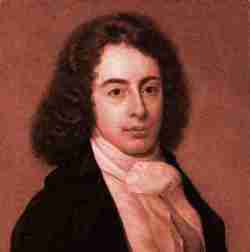
Robert Southey was an English Lake Poet and biographer. He was born on 12th August 1774 in Bristol, England and died on 21st March 1843 in Keswick, England aged 68.
Major Works
“The Fall of Robespierre” (1794)
“Joan of Arc” (1796)
“Poems” (1797)
“Thalaba the Destroyer” (1801)
“Madoc” (1805)
“The Chronicle of Cid” (1808)
“The History of Brazil” (1812)
“The Life of Nelson” (1813)
“The Lay of the Laureate”. “A Poet’s Pilgrimage to Waterloo” (1816)
“The Life of John Wesley” (1820)
“The Life of Cromwell” (1821)
Biography Timeline
1774: Robert Southey was born on12th August at 9 Wine Street in Bristol, England. He was the son of a linen draper and his father worked in Wine Street with William Britton. His mother was Margaret Hill. He was educated at Westminster school where he was expelled for his radical ideas. He went up to Oxford University but left without taking a degree.
1794: He meets Samuel Taylor Coleridge in Bristol and the two become great friends. They develop their own politico-religious views which they call Pantiscocracy and decide to set up a settlement in Pennsylvania, USA with their girlfriends, the Fricker sisters. They eventually abandon the plans and stay in England.
1795: On 13th November he marries Edith Fricker at St. Mary Redcliffe, Bristol. Edith was the sister of Sarah Fricker who became the wife of Samuel Taylor Coleridge.
1796: He begins writing ballads.
1798: He writes “The Battle of Blenheim” although his poetry does not make him much money and he has to rely on an allowance made to him by a friend.
1801: He writes “Thalaba the Destroyer “.
1802: He goes to Greta Hall in Keswick to stay with Coleridge.
1803: On September 7th Southey decides to stay permanently at Greta Hall, where he will remain for the rest of his life.
1805: He writes his epic “Madoc”.
1807: He receives an allowance from the Government.
1809: He joins the staff of the literary magazine “The Quarterly Review”. Death of the owner of Greta Hall, William Jackson, a retired wool trade carrier. The house is inherited by his brother Rev. J Jackson.
1813: He is appointed as the Poet Laureate and is heavily criticised by his former friends William Hazlitt and Lord Byron for betraying his radical ideas for money. He writes a biography of Lord Nelson.
1820: He writes a biography of John Wesley.
1821: He commemorates the Death of King George the Third in a Poem “A Vision of Judgment” which was heavily satirised by Lord Byron. He begins to turn his full attention to biographies and historical works.
1829: He writes “The Lives of the British Admirals”.
1830: He completes a biography of John Bunyan.
1834: He publishes “The Doctor” which contains the now famous fairy tale “The Three Bears”.
1835: The Prime Minister Sir Robert Peel increases his pension.
1837: Death of his wife Edith.
1839: On 4th June he marries the poet Caroline Anne Bowles after twenty years of mutual correspondence between the two.
Robert Southey died on 21st March 1843 at Greta Hall, Keswick, Cumbria, England of a stroke and was buried at St. Kentigern’s Churchyard, Crosthwaite, Keswick, Cumbria. (The grave monument was restored in 1961 with a Grant from the Brazilian Government).
Influences
Southey was always a well-read but independently minded person right from an early age, so much so that he was expelled from Westminster school in London for speaking out against flogging. His days at boarding school meant he began reading to escape the tyranny of school discipline and devoured the plays of William Shakespeare and the works of Voltaire, Jean-Jacques Rousseau, Edward Gibbon, Thomas Paine and the philosopher William Godwin. In his later writings was particularly influenced by Dante Alighieri and his “The Divine Comedy” as well as the poetic works of John Milton and Edmund Spenser. He also read avidly the writings of Emanuel Swedenborg the Swedish scientist and religious thinker. At one stage having met Samuel Taylor Coleridge the two decided to set up a Pantisocratical colony in America to practice their philosophy although it never came to pass.
Most critics agree nowadays that his prose is superior to his poetry or attempts at drama. After 1803 when Coleridge convinced him to visit him at Greta Hall in Keswick in the Lake District, he was so smitten with the place that he never left it and built a 14,000 book library there. Always dutiful, he had to look after his own and Coleridge’s family and to earn money he wrote prose works and critical reviews for newspapers. He had already gained a reputation as a reviewer with notices in the “Monthly Magazine” about Portuguese literature and then in 1799 in “Critical Review” where, amongst other things he wrote an enthusiastic review of Walter Savage Landor’s poem “Gebir”. In 1802 he was a regular contributor to the newly founded “Annual Review” which he continued for the next six years. He became known as the architect of the Georgian style”, more practical and functional than the ponderous writings of Edward Gibbon or Samuel Johnson before him. His many detractors, however, described his work as colourless or puerile.
This is not to say that the poetry was completely dismissed and some critics at the time thought of him a better poet than either Wordsworth or Coleridge. Charles Lamb said about “Joan of Arc” that he “had not presumed to expect of anything of such excellence from Southey” and excepted him one day to rival Milton. Percy Bysshe Shelley thought that “Thalaba the Destroyer” from 1801 was his favourite poem and John Keats was also impressed. Even the devout Catholic Cardinal John Henry Newman considered it the most “morally sublime” of English poems. Even Coleridge himself thought “Madoc” in 1805 would be superior to the “Aeneid” despite the fact that Southey had written a disparaging review about his earlier “Rime of the Ancient Mariner”.
His best work now is regarded as the biographies such as “Life of Nelson” in 1813, “Life of Wesley” in 1830 and “Life of William Cowper” in 1833. His seven-volume “The Doctor” (1834–47) is mainly famous for one thing. It contains his “The story of the Three Bears” story. Although now regarded as a children’s fairy tale his intention was as a repudiation of vagrancy, which was a major problem in England at the time and the abuses of hard-working people were represented by the three bears with Goldilocks as the villain. The once radical young man turned more conservative as he got older and between 1809 and 1838 he wrote over ninety political articles for the Tory (Conservative) “Quarterly Review”. His reputation was secured in 1813 when with a little help from Walter Scott he became Poet Laureate with a state pension to follow. In the same year Shelley wrote to his friend Thomas Jefferson Hogg that Southey’s work had had a great influence on his poem “Queen Mab”.
He has also had an influence on Russian literature with Alexander Pushkin appreciating and translating the “Hymn to the Penates and Madoc” and also being inspired by the plot of “Roderick the Last of the Goths” to create his own poem on the subject. In the twentieth and twentieth-first centuries several of his ballads have been translated into Russian.
Further Information
For more information on Robert Southey see his Britain Unlimited page here.
Poems by Southey.