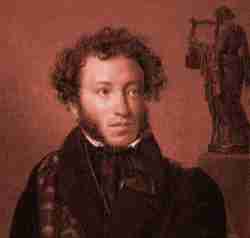
Alexander Pushkin was a Russian poet, playwright and novelist. He is seen as the founder of modern Russian literature. He was born in Moscow, Russia on 6th June 1799 and died in Saint Petersburg, Russia on 10th February 1837 aged 37.
Major Works
“Ruslan and Ludmila” (1817-1820)
“Eugene Onegin” (1823-1832)
“Boris Godunov” (1825)
“Little Tragedies” (1830)
“Tales of the Late Ivan Petrovich Belkin” (1830)
“The Bronze Horseman” (1833)
“The Queen of Spades” (1834)
“The Captain’s Daughter” (1836)
Biography Timeline
1799: Aleksandr Sergeevich Pushkin was born on 26th May in Moscow, Russia. His father Sergei was a minor nobleman and his mother Nadezhda was related to an African lord although the family were not wealthy.
1811: He attends a special school for privileged children of the nobility the Tsarskoye Selo Lyceum.
1814: He writes his first poems.
1817: He leaves school but most of his many poems over the next few years were deemed not appropriate for publication due to their subject matter.
1820: He leaves St. Petersburg on 6th May as the political nature of most of his poems was deemed unacceptable by the state and he was banished to the south of Russia. In June however his first narrative poem “Russlan and Ludmilla” is published. Pushkin spent the years from 1820 to 1823 in various places in the southern part of Russia, including the Caucasus and the Crimea. Although happy at first he later became bored and took up drinking and gambling. He was consequently always short of money even though he had a job as a civil servant. He writes “Prisoner of the Caucasus”.
1823: He moves to Odessa which was a much larger city than he had been used to and more fun.
1824: He then moves to Mikhailovskoye, a town to the north of Moscow where his family owned an estate. When Pushkin arrived there his relations with his parents, particularly his father, were not good, however they left in November and Pushkin found himself alone with only the family nurse. She told Pushkin many folk tales to pass the time and it is thought that instilled in him a feeling for country life that appears in many of his poems. This was a productive period during which he wrote the first three chapters of “Eugene Onegin” and composed the tragedy “Boris Godunov”. Pushkin was eventually forgiven by the new Tsar Nicholas the First on the understanding that all his new work should be passed by him first. Pushkin promised not to publish anything harmful to the state.
1825: He writes “Boris Godunov”.
1829: He writes “Poltava”.
1830: He proposed to Natalya Nikolayevna Goncharova and managed to obtain money, and and a house from her parents.
1831: He finally completes “Eugene Onegin”. He marries Natalya Goncharova on 2nd March when she was sixteen. Although they had three children together it was not a happy marriage as his pretty wife had many admirers.
1834: He writes “The Queen of Spades”.
1835: He writes “Egyptian Nights”.
1836: He writes “The Captain’s Daughter” and“A Journey to Arzrum”.
1837: He writes “The Bronze Horseman”. Things come to an head on 29th January when he challenged one of these admirers, Baron Georges d’Anthès, to a duel in St Petersburg after he had heard they were having an affair. Pushkin is wounded and died on the same day. There was a great outpouring of grief at this news. The Tsar, fearing an uprising, had Pushkin buried in secret on 6th February next to his mother at Svyatogorsky Monastery, near Mikhailovskoye.
Influences
As a young man Alexander Pushkin was influenced by the English Romantic poet Lord Byron but in later life distanced himself from this view and his 1833 work “Eugene Onegin” provided a critique of and challenge to Byron and in particular “Don Juan”. He also read the works of William Shakespeare, Dante Alighieri, Voltaire, Jean-Jacques Rousseau, John Keats and the Germans Johann Wolfgang von Goethe and Friedrich Schiller. According to Vladimir Nabokov he also read widely amongst the earlier Russian poets including Gavrila Derzhavin, Vasily Zhukovsky, Konstantin Batyushkov, Nikolay Karamzin and Ivan Krylov. His first language was French but he also spoke and read English and learned Latin and Ancient Greek at school.
He was proud, of his partial African roots, through African great-grandfather, General Abraham Petrovitch Gannibal. He was however, unacquainted with African life and never particularly influenced by it. His major writings spanned a period during the 1820s and 1830s and he is considered by many to be Russia’s greatest poet. He is often credited with developing Russian literature and expanding its language, often by introducing foreign language terms and was a great shaper of Russian Romanticism. Even though he related to all the main themes of European Romantic writing such as understanding emotion, the importance of the poet and social freedoms and an interest in folk literature and history he is still seen as the quintessential Russian writer and the founder of modern Russian literature. Many Russian proverbs are taken directly from his work.
Besides his prolific poetry and fiction, he also wrote works of history such as those about the peasant and Cossack rebellions of the 1770’s. The fact that his life ended tragically short in a duel has also turned him into a legend. Fyodor Dostoevsky declared him a prophet and the “embodiment of Russia’s national ideals”.
His style and using contemporary society as a subject directly influenced other Russian writers such as Ivan Turgenev, Leo Tolstoy and Ivan Goncharov and pointed the way to Russian realism later in the century. During his lifetime Pushkin’s importance as a great national poet was recognised by his pupil Nikolai Gogol and his contemporary the Russian critic Vissarion Belinsky wrote a major critical study of his work which is still relevant today. Pushkin also introduced Russia to all the European literary genres and writers.
His work as an influential critic began the age of Russian magazine culture in publications such as “Sovremennik” (The Contemporary). He inspired folk tales by Maxim Gorky and poets such as Mikhail Lermontov and operas by Pyotr Tchaikovsky.
He has been translated into all the major languages and his subjects of the triumph of reason over prejudice and humanity over slavery and oppression has found an audience worldwide. He is at once seen as representing the Russian national consciousness as well as being relevant to all other cultures. The list of other writers he influenced is long and includes Fyodor Dostoevsky, Anton Chekov, Vladimir Mayakovsky, Boris Pasternak, Vladimir Nabokov, Isiah Berlin, Henry James, Adam Mickiewicz, Pablo Neruda and even the Welsh poet Dylan Thomas.
During the Soviet period Vladimir Lenin defended his work against critics, Joseph Stalin called him a hero and in 1937 at the centenary of his death many streets were renamed after him. He was used in a great deal of government propaganda even though his aristocratic and libertine image did not fit comfortably with the image they were trying to portray.
In the recent century he has even been acclaimed as the first Russian feminist due to his sympathetic handling of female characters and several Russian Rap musicians see him as a forefather of hip-hop.
Further Information
List of books by Pushkin.