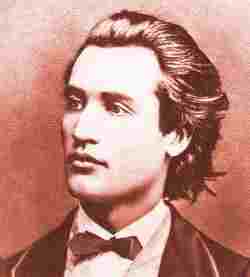
Mihai Eminescu was a Romanian poet, novelist and journalist and generally regarded as one of the most influential writers in Romania. He was born in Botosani, Romania on 15th January 1850 and died in Bucharest on 15th June 1889 aged 38.
Major Works
“Doina” (1884)
“Lacul” (The Lake), 1876
“Luceafarul” (The Vesper) (1883)
“Sarmarnul Dionis” (Poor Dionis) (1872)
Biography Timeline
1850: Mihai Eminescu (originally Mihail Eminovici) was born on 15th January in Botoșani, Moldavia, then part of the Ottoman Empire. His father was Gheorghe Eminovici, an aristocrat from Bukovina in the Austrian Empire. His mother was Raluca Iurașcu, an heiress from an old noble family. He spent his early childhood in Botoșani and the village of Ipotesti.
1858: He goes to school in Cernăuƫi, a Germano-Romanian cultural centre (now in Ukraine).
1866: He attends two years at the gymnasium school. His first poetry is first published in the student pamphlet “Lăcrămioarele Invățăceilor Gimnaziaști” (The Tears of the Gymnasium Students) and is entitled “La Mormântul lui Aron Pumnul (At the Grave of Aron Pumnul) after the recent death of his Romanian teacher. In February he publishes “De-aș Avea” (If I Had) in the literary magazine in Pest, Hungary called “Familia”.
1867: His first job is as a clerk and prompter to Iorgu Caragiale’s theatre group. he begins his novel “Geniu Pustiu” (Wasted Genius) which is not published until 1904 still unfinished.
1868: He transfers to Mihai Pascaly’s theatre group and also works as a clerk at Bucharest’s National Theatre. He continues writing poetry and translating the works of the theatre critic Heinrich Theodor Rötscher. He begins work on his novel “Geniu Pustiu” (Wasted Genius) (published 1904).
1869: He is one of the founder members of the “Orient” literary circle on 1st April which collects Romanian folklore and literary history. On 29th June members of the “Orient” group are commissioned to go to different provinces and he travels to Moldavia where he accidently meets his brother, the soldier Iorgu, in Cismigiu Gardens. He eventually renews ties with his family and his father gives him an allowance to continue his studies at the University of Vienna which begins in October. He attends the faculty of Philosophy and Law as an “extraordinary auditor” not having passed the requisite exams. He publishes “La Moartea Principelui Știrbei” (On the Death of Prince Știrbei) about the former ruler of Wallachia. He also contributes to the periodical “Convorbiri Literare” (Literary Conversations) which is produced by Junimea, a Romanian literary society as its editor Iacob Negruzzi is impressed by his poem “Venere şi Madonă” (Venus and Madonna).
1870: He writes three articles under the pseudonym “Varro” about the plight of Romanians and other minorities in the Austro-Hungarian Empire in the magazine “Federaţiunea” in Pest. He then works as a journalist for “Albina” (The Bee) newspaper in Pest.
1872: He finishes at the University of Vienna and moves to Berlin where he continues his studies at the university there funded by Junimea. He is influenced by German philosophy and western literature. He writes the poem “Memento Mori” and the prose work “Sarmanul Dionis” (Poor Dionis).
1874: He is appointed as a school inspector and chief librarian at the University of Iasi. He edits the paper “Curierul de Iași” (The Courier of Iaşi) and continues to write for “Convorbiri Literare”.
1876: He writes the story “Cezara” and the poem “Lacul” (The Lake).
1877: He moves to Bucharest where he works as a journalist.
1880: He becomes editor in chief of the conservative newspaper “Timpul” (The Time).
1883: He begins to suffer from mental health problems and is treated by doctors in Austria and Italy. He writes the poem “Luceafărul” (The Evening Star or the Vesper) which concerns Romanian medieval history and folklore and later has a literary review named after it. He also writes “Odă în Metru Antic (Ode in Ancient Meter).
1884: He writes the poems “Doina”, “Floare Albastră” (Blue Flower), “Dorința” (Desire) and “Epigonii” (Epigones).
1885: He writes the poem “Sara pe Deal” (Evening on the Hill).
1886: He writes the poem “La Steaua” (To the Star). He has a nervous breakdown and is treated for syphilis by Romanian doctors at the Neamt Monastery.
1889: Dr. Itszak in Botosani recommends massages but later in Bucharest Dr Alexandru A Suțu injects him with mercuric chloride at his sanatorium, the Caritas Institute.
Mihai Eminescu died on 15th June 1889 at 4 a.m. at the Caritas Institute in Bucharest, Romania. His cause of death is disputed. Being hit over the head by Petre Poenaru, another patient, or mercury poising are suggested but the latter is more likely according to modern medical theories. He was buried at the Bellu Cemetery, Bucharest, Romania.
Influences
Mihai Eminescu’s father Gheorghe Eminovici was in the service of the boyar Ioan Ienacaki Cârstea and his mother’s ancestors, the Jurăscești family, came from Hotin, now Romania. Mihai was the seventh of the eleven children and spent his early childhood in Botoșani and Ipotești. From 1858 to 1866 he attended school in Cernăuți (now Chernovtsy in Ukraine).
His first poem appeared in 1866 about the death of his Romanian teacher Aron Pumnul entitled “La Mormântul lui Aron Pumnul” (At the Grave of Aron Pumnul) and appears in “Lăcrămioarele învățăceilor Gimnaziaști” (The Tears of the Gymnasium Students). It is signed M. Eminovici. In 1869 he went to the University of Vienna and then on to Berlin in 1872 where he was heavily influenced by the German philosophy of Immanuel Kant and Georg Wilhelm Friedrich Hegel and especially the pessimism and metaphysical concepts of Arthur Schopenhauer. He was also opened up to Western European Romanticism and read writers such as Johann Wolfgang von Goethe, Friedrich Schiller and the poet Novalis. He was also heavily influenced by the works of William Shakespeare. In Vienna he befriended the writer and journalist Ioan Slavici and began a love affair with the poet Veronica Micle. His interest in metaphysics would lead him towards studying Hinduism and he would later become fully convinced of an inherent spiritual relationship between East and West. He translated parts of Sanskrit grammars and weave Hindu concepts into works such as “Rugăciunea Unui Dac” (A Dacian’s Prayer) in 1879.
His work also drew heavily on local Romanian myths, fairy tales, pastoral traditions and folklore and often used rustic language. In April 1869, he was one of the co-founders of the “Orient” literary circle, whose interests included the gathering of Romanian folklore and documents relating to Romanian literary history. His first major breakthrough emerged in 1870 when he published two poems in “Convorbiri Literare” the journal of the Junimea Literary Society in Iaşi. He collaborated with and was shaped by the intellectual community of the society and its mentor the major Romanian critic Titu Maiorescu who dubbed him “a real poet”. The leaders of the organisation, Petre P Carp, Vasile Pogor, Theodor Rosetti, Iacob Negruzzi continued their political and cultural influence over Eminescu for the rest of his life. It was Iosif Vulcan, who disliked the Slavic source suffix “-ici” of the poet’s last name, that chose for him the more apparent Romanian pseudonym of Mihai Eminescu.
In 1874 he was appointed school inspector and librarian at the University of Iaşi. The glory of the Romanian medieval past and in folklore can be seen in his 1883 work “Luceafărul” (The Evening Star). His poetry has a distinctive simplicity of language, a brilliant handling of rhyme, and profound thought which appealed to his contemporaries and has affected nearly every Romanian writer ever since. In 1877 he moved to Bucharest becoming editor in chief of the conservative newspaper “Timpul” (The Time). Most of his notable editorial pieces come from this period when Romania was fighting the Ottoman Empire for independence in the Russo-Turkish War of 1877-8.
He was probably the first Romanian writer to publish in all Romanian provinces and interested in the problems of all Romanians which helped his national reputation. He defined himself as a Romantic, in his poem “Criticilor Mei” (To My Critics). He was first translated into German by Elizabeth, the Romanian Queen of the time (under the name Carmen Sylva) and since has been translated also into English, French, Spanish, Portuguese, Italian, Hindi, Arabic, Hungarian and Esperanto. Romania’s greatest playwright, Ion Luca Caragiale, described him as being “joyful and sad, communicative and abrasive, gentle and severe, satisfied with anything and always dissatisfied with everything; sometimes ascetically abstinent, sometimes greedy for life’s pleasures; running away from people and seeking them out; heedless as a stoic ancient and irritable as an ill-natured girl. A strange mixture.”
Though he attained much success during his lifetime, most of his magnum opus was published posthumously as his life was cut short mysteriously at the age of thirty-nine. His death still has conspiracy theories today ranging from murder downwards but the common consensus is between mercury poisoning for syphilis or an old fashioned treatment for Bipolar Disorder. In 1886, he suffered a nervous breakdown and was treated by numerous Romanian doctors.
He was soon proclaimed Romania’s national poet in all provinces. Even today, he is considered the national poet of Romania, Moldova, and of the Romanians who live in Bukovina. He shaped nearly every subsequent Romanian writer, poet and intellectual from the late nineteenth century Romantics and Symbolists to the modern era and is seen as the foundational architect of modern Romanian literary language. The early symbolist and journalist Alexandru Toma modelled himself on Eminescu’s work.
The twentieth century scholars Mircea Eliade and Ioan Petru Culianu were influenced by his pioneering comparative syntheses of Eastern philosophy and Western metaphysics. The Romanian historian Nicolae Iorga considers Eminescu the godfather of the modern Romanian language. He was claimed by the Fascist party of the 1930s and equally by the communists after World War Two who had originally seen him as bourgeois.
Today nearly everyone in Romania and the Republic of Moldova can recite some of his work and he is taught in schools, some of which are named after him. There are at least 133 statues to him throughout the region and indeed other parts of the world. Composers Didia Saint Georges, Rodica Sutzu and Elise Popovici have used Eminescu’s texts for their songs and in 2021, the Dutch artist Kasper Peters performed a theatre show entitled “Eminescu” dedicated to him.
Not all is reverential however as many younger writers today are questioning the “traditional’ view of their literature and critics and readers seem to be polarised on both sides in the post-modern generation.
Further Information
List of books by Eminescu.