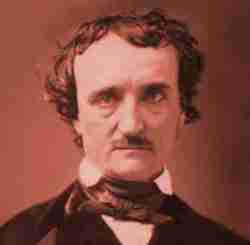
Edgar Allan Poe was an American writer, poet, editor, and literary critic best known for his tales of mystery. He is widely regarded as a central figure of Romanticism in the United States. He was born in Boston, Massachusetts, USA on 19th January 1809 and died in Washington, USA on 7th October 1849 aged 40.
Major Works
“To Helen” (1831),
“The Fall of the House of Usher” (1839)
“The Murders in the Rue Morgue” (1841)
“The Pit and the Pendulum” (1842)
“The Tell-Tale Heart” (1843)
“The Raven” (1845)
“Annabel Lee” (1849)
Biography Timeline
1809: Edgar Allan Poe is born on 19th January in Boston, USA.
1810: Edgar’s parents separate and his mother Elizabeth takes the children.
1811: Edgar’s mother dies. Mr. and Mrs. John Allan adopt Edgar Poe.
1815: Edgar Allan goes to school in England.
1820: He returns to the United States and continues his schooling.
1826: He attends the University of Virginia and goes by the name of “Edgar Poe”.
1827: He drops out of school because John Allan won’t give him any money. He writes and prints his first book “Tamerlane and other Poems” but as he can’t support himself he joins the United States Army.
1828: He does well in the Army and attains the rank of sergeant major.
1829: Mrs Allan dies and Edgar returns home. Poe and John Allan temporarily reconcile their differences. Poe applies to West Point and John Allan sponsors him.
1831: He gets deliberately thrown out of West Point.
1832: He submits a number of stories to magazines but they are all rejected.
1833: He sends a desperate letter to John Allan asking for help but is ignored.
1834: John Allan dies and leaves Edgar nothing in his will. Poe writes “Berenice”.
1835: He wins a prize for “The Manuscript Found in a Bottle”.
1836: Edgar Poe marries his thirteen year old cousin Virginia in May.
1838: He writes “Ligeia”.
1839: He writes “The Fall of the House of Usher” and “Tales of the Grotesque and Arabesque”. He receives no money from his publisher for his short stories.
1840: He writes “The Man of the Crowd”.
1841: He writes “Eleorora”, “Descent into the Maelstrom” and “The Murders in the Rue Morgue”.
1842: He writes “The Mystery of Marie Roget”, “The Oval Portrait”, “The Pit and the Pendulum” and “The Tell Tale Heart”. Virginia Poe breaks a blood-vessel whilst playing the piano.
1843: He writes “The Black Cat” and wins a hundred dollar prize for “The Gold Bug”.
1844: He moves back to New York City. Poe writes “The Balloon Hoax”, “The Purloined Letter” and “The Premature Burial”.
1845: He writes “The Raven”, “The Facts in the Case of M. Valdemar”, “The Imp of the Perverse” and “Some Words with a Mummy”. Although Poe was working long hours he still couldn’t make a living.
1846: He writes “The Cask of Amontillado” and “The Philosophy of Composition“. He sues a newspaper for libel and wins. The suit is settled for $225.00.
1848: He writes “The Poetic Principle”.
1849: He writes “Hop Frog”. On 30th June Poe leaves New York City and visits John Sartain in Philadelphia. Poe joins the “Sons of Temperance” in an effort to stop his excessive drinking. On 3rd October Poe is found half conscious and is taken to a hospital.
Edgar Allan Poe died on October 7, 1849 in Washington, USA and was buried in an unmarked grave at the Westminster Presbyterian Church in West Baltimore.
Influences
Despite a difficult childhood where both of his parents died whilst he was young Edgar Allan Poe was quite well read. He was a great admirer of William Shakespeare and Alexander Pope and his early poetry shows his love of the English Romantics Samuel Taylor Coleridge, Lord Byron, John Keats, and Percy Bysshe Shelley. He was also fond of the work of Elizabeth Barrett Browning.
In his other writings influences can be seen from Thomas de Quincy, E.T.A Hoffman and Charles Dickens. Dickens and he were both masters of serialisation in magazines. Some critics have also suggested Mary Shelley as someone he would have read and liked.

In life he was often compared with Nathaniel Hawthorne as both wrote during the mid-nineteenth century Romantic Period in American literature. He was also well known for suffering depression and possibly even bi-polar disorder and freely took drugs and alcohol which most likely led to his early demise. The early deaths of the many women closest to him often created dark and macabre thoughts, mourning and regret.
Besides being a writer, he was also a critic well known for his harsh pieces about some authors and had a major influence on the literature of the day. His most famous poem “The Raven” earned him international fame when it was published in 1845 and the scholar of the story mourns the loss of his lover, Lenore.
He is often credited with introducing the genres of horror, gothic horror and detective fiction and became an influence on Arthur Conan Doyle whose character Sherlock Holmes has a personality very similar to his Dupin. His 1841 story, “The Murders in the Rue Morgue”, was the first to follow the adventures of a fictional detective also later inspiring Doyle.
The science fantasy and horror writer H.P Lovecraft like Poe also experienced tragedy at a young age and was afflicted with recurring nightmares and described the older writer “My God of Fiction”. The modern American best-selling writer Stephen King has often acknowledged the important influence that he exerted on his fiction but most Poe scholars seem to have overlooked these allusions in their work.
Some critics have suggested that there is a comparison between Oscar Wilde’s “The Picture of Dorian Gray” and Poe’s short story titled “William Wilson”. Poe’s stress upon correctness of language, structure and metre and the importance of achieving a particular mood has also shaped literary theory ever since.
In music Claude Debussy began composing his opera, “La Chute de la Maison Usher” based on Poe’s short story, “The Fall of the House of Usher”.
Poe’s acerbic critical reviews had offended many of his contemporaries and after his death the editor and poet Rufus Wilmot Griswold began trashing his character. Despite all this he is still seen as the most influential writer in America as well as a master of the melancholic and macabre.
Poe was one of the first authors to experiment with scientific discoveries and ideas of space and time. In his story “The Unparalleled Adventures of One Hans Pfaal” the main character builds a balloon and flies to the moon. The Frenchman Jules Verne went on to write “The Sphinx of the Ice Fields” as a sequel to Poe’s “The Narrative of Arthur Gordon Pym”.
Further Information
Complete list of works by Poe.