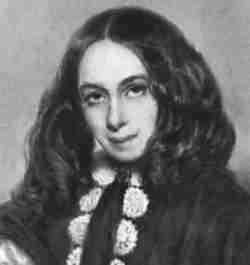
Elizabeth Barrett Browning was an English poet of the Victorian era who was popular in Great Britain and the United States during her lifetime. She was born in Coxhoe, County Durham, England on 6th March 1806 and died in Florence, Italy on 29th June 1861 aged 55.
Major Works
“An Essay on Mind” (1826)
“Prometheus Bound” (1833)
“The Seraphim and Other Poems” (1838)
“The Cry of the Children” (1842)
“Aurora Leigh” (1857)
Biography
1806: Elizabeth Barrett Moulton-Barrett, the oldest of twelve children was born on 6th March 1806 at Coxhoe Hall, County Durham, England. Her father was Edward Moulton-Barrett, a country gentleman and her mother was Mary Graham Clarke Moulton-Barrett. Her maternal grandfather owned sugar plantations and slaves in Jamaica, mills, glassworks and ships that traded between Newcastle upon Tyne and Jamaica. She was educated at home by Daniel McSwiney and was a voracious reader and writer.
1807: Her bother Edward (known in the family as “Bro”) is born in June.
1809: The Family moves to Hope End, near Ledbury in Herefordshire. Her father converts the Georgian house into stables and builds a new house of Turkish design.
1818: She writes her narrative poem “The Battle of Marathon.”
1820: Her father has the “Battle of Marathon” privately printed and is proud of her work calling her the “Poet Laureate of Hope End”. She develops a mystery lung illness that requires her to take morphine for the rest of her life.
1821: She suffers a spinal injury further ruining her already fragile health.
1825: Her first published work “The Rose and Zephyr” appears in the “Literary Gazette”.
1826: She publishes her first volume of poetry entitled “An Essay on Mind and Other Poems” anonymously, although it is overlooked by the critics.
1828: Elizabeth’s mother dies and is buried at St Michael’s Church, Ledbury, next to her daughter Mary. Her aunt Sarah Graham-Clarke arrives to look after the children but clashes with the strong-willed poet. Elizabeth studies classical literature under H. S. Boyd.
1831: Elizabeth’s grandmother, Elizabeth Moulton, dies. Following lawsuits and the abolition of slavery, her father suffers great financial losses and is forced to sell Hope End.
1832: The family move to a smaller home at Belle Vue, Sidmouth, Devon.
1833: She publishes “Prometheus Bound”, a translation of the play by Aeschylus and “Miscellaneous Poems” anonymously.
1835: The family move to a house at Gloucester Place in London.
1837: She suffers from intense head and spinal pain and loss of mobility which doctors couldn’t diagnose. Some suggest this was due to an earlier riding accident but this is not certain.
1838: She publishes “The Seraphim and Other Poems” which is the first work under her own name. It receives good reviews and sells well. She begins to correspond with famous authors of the day such as William Wordsworth, Edgar Allan Poe and Thomas Carlyle. She travels with her brother Edward to Torquay to try and find a cure. Her uncle dies and leaves her enough money to have security for her later life. The family eventually settle at 50 Wimpole Street, London.
1840: In February her brother Samuel dies of a fever in Jamaica and later her favourite brother Edward drowns in a sailing accident at sea off Torquay which greatly upsets her. She writes “De Profundis” expressing her grief but it is not published until after her own death.
1841: She returns to her family in London and works reviewing books, writing articles and doing translations. She publishes “The Cry of the Children” attacking child labour in “Blackwoods” magazine. This helped support Lord Shaftesbury’s “Ten Hours Bill” which brings about legislative reforms. She also writes in praise of Thomas Carlyle in “A New Sprit of the Age” magazine.
1844: She publishes a two-volume edition of “Poems” . An edition is made available in the United States with and introduction by Edgar Allan Poe. The book is a major success and she becomes popular throughout the country even inspiring the poet Robert Browning to write to her.
1845: Robert Browning visits Elizabeth at Wimpole Street on 20th May and declares his love for her the next day, however her father opposes the marriage of any of his children. Elizabeth works on love poems, “Sonnets from the Portuguese,” which was named after Robert’s nickname for her of “Portuguese”.
1846: Robert Browning and Elizabeth secretly marry in London at St Marylebone Parish Church on 12th September. Elizabeth’s Lady’s Maid, Elizabeth Wilson, witnesses the marriage as her father does not approve of the union. She travels with them on honeymoon to Paris before moving on to Italy in September. They settle in Florence where Elizabeth’s health improves slightly and she is idyllically happy. Mr Barrett disinherits Elizabeth and never sees or writes to her again.
1848: She becomes involved with Italian politics especially the cause of unification of the country.
1849: Their son Robert Wiedeman Barrett Browning is born. He is their only child despite Elizabeth’s four other miscarriages.
1850: She publishes a new two-volume edition of her “Poems” which includes “Sonnets from the Portuguese”. She is tipped in the journal “The Athenaeum” as a candidate to succeed William Wordsworth as poet laureate but that honour goes to Alfred Lord Tennyson.
1851: She publishes “Casa Guidi Windows”, which includes her political views on Italy and her hopes for its unification free from Austrian rule. She meets Thomas Carlyle in Florence.
1852: She meets the novelist George Sand in Italy.
1856: “A Curse for a Nation” is published in “The Independent” newspaper of Boston, USA which criticises slavery in America (without specifically mentioning the name). She writes the blank verse poem “Aurora Leigh”.
1857: Her father dies. “Aurora Leigh” is published and is highly successful however she is also attacked in certain quarters as it describes an independent woman who is an artist and unmarried mother. The Brownings move from Forence to Siena and live at the Villa Alberti.
1860: She writes “Poems Before Congress”. This is not a popular work and her health declines further. It is especially controversial in Britain and “Blackwood’s” Magazine and the “Saturday Review” describe her as a fanatic for her views on Italian unification. Her sister Henrietta dies in November. The Brownings spend the winter in Rome.
1861: The family return to Florence in early June.
Elizabeth Barrett Browning died of a severe cold on 29th June 1861 in Florence in her husband’s arms. She was buried in the Protestant English Cemetery of Florence. Such was her popularity that on the following Monday shops in the area around Casa Guidi were closed as a mark of respect. One of her most popular poems “De Profundis” was included in “Last Poems”, which was published by her husband in 1862.
Influences
Elizabeth Barrett Browning is probably best known for her love poetry and her relationship with the poet Robert Browning.
As a child she began writing at the age of four, encouraged by her father and although she didn’t have a formal education like her brother she read widely and developed a vivid imagination. Her early inspiration was garnered from the works of classical writers, particularly Homer, as well as William Shakespeare, the neo-Classical author Alexander Pope and the Romantic Lord Byron. She also read plays by Racine and Molière, and a portion of Dante’s “Inferno” all in the original languages as well as works by Tom Paine, Voltaire, Jean-Jacques Rousseau and Mary Wollstonecraft.
Robert Browning was impressed by her poetry and arranged an invitation to meet her in May 1845 and they promptly fell in love although during the years of her marriage to Robert Browning her reputation was far greater than that of her husband. She was widely popular in the United Kingdom and the United States during her lifetime and was probably the most famous female poet of the age. Due to her use of imagery, metaphors, and similes she was often compared to Shakespeare and Petrarch.
Her popularity was greatly enhanced by her stands against social injustice at home including child labour in mills and mines, against slavery in the USA and justice for the Italians against their Austrian rulers where she had moved with her husband Robert. Visitors came to their home in Florence where she was the bigger attraction.
Her poetry greatly influenced Emily Dickinson who thought of her as a role model for a successful woman who reconciled the multiple roles of woman, wife, and poet. She had a framed portrait of Elizabeth hung in her bedroom. Edgar Allan Poe was inspired by her poem “Lady Geraldine’s Courtship” and alluded to its style in his “The Raven”. He dedicated his 1845 collection “The Raven and Other Poems” to her and called her “the noblest of her sex”. The American journalist Lilian Whiting published a biography of her in 1899 and described her as “the most philosophical poet” and records her life as “a Gospel of applied Christianity”. A good number of the Browning’s literary friends such as Algernon Swinburne, Walter Savage Landor, James Henry Leigh Hunt, John Ruskin and Dante Gabriel Rossetti were impressed by many of her poems. The most influential poem and one of the best-known of all her works, was “The Cry of the Children” which first appeared in Blackwood’s Magazine”.
Her masterpiece “Aurora Leigh” of 1857 published in nine volumes is often cited by feminists as it relates the story of a woman poet and a philanthropist who loves her. Aurora is a strong and independent woman who copes with both work and love and survives a series of catastrophes until the happy ending is achieved.Nevertheless, at the time it was controversial. The plight of “a fallen woman” was considered by the Victorian public as outside that worthy of a serious novelist or poet. A number of women readers were shocked saying that the reading of “Auroa Leigh” had endangered their morals. Nevertheless, many journals which reported Barrett Browning’s untimely death all spoke of her as the greatest woman poet in English literature.
Some writers in the twentieth century such as Angela Leighton have suggested that the portrayal of her as a pious woman has actually distracted critics from her poetical achievements. She stated that the 1931 play “The Barrett’s of Wimpole Street” by Rudolf Besier did much more to dent her popularity than her poetic ineptitude and others have agreed that it gave rise to many false myths. Throughout the twentieth century, literary criticism of her poetry was almost non-existent until her poems were discovered by the women’s movement. In 1930 Virginia Woolf wrote an article in the “Times Literary Supplement” lamenting the fact that her poetry was no longer being read and especially that “Aurora Leigh” had been forgotten.
A five-volume scholarly edition of her works was published in 2010.
Further Information
Complete works of Elizabeth Barrett Browning.