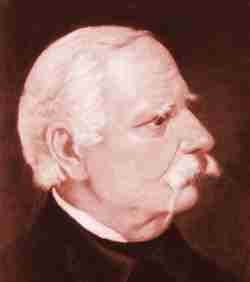
Wincenty Pol was a Polish poet and geographer. He was born in Lublin, Poland on 20th April 1807 and died in Krakow, Poland on 2nd December 1872 aged 65.
Major Works
“Songs of Janusz” (1836)
“Pieśń o ziemi naszej” (Song of our Land) (1843)
“Obrazy z życia i podróży” (Pictures of Life and Travel) (1846)
“Mohort” (1865)
Biography Timeline
1807: Wincenty Ferrerius Jakub Pol (pen name “Janusz”) was born on 20th April in Lublin, Poland (then Galicia). His father was Franz Pohl (or Poll), a German in the Austrian government service. His mother was Eleonora Longchamps de Berier, who was from a French family living in Poland. He grew up and was educated in Lviv.
1830: He teaches German at the University of Vilnius but gets known for his anti-Tsarist agitation and, although defended by some of the professors he has to leave. He fights in the Polish army in during the November Uprising (also known as the Polish-Russian War). He is captured and sent to a prison in Konigsberg (now Kaliningrad, Russia).
1832: He leaves exile in Saxony and returns to Galicia again to engage in underground activity.
1835: Now exiled to live in France he writes ““Pieśni Janusza” (Songs of Janusz) a poetic description of the Poland’s regions which later inspires Frederic Chopin to write Polish songs.
1837: He marries Kornelia née Olszewska and they go on to have four children, Wincenty Junior, Julia, Zofia and Marek Stanisław.
1843: He publishes the poem “Pieśń o Ziemi Naszej” (Songs of our Land).
1846: He writes “Obrazy z Zycia i Podróży” (Pictures of Life and Travel).
1848: He serves as an aide-de-camp on the staff of the National Guard in Lwów (Lviv) during the 1848 Revolution.
1849: Despite having no formal qualifications in geography he is appointed a professor at the Jagiellonian University in Krakov in their first Chair of Geography.
1851: He publishes “Rzut oka na Północne Stoki Karpat i Przyległe im Krainy” (A glance at the Northern Slopes of the Carpathians and the Adjacent Lands) and “Północny Wschód Europy Pod Względem Natury” (North-East Europe in Terms of nature).
1855: He publishes the poem “Mohort” about the era of the Polish King Stanislaw August Poniatowski.
1866: He publishes “The Song of Our Home” in Lviv which contains descriptions of holidays, rituals and Polish customs.
1869: “Obrazy z Życia I Natury” (Pictures from Life and Nature) is published in Kraków by the Society of Friends of Education
Wincenty Pol died on 2nd December 1872 in Kraków. He was buried at the Rakowicki Cemetery, and later his ashes were moved to a sarcophagus in the Crypt of the Meritorious in Kraków’s historic Church of St. Michael the Archangel and St. Stanislaus Bishop and Martyr.
Influences
Wincenty Pol was born into a German family living in Lublin and spent his childhood and youth in Lviv where the family moved in 1809. He studied philosophy at the Lviv University. He was considered a national Polish poet and successor of Adam Mickiewicz. He was also considered the father of Polish geography.
He was heavily influenced by the works of Johann Wolfgang von Goethe and Friedrich Schiller and agreed with Schiller’s theory about the connection between the “romantic” and the “poetic”.
The poetry of his youth was also influenced by the work of Lord Byron from England and also the Polish Romanticism of Mickiewicz. He had an interest in the history of Poland and its national identity and was known for his patriotism. Most of his poetry had vivid descriptions of Polish landscapes and local folklore.
He was also influenced by Alexander von Humboldt, the famous Prussian naturalist and traveller, and he followed Humboldt’s methodology, emphasising empirical research and viewing nature, culture, language, and history as one “organic wholeness”. His passion for geography would lead him eventually to founding the first geography department in Poland at the Jagielloninan Univesrity in Krakov in 1849 and becoming its first professor of the discipline
He was deeply influenced by the gawęda szlachecka, a traditional, highly conversational style of oral storytelling used by the Polish nobility. Writers such as Franciszek Karpiński and his friends within the aristocratic Krasicki family influenced his narrative style, helping him capture the folklore and values of regional Poland. He was also fascinated by the landscapes and multi-ethnic cultures of the eastern borderlands and is widely credited with introducing the term “Kresy” into Polish literature to describe these frontier lands.
In 1830 and 31 he actively fought in this Polish insurrection against the Russian Empire. After its defeat he suffered trauma in exile in Paris, France but this directly inspired his highly influential debut poetry collection “Pieśni Janusza” (Songs of Janusz) which paid tribute to the heroism of his fellow fighters and later inspired composers such as Frédéric Chopin.
He travelled widely in Poland particularly in Galicia in the south east and became an expert on the antiquities of the area. In 1864, he prepared the opening of a museum within the Ossoliński National Institute. In his report for the museum he listed the main ancient monuments in Lviv and the eastern part of Galicia. He clearly emphasised the need for a monument conservator in Lviv and a monument preservation institution. In 1866 he collaborated with conservator Mieczysław Potocki as a correspondent of the Central Commission for the Protection of Monuments but became a vocal critic of the institution with their refusals to protect the monuments in Galicia. He was removed from the committee on the pretext of his failing eyesight. Later in the 1880’s two autonomous Circles of Conservators were formed in Lviv and Krakow against the will of the Central Commission and so Wincenty Pol’s brief involvement had had a visionary influence on it.
As an influential Polish romantic poet, ethnographer and the father of modern Polish geography he created a significant cultural and scientific impact during the 19th-century partition of Poland. Chopin set a number of his poems to music as Polish art songs, though only “Śpiew z mogiły” (Leaves are Falling, A Song from the Tomb) survives today. He was so deeply respected as a “father of the nation” that contemporary and subsequent critics frequently categorised him alongside Poland’s legendary Three Bards. His epic travel log, “Pieśń o Ziemi Naszej” (Song of Our Land) published in 1843 triggered a widespread surge of interest in regional nature, travel, and ethnography among ordinary Polish people.
Further Information
List of works by Pol.