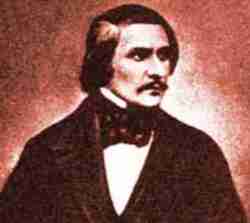
Nikili Gogol was a Russian novelist, short story writer and playwright of Ukrainian origin. He was born in Velyki Sorochyntsi, Ukraine in 1809 and died in Moscow, Russia on 4th March 1852 aged 43.
Major Works
“Diary of a Madman” (1835)
“Taras Bulba” (1835)
“The Carriage” (1836)
“Marriage” (1842)
“Shinel” (The Overcoat) (1842)
“Myortvye Dushi” (Dead Souls) (1842)
“The Portrait” (1843)
Biography Timeline
1809: Nikolay Vasilyevich Gogol was born on 31st March in Sorochintsy, Poltava, Ukraine. His father was Vasily Gogol-Yanovsky, allegedly a descendent of Ukrainian Cossacks and was an amateur playwright in his own theatre and wrote poetry in Ukrainian as well as Russian. His mother traced her heritage back to Leonty Kosyarovsky, an officer of the Lubny Regiment in 1710. Whilst still a child he helped stage plays in his uncle’s home theatre.
1820: He is sent to a high school in Nezhin where he begins to write prose and poetry for magazines and play old men and women in school plays.
1824: Death of his father.
1828: He leaves school and goes to St Petersburg with the intention of joining the civil service but lack of connections means he cannot gain a position. He even toys with the idea of becoming an actor but is unsuccessful in auditions. He publishes a poem he had written at school called “Hans Küchelgarten” at his own expense under the pseudonym V. Alov. This too is a failure and he burns all the copies. His mother sends him money to pay for her farm but instead he spends it on a sea passage to Lubeck in Germany. Running out of money he returns to St Petersburg where at last he gains a low paid job with the government. He writes the occasional article for magazines retelling Ukrainian folklore and superstition.
1830: A rise of Russian Nationalism makes him change his surname from the Polish sounding Gogol-Lanovskii to the more Russian Gogol.
1831: The first volume of his two-volume collection of Ukrainian stories is published entitled “Vechera na Khutore Bliz Dikanki “(Evenings on a Farm near Dikanka) under the pseudonym Rudy Panko. This becomes his first success.
1832: The second volume of Ukrainian stories is published. Editors and critics see him as a typical Ukrainian writer but his sophisticated satire sets him apart. He tries to get a job at the History Department of Saint Vladimir Imperial University in Kiev but despite the support of other writers such as Alexander Pushkin he is unsuccessful as the authorities feel he is underqualified.
1834: After teaching history in a boarding school for girls Gogol is appointed Professor of Medieval History at the University of St Petersburg. He is a failure at this and misses several lectures and when he does speak, he is unintelligible. He continues writing in his spare time.
1835: He resigns his professorship and publishes another collection of stories called “Mirgorod”. One of these stories is “Taras Bulba” based on the history of Zaporozhian Cossacks. Another “Povest o Tom, Kak Possorilsya Ivan Ivanovich s Ivanom Nikiforovichem” (Story of the Quarrel Between Ivan Ivanovich and Ivan Nikiforovich) is humorous but full of bitterness and in “Starosvetskiye Pomeshchiki” (Old-World Landowners) the idyllic lifestyle is ruined by the fact that the pair are gluttons. In “Zapiski Sumasshedshego” (Diary of a Madman), the hero is a frustrated office worker who becomes a megalomaniac and ends his days in a lunatic asylum. In another, “Nevsky Prospekt” (Nevsky Prospect), a romantic dreamer is contrasted with an adventurous philistine. He develops a lifelong friendship with Mykhaylo Maksymovych the naturalist and historian.
1836: He published the satirical story “Kolyaska” (The Coach) and the humorous “Nos” (The Nose) in Alexander Pushkin’s periodical “Sovremennik” (The Contemporary). Pushkin inspires him to write the play “The Government Inspector”. The latter is given its premiere on 19th April at the Alexandeinsky Theatre in St Petersburg and the play satirises the corrupt bureaucracy under Tsar Nicholas the First who is present at the performance. The hostile reception by the press and the authorities is so bad that Gogol leaves the city to travel through Germany and Switzerland. He spends the winter in Paris fraternising with Russian expatriates and Polish exiles including the poet Adam Mickiewicz and finally settles in Rome where he meets the religious painter Aleksandr Ivanov and the two become friends.
1837: The death of Alexander Pushkin has a great effect on him and he begins to write the novel “Myortvye Dushi” (Dead Souls).
1841: The first part of “Dead Souls” is completed and he takes it to Russia to have it printed.
1842: “Dead Souls appears in Moscow under a new title approved by the state censor, “The Adventures of Chichikov” and cements his reputation as a great prose writer. The book was planned by the author to be the first part of a modern-day version of Dante’s “Divine Comedy”. He also revises the earlier stories “Taras Bulba”and “The Portrait” and completes his second theatrical comedy “Zhenitba” (Marriage) and the short story “Shinel” (The Overcoat)
1847: He writes “Bybrannyye Mesta iz Perepiski s Druzyami (Selected Passages from Correspondence with My Friends), a collection of 32 conversations eulogizing not only the official church but also the very authorities he had so condemned a few years before. The book is attacked by his admirers and thinking he has lost God’s favour favour forever he turns to a life of prayer.
1848: He makes a pilgrimage to Jerusalem and begins to wander from place to place. Finally, he settles in Moscow in April where he reunites with the fanatical leader of a monastery, Father Matvey Konstantinovsky. The priest insists he is damned due to the sinfulness of his imaginative writings.
1852: On 24th February Gogol burns the completed manuscript of the second volume of “Dead Souls”. He explains it his to friends as a practical joke played on him by the devil. He then takes to his bed refusing all food and is in great pain.
Nikili Gogol died on 4th March 1852 and lay in state at the Saint Tatiana church at the Moscow University before his funeral. He was buried at the Danilov Monastery in Moscow. In 1931 the Communist authorities demolished the monastery and Gogol’s remains were transferred to the Novodevichy Cemetery in St Petersburg.
Influences
Nikolai Gogol was influenced by his Ukrainian background and its folklore provided a major source of material for his early works. His father was a Ukrainian Cossack who wrote poetry and drama in the Ukrainian language which influenced him as a young man and later in his humorous works. His first collection “Evenings on a Farm Near Dikanka” of 1832 describes Ukrainian landscapes, customs and oral traditions and includes tales of devils and witches. He was also a deeply religious man which became even more ingrained as an older man.
His friend Alexander Pushkin was a major mentor for his literary writings. He helped establish his career as an author by publishing some of his stories and also provided him with ideas for both “Dead Souls” and “The Inspector General”. Gogol was completely devastated to learn of Pushkin’s death but went on to develop a more ornate style than Pushkin. Other literary influences were the work of the Spanish writer Miguel de Cervantes, particularly in his use of humour. He was also indebted to the school of Russian Romanticism and the Europeans in general who wanted to break free from earlier classical styles and who emphasised emotion, individualism, and the supernatural. Other influences were the works of E.T.A. Hoffman and the English writer Laurence Sterne.
He saw his book “Dead Souls” as a modern-day version of Dante Alighieri’s “Divine Comedy” with the first and second books covering the Inferno and Purgatory respectively. Much of his mature work takes the form of a satire against the corruption and immorality of the Russian Empire’s provincial structure and bureaucracy. Works like “The Inspector General” highlight the hypocrisy and absurdity within the social and political system.
Brought up as a devout Christian by his mother his later spiritual struggles and fear of damnation and the overbearing influence of a priest, Father Matvey Konstantinovsky, led him to see his literary work as sinful. He ended up burning the second volume of “Dead Souls” on the night of February 24, 1852 shortly before his death.
He was one of the first Russian authors to champion the “little man” as a hero and characters like Akaky Akakievich in “The Overcoat” would later influence other writers such as Fyodor Dostoevsky to explore themes of social injustice. However, in politics he believed in the Divine Right of the Tsars and the Russian Orthodox church and accepted serfdom which set him at odds with more liberal voices.
Many later writers were influenced by his writings such as Fyodor Dostoevsky himself who mentions Gogol several times in “Poor Folk” and “Crime and Punishment” as does Anton Chekhov in “The Seagull”. Others were Mikhail Saltykov-Shchedrin, Franz Kafka, Mikhail Bulgakov, Vladimir Nabokov, Flannery O’Connor as well as several others.
Despite his reputation for portraying Jewish characters in a bad light thus leading to charges of antisemitism the Jewish writer Sholem Aleichem, who at one time lived in the Russian Empire, modelled much of his writing, and even his appearance, on Gogol. In the 1920s the Serapion Brothers, a group of Russian short-story writers named Gogol among their influences and sought to imitate his techniques. In 1934 the Russian novelist Andrei Bely published the most thorough study of Gogol’s literary techniques up to that point. The Japanese writer Ryūnosuke Akutagawa also considered Gogol and Edgar Alan Poe his favourite writers.
His works have been adapted in music and for the screen numerous times. More than 135 films have been based on his work. In 1928 Dmitri Shostakovich used “The Nose” as the basis for his first opera and the Russian composer Alfred Schnittke wrote the “Gogol Suite” as incidental music to “The Government Inspector” performed in the theatre.
Further Information
List of works by Gogol in chronological order.