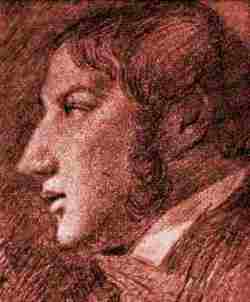
John Constable was an English painter most famous for his landscapes which were principally about subjects in the Suffolk countryside. He was a member of the Royal Academy of Arts in London. He was born in East Bergholt in Suffolk on 11th June 1776 and died on 31st March 1837 aged 60.
Major Works
“View on the Stour” (1819).
“The Hay Wain” (1820).
“Salisbury Cathedral” (1823).
Biography Timeline
1776: John Constable was born on 11th June at East Bergholt in Suffolk, England. He was the son of a wealthy mill owner and was educated at the Royal Academy Schools in London.
1794: He works for a year in his father’s mill but the wealthy landscape painter and art patron Sir George Beaumont encourages his family to send him to the Royal Academy Schools.
1802: He exhibits his first painting at the Royal Academy in London.
1816: He marries Maria Bicknell.
1819: He is elected an Associate of the Royal Academy.
1824: He has a success at the Paris Salon with “The Haywain” winning a Gold Medal.
1825: He wins a Gold Medal at Lille with “White Horse”.
1827: Death of his wife Maria.
1828: On the death of Constable’s father-in-law he inherits £20,000 and is able to devote himself entirely to landscape painting.
1829: Constable is elected a Full Member of the Royal Academy of Arts. His style particularly encompasses the changing light on a landscape and the movement of clouds across the sky. His later years are saddened by bereavement, ill health and depression but he continues painting, although many of his landscapes remain unsold.
John Constable died on 31st March 1837 in London of heart failure and was buried at St. John’s Churchyard in Church Row, Hampstead, London, England.
Influences
Constable himself was influenced by Dutch artists such as Jacob van Ruisdael and the Flemish Peter Paul Rubens. The seventeenth century French painter Claude Lorraine in particular was his model for landscapes in the use of tones but his use of realism was very much his own.
Constable’s popularity dipped in the middle of the nineteenth century in Britain as the critic John Ruskin took a very harsh view of his work and the popular Pre-Raphaelite Brotherhood took a less realistic view of nature painting. However, he remained popular in France where “The Hay Wain” was exhibited in 1824 at the Paris Salon. Eugène Delacroix in particular was so influenced by Constable’s use of broken colour that he repainted the background of his masterpiece “Scenes from the Massacres of Chios” after seeing it. On his visit to London in 1825 he visited Constable’s studio. His biggest influence on French artists such as the Barbizon School painters Theodore Rousseau and Jean-Baptiste Camille Corot was to work from everyday life especially outside in nature. Jean-Francois Millet owes a direct debt to him in paintings such as his 1857 work “The Gleaners” where farm labourers are seen harvesting in the fields.
Impressionists such as Claude Monet outrightly rejected the suggestions that they were influenced by Constable and J.M.W Turner even though they had seen both artists work. In the twentieth century Lucian Freud was a huge admirer of Constable, especially his portraits. Leon Kossof created a series of prints from the Old Master’s and was particularly taken by the work of Constable.
Further Information
Please see Britain Unlimited’s John Constable page for further information.
Examples of paintings by Constable.