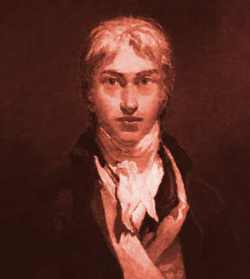
Joseph Mallord William Turner was an English Romantic painter, printmaker and watercolourist. Known as William Turner in his lifetime he is best known for his colour work and large expressive landscapes. He was born in Covent Garden, London on 23rd April, 1775 and died in Chelsea, London on 19th December 1851 aged 76.
Major Works
“The Fighting Temeraire tugged to her last berth to be broken up”. (1839).
“Snow Storm: Steam-Boat off a Harbour’s Mouth” (1842)
“Rain, Steam, and Speed – The Great Western Railway” (1844)
Biography Timeline
1775: Joseph Mallord William Turner was born on 23rd April at 21 Maiden Lane in Covent Garden, London, England. He was the son of a barber and wig-maker from the provinces. He studied at the Royal Academy Schools in London from the age of 14.
1793: He is awarded the Greater Silver Palette by the Society of Arts.
1799: He is elected as an Associate of the Royal Academy of Arts in London.
1800: He publishes some poetry which was originally intended to complement his exhibits at the Royal Academy. He often stays with his patron Lord Egremont at Petworth House and lodges in many London taverns around this period.
1802: He is elected a full Member of the Royal Academy. He visits the Louvre in Paris for the first time to see the paintings looted from abroad by Napoleon.
1804: He sets up his own gallery in his home at Harley Street, London.
1807: He is appointed as a Professor at the Royal Academy (of Perspective).
1811: He makes a trip to Italy and is impressed by the landscape.
1814: He helps set up the Artist’s General Benevolent Institution.
1823: He is commissioned to paint “The Battle of Trafalgar” by St. James’s Palace.
1831: He makes an extensive visit to Scotland.
1832: He travels to France and meets the famous artist Eugène Delacroix in Paris.
1834: He tours Germany.
1837: He resigns his teaching post at the Royal Academy in London.
1840: He meets the critic John Ruskin who admires his work greatly and who inspires him to visit Venice.
1844: He makes the acquaintance of Charles Dickens and again makes a visit to Switzerland and Germany.
1845: He is appointed the Acting President of the Royal Academy.
1846: He takes lodgings with his mistress Sophia Caroline Booth at 118-19 Cheyne Walk in Chelsea, London and lives out the rest of his days as a virtual recluse under the assumed name of Admiral Booth.
1850: He exhibits for the last time at the Royal Academy.
Joseph Mallord William Turner died on 19th December 1851, at Cheyne Walk, Chelsea, London, England of cholera and is buried in the crypt of St Paul’s Cathedral in London.
Influences
Turner claimed that it was a print by the Dutch marine Willem van de Velde the Younger (1633-1707) that made him want to become an artist, however the biggest influence on his landscapes was the Frenchman Claude Lorrain (1600-1682). In particular it was Claude’s use of light that fascinated him and something he tried to emulate in his own work and he eventually became known as “the painter of light”.
His earliest influences were John Robert Cozens, the English artist of romantic watercolour landscapes (1752-1797) and the Welshman Richard Wilson (1714-1782) who introduced him to a more imaginative interpretation of the views he saw before him. Most of his life coincided with the French Revolutionary and Napoleonic wars and many of his themes are inspired by actions he saw or read about.
One factor in why they were available to other artist to study is that many have been made available to public collections. On his death his will was disputed by one of his cousins, Thomas Price Turner who took some of his vast fortune but much of his work, mainly the oil paintings, were bequeathed to the British nation. Twenty-two years after his death Parliament allowed them to be lent to museums outside of London as they couldn’t find a suitable location to house them. It was not until 1910 that the major part of the Turner Bequest was brought together in the Duveen Turner Wing at the National Gallery of British Art. (nowadays known as Tate Britain). One of his greatest collectors was the London based Henry Vaughan (1809-1899) who owned more than one hundred watercolours and drawings and a large number of prints including proofs for the “Liber Studiorum” notebooks. He bequeathed the collection to British and Irish galleries on his death with the stipulation that they should be exhibited widely.
Turner’s influence as a painter can be seen in the work of the French Impressionists and in particular Claude Monet who studied his techniques. He has influenced many British artists from David Hockney to Tracy Emin and there is a view that American Abstract works such as by Mark Rothko were a direct result of his paintings. Artists around the works such as the Russian Ivan Aivazovsky and the Australian Nora Sumberg have all been indebted to him and he seems to have lost none of his appeal in the present day as his “Fighting Temerarie” painting was named Britain’s favourite painting in a BBC poll in 2005.
Further Information
For more information see Britain Unlimited’s page on Turner here.
Examples of paintings by Turner.