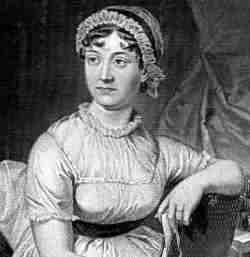
Jane Austen was an English novelist known for her works which offer a critique of the British landed gentry. She was born in Steventon, Hampshire, England on 16th December 1775 and died in Winchester, Hampshire on 18th July 1817 aged 41.
Major Works
“Sense and Sensibility”. (1811)
“Pride and Prejudice”. (1813)
“Mansfield Park”. (1814)
“Emma”. (1816)
“Northanger Abbey”. “Persuasion”. (1818)
Biography Timeline
1775: Jane Austen was born on16th December at the Rectory in Steventon, Hampshire, England. She was the second daughter of the Reverend George Austen and his wife Cassandra in a family of seven children. She was educated by her father at home except for boarding schools at Oxford, Southampton and the Abbey School in Reading.
1790: She begins writing stories at home to entertain her family, culminating in the burlesque novel “Love and Friendship”.
1795-7: She writes the first versions of “Northanger Abbey”, “Sense and Sensibility” and “Pride and Prejudice”.
1797: The original version of “Pride and Prejudice” called “First Impressions” is rejected by a publisher in London.
1801: Her father retires and the whole family move to Bath.
1803: The original version of “Northanger Abbey”, entitled “Susan” is taken on by a publisher but never released.
1804: She starts to write another novel called “The Watsons” but quickly decides not to finish it.
1805: Death of her father.
1808: Her mother and sisters move to Southampton then move into a house in Chawton, Hamphsire which was provided for them by Jane’s well-off brother Edward.
1811: She begins revising “Sense and Sensibility” and it is finally published.
1813: The finished version of “Pride and Prejudice” is published.
1814: She starts work on“Emma”.
1816: “Emma” is published and she dedicates it to George, The Prince Regent, (Later King George the Fourth) at his request. She also completes the novel “Persuasion”.
1817: She begins writing “Sanditon” but cannot finish it due to a major illness. She moves to Winchester to seek medical help and lives in a house near the water meadows, not far from the Cathedral but dies there on18th July. (Jane thought she had “bile” or rheumatism but later scholars have suggested either Addison’s Disease, an adrenal disorder, or Hodgkin’s Lymphoma, a type of cancer). She was buried in the North Aisle of the Nave of Winchester Cathedral, Hampshire, England.
Influences
Austen came from an upper middle-class family where the daughters read widely and in particular novels of the day. Her favourite author and major influence was Fanny Burney and indeed she took her title “Pride and Prejudice” from a quotation in Burney’s “Cecilia”.
Other writers she admired were Samuel Richardson, Maria Edgeworth, Samuel Johnson and Robert Burns. It has also been said by critics that her dramatic qualities owe a debt to her readings of William Shakespeare. Her other influence, of course, was her detailed observations of daily life of friends and family. She even wrote down in her diaries what they thought of her work.
Jane Austen is now one of the most famous writers in English literature and her work is read all around the world and countless film and television adaptations have been made. This was not always the case and as her books were published anonymously she derived little personal fame from them. Although fashionable in some quarters they were rarely reviewed in the literary magazines. Those that were, were usually short. Walter Scott in 1815 wrote a review (again anonymously) of “Emma” in an effort to defend what was then thought of as the disreputable genre of the novel, praising her realism. Richard Whately published a review of her work in 1821 but subsequently denied he had ever done so. In it he drew comparisons with Homer and Shakespeare. Many people during the Victorian period preferred the work of Charles Dickens and George Eliot. However, her novels were republished in Britain from the 1830’s and sold well. In the United States, she was being recommended in schools by 1838 but It was not until 1878 that her novels were appreciated by critics in France and her fame slowly spread across Europe. By the 1880’s the critic Leslie Stephen described the mania for her works as “Austenolatry” and around the beginning of the twentieth century so called “Janeites” developed to rescue her name as being more important than just the writer of frothy novels. After that some “Anti-Janeites” came on the scene to try and put things into perspective. Amongst the most notable were Mark Twain, D.H. Lawrence and Kingsley Amis. The first scholarly edition of her collected works was published by R.W. Chapman in 1923 which remains the standard text for all subsequent published editions.
In 1939 Mary Lascelles published “Jane Austen and Her Art” and it began a concerted academic study of her work and a gulf has since developed between the Janeites who can see no wrong and the many academic theories about her including those of feminist philosophy. In 1994 the literary critic Harold Bloom put Austen among the greatest Western writers of all time and by 2000 there were over 100 printed adaptations of her works. The first staged adaptation “The Bennets” appeared in 1901 and the first film adaptation in 1940 was “Pride and Prejudice” starring Laurence Oliver and Greer Garson. Her books have been translated into thirty-five different languages.
“Pride and Prejudice”, “Mansfield Park” and “Northanger Abbey” have had the most significant effect on attitudes towards the education of women. While none of her characters showed overt feminist traits Austen herself did in her life. She actively chose not to marry but become a writer about societies attitudes and challenged the notion that unmarried women could not support themselves. Her appeal is that the stories revolve around timeless elements such as family conflict, money worries or romantic relationships and her characters remain relatable to the average reader. It has been said that she wrote “Emma” to explore the isolation of high-class women and to argue the importance of knowing yourself before claiming to know or be critical of others. All individuals should be respected regardless of their wealth or status she felt.
Further Information
For more information see Britain Unlimited’s Jane Austen page here.
Complete works of Jane Austen including juvenilia.