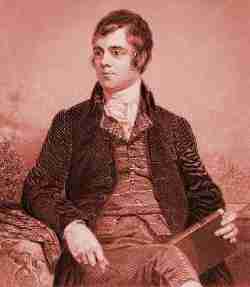
Robert Burns is remembered as the Scottish National poet and is famous worldwide. He was born in Alloway, Scotland on 25th January 1758 and died in Dumfries, Scotland on 21st July 1796 aged 37.
Major Works
“Green Grow the Rashes O”. (1784)
“Kilmarnock Edition of Poems, “Address to a Haggis.” (1786)
“Old Lang Syne” (1787)
“Tam O’ Shanter”. (1790)
“For a’ That and a’ That”. (1795)
Biography Timeline
1759: Robert Burns was born on 25th January in a cottage built by his father at Alloway in Ayrshire, Scotland. Robert was the eldest son of seven children to a poor tenant farmer William Burnes and Agnes nee Brown. He was educated at John Murdoch’s School in Alloway and. at Ayr Grammar School as well as being taught at home.
1765: His father rented the farm of Mount Oliphant in order to make a living and Robert works as a labourer in the fields even though the soil was very poor.
1777: He writes many of his poems “Chiefly in the Scottish Dialect” here.
1780: He and his friends David Sillar and John Rankine found the Tarbolton Bachelor’s Club, a debating society on 11th November and he is elected as chairman.
1781: He becomes a Freemason on 4th July with meetings being held at James Manson’s inn in Tarbolton. He finds employment as a Flax dresser in Irvine lodging at 4 Glasgow Vennel.
1784: After his father’s death Burns rents the farm of Mossgiel with his brother Gilbert.
1785: Birth of his illegitimate daughter Elizabeth to a farm servant Elizabeth Paton. Birth of illegitimate child to Jean Armour the daughter of a master mason who issued a writ against him. He threatens to escape legal action by emigrating to the West Indies possibly with Mary Campbell of Dunoon, a dairy maid, as he was barred from seeing Jean.
1786: Death of Mary Campbell. The first appearance of the “Kilmarnock Edition” is published by John Wilson which receives much praise. Jean Armour’s father reviewed his opinion of him now he has become famous. He borrows a pony to travel to Edinburgh on 27th November to arrange for a second printing and is introduced to the leading people in the city’s intellectual and social life by the Earl of Glencairn.
1787: The second impression of the Kilmarnock poems is published on 21st April selling 3,000 copies which made it a phenomenal bestseller for the day. “The Scots Musical Museum” is published in several parts. “Old Lang Syne” appears in Volume Five.
1788: He marries Jean Armour in Mauchline. Birth of an illegitimate child to Jenny Clow. Burns and his wife rent a room in Castle Street, Mauchline which is now called the Burn’s House. In June he takes on the lease of Ellisland Farm, north of Dumfries.
1789: He is appointed as Excise Officer for Dumfries, a post he held until his death.
1790: He writes “Tam O’ Shanter” at Ellisland Farm.
1791: Birth of an illegitimate child to Ann Park. Birth of son William Nichol to Jean. The farm is not a financial success and the family has to leave, moving to a house in Dumfries.
1794: Birth of his Son James Glencairn.
1795: Publication of the radical “For a’ That and a’ That”.
Robert “Rabbie” Burns died on 21st July 1796 in Dumfries, Scotland of rheumatic fever. (His son James Maxwell is born on the day of Burn’s funeral). He was buried in Dumfries, Scotland.
Influences
Burns is seen not only as the national Bard of Scotland but a great exponent of using the Scots language in poetry (the Vernacular Revival) however in this he would have been influenced by his reading of the works of Allan Ramsay (1686-1758) and the Edinburgh poet Robert Fergusson (1750-1774). As a boy he loved hearing stories of the supernatural from one of the women who helped out on his father’s farm, some of which appeared in later poems. He was a very well-read person in his youth, mainly from his father’s library and from items lent by his friend and patron Mr Graham of Fintry. This was not just in literature but also works from the Scottish Enlightenment on philosophy and politics and in particular Adam Smith. Smith’s “The Wealth of Nations” was a special favourite and there is evidence he also read “The Theory of Moral Sentiments” of 1759. The two writers never met even though they were often in the same town together.
Burns is seen as a proto-Romantic, i.e. a pioneer of the Romantic Movement due to his lyricism and his writing about the natural world of the day. He directly influenced William Wordsworth and Samuel Taylor Coleridge and later on Percy Bysshe Shelley was particularly taken with his work. His journey from humble rural beginnings to international renown for writing about nature, class culture and love is also a Romantic story in its own right. Although he is intrinsically linked with Scottish culture, he influenced many poets in the north of England at the time who also began writing in the Scots dialect. These ranged from farmers and industrial workers through to those with loftier literary ambitions.
In general, the Edinburgh literary establishment tended to sentimentalise Burns during his lifetime and especially immediately after his death, dismissing his education and calling him a “heaven-taught ploughman”. Since then his reputation has widened and many biographies and literary studies have added to this more rounded picture. Other Scottish writers, in particular Hugh MacDiarmid have tried to remove the sentimentality altogether.
His songs and poems inspired many famous artists and important figures around the world including President Abraham Lincoln, Sir Winston Churchill, Martin Luther King and the singer-songwriter Bob Dylan. Scottish Canadians have adopted him as a patron and “Robbie Burns Day” is celebrated every year in Newfoundland and elsewhere. He has had a major influence on the work of the Canadian Alexander McLachlanand. The title of John Steinbeck’s novel “Of Mice and Men” is taken from the penultimate stanza of “To a Mouse”. The American poets James Whitcomb Riley and Frank Lebby Stanton have also acknowledged their indebtedness. His poetry was translated into Russian during the Imperial era and he became a quasi “people’s poet” during Soviet times and was even endorsed as a progressive artist by the Communist regime. He is still popular there today.
Further Information
For more information see Britain Unlimited’s Robert Burns page here.
Complete A-Z of works by Burns.