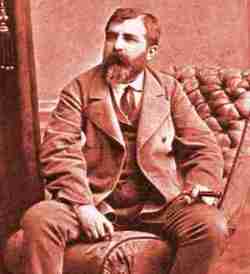
Georgije “Đura” Jakšić was a Serbian poet, painter and dramatist. He was born on 27th July 1832 in Srpska Crnja, Serbia and died on 16th November 1878 in Belgrade, Serbia aged 46.
Major Works
“Devojka u Plavom” (Girl in Blue) (1856)
“Seoba Srbalja” (The Migration of the Serbs) (1864)
“Jelisaveta Kneginja Crnogorska” (Elizabeth the Montenegrin Queen)
“Na Straži” (Night Watch)
“Stanoje Glavaš” (1878)
Biography Timeline
1832: Georgije “Đura” Jakšić was born on 27th July in Srpska Crnja (Austrian Empire now modern Serbia). His father was a Serbian Orthodox priest. He had his early education in Timisoara (modern Romania) and Szeged (modern Hungary). He lived for a while in Grossbetschkerek (modern Zrenjanin, Romania) where studied painting under Konstantin Danil. He went on to study fine art at the University of Vienna, Austria and then in Munich, Germany.
1848: He is not able to finish his art education due to the events of the 1848 Year of Revolutions. As a fervent liberal he joins in with the struggle and is wounded in the fighting at Srbobran in Serbia. After hostilities cease he moves to Belgrade to work as a schoolteacher and also works for a printer but he is often unemployed giving him time to write. Much of his poetry is influenced by the Hungarian revolutionary poet Sandor Petofi and Lord Byron’s poetry about the Greek War of Independence. Poems of the period include “Na Liparu” (On the Lipar Hill), “Put u Gornjak” (The Road to Gornjak) and “Mila”. The last is dedicated to the girl he falls in love with who works at the White Cross Inn owned by his father but is too timid to speak to.
1856: Having sketched Mila often he paints his famous “Pa Devojka u Plavom” (Girl in Blue).
1858: He completes his self-portrait.
1862: He paints “Uprising of Montenegrins”.
1864: Chiefly known nowadays as a poet and artist he also wrote several plays including “Seoba Srbalja” (The Migration of the Serbs).
1868: He writes the play “Jelisaveta Kneginja Crnogorska” (Elizabeth the Montenegrin Queen) and the novel “Warriors”.
1876: He begins painting “The Uprising at Takovo” which illustrates the Second Serbian Uprising and “Odmor Posle Boja (Karaula)“.
1878: He writes the play “Stanoje Glavaš” about the Serbian hero of the first Serbian uprising (1804-13) and also paints a portrait “Ubistvo Karađorđa” (The Assassination of Karadorde Petrovic), another hero in the uprising against the Ottoman Empire.
1878: He completes the painting “The Uprising at Takovo”. Other notable paintings are “Kosovo, Battle of Montenegris” and “Night Watch” and amongst his poetry “Otadžbina” (Fatherland), “Veče” (Evening), Stanoje Glavaš and “Ponoć” (Midnight) stand out.
Georgije “Đura” Jakšić died on 16th November 1878 in Belgrade, Serbia after taking part in the Second Serbian-Ottoman War. He was buried in the Novo Groblje cemetery in Belgrade. His work “Pripovetke” (Storytelling) was published posthumously in 1882–1883 and again in 1912.
Influences
Đura Jakšić was educated in Temeschwar (modern Romania) and Szeged (modern Hungary) and lived for a time in Großbetschkerek (modern Zrenjamin in Serbia) where he began studying painting under the Serbian artist Konstantin Danil. Danil’s influence can be seen in his early portraits. He also studied the old masters and was particularly influenced by Rembrandt, Diego Velázquez and Peter Paul Rubens.
He later became a devotee of Romanticism and a major figure of Serbian Romanticism. His studies in Vienna and Munich were curtailed by the 1848 Revolution and he never completed his course. During the revolution he was wounded whilst fighting in Srboban. According to the Hungarian poet and critic Jovan Skerlić the events of that time and the work of Sándor Petőfi were key influences on his poetry and revolutionary spirit and shaped his political views. His work focuses on nature, patriotism, and emotional intensity. He was also influenced by the poetry of Lord Byron, who had died whilst fighting for Greek independence, and much of his own output concerns the struggle for Serbian independence. Other literary influences were his fellow Serbians, the poet Jovan Jovanović Zmaj and the philologist Vuk Karadžić who created the modern Serbian phonetic alphabet. He also read widely in Serbian epic poetry and the Kosovo myth was often a motif in his work. His poems are about freedom and against tyranny and wanted to show the possibility of the true freedom of the spirit and free his countrymen from the shackles of convention and tradition.
After the revolution, he went to live in Belgrade, the major city of Serbia, where he found some work as a schoolteacher but was often unemployed for long periods. His life often descended into poverty and political persecution and his sense of disappointment and pessimism shows through in his writings. Besides portraits his paintings, nearly two hundred in number, covered historical events and religious themes and he hated the rationalism and materialism of his predecessors. His poetry is about freedom and a cry against tyranny. Although he wrote a number of romantic plays such as “Seoba Srbalja” (The Migration of the Serbs) of 1864, his reputation rests largely on his paintings and poetry. His most famous painting is “Devojka u Plavom” (Girl in Blue) of 1856.
During his lifetime he had many admirers. Painters such as Katarina Ivanović, Pavle Čorbanović, Jovan Popović, and Đorđe Krstić and poets and writers such as Laza Kostić, Simo Matavulj, Kosta Trifković, Vojislav Ilić and Jovan Jovanović Zmaj. Not all painters revered him however and his contemporary Novak Radonić described the biggest problem with his painting was the improper use of anatomy however his portrait of “The Lady in Blue” is seen as one of the highlights of the collection in the National Museum of Serbia in Belgrade.
Although he wrote a number of plays, his reputation today rests largely on his paintings and poetry, which covers everything from sonnets, lyrics, and patriotic songs to full scale epics. He also wrote about forty short stories as well as painting around two hundred paintings. Much of his later writings were more obscure and “Pripovetke” (Storytelling) was published posthumously both in 1883 and again in 1912 in Belgrade.
He died in despair in 1878 after a long illness and after having taken part in the uprising against the Turks in Bosnia and Herzegovina. His laster major work “Pripovetke” (Storytelling) was published posthumously in Belgrade in 1882. In it he expressed his bitterness about the harsh blows life and people had dealt him.
He has had a significant influence on later generations of Serbian writers and artists such as Laza Kostić, Jovan Jovanović Zmaj, the realist Simo Matavulj, the playwright Kosta Trifković, the poet Vojislav Ilić and the painter Đorđe Krstić. The political leader Svetozar Miletić was also an admirer.
Today he is seen as one of the most talented and accomplished Serbian painters of the nineteenth century and the most important Serbian Romantic painter and is known as one of the one hundred most prominent Serbs. Schools and colleges throughout Serbia and former Yugoslavia still bear his name and he still continues to influence contemporary Serbian art and literature. The best books of modern poetry in the Serbian language take part in a competition named in his honour.
Further Information
“Ponoć” by Jakšić.
“Pesme” by Jakšić.