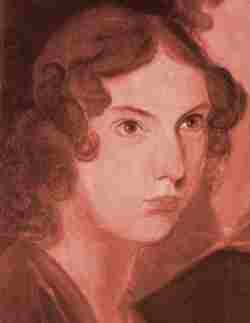
Anne Brontë was an English novelist and poet, and youngest of the Brontë daughters. She was born in Thornton, Yorkshire, England on 17th January 1820 and died at Howarth, Yorkshire on 28th May 1949 aged 29.
Major Works
“Agnes Grey” (1847)
“The Tenant of Wildfell Hall” (1848)
Biography Timeline
1820: Anne Brontë was born on 17th January at The Vicarage, 74 Market Street, Thornton, Yorkshire, England. She was the daughter of a cleric, Patrick Bronte and sister to Charlotte, Emily and Branwell and was educated mainly at home.
1820: She is baptised on 25th March in the “Old Bell Chapel at Thornton. The Bronte family move to the Parsonage at Haworth in April.
1821: In May Elizabeth Branwell, her aunt and sister to her mother Maria, arrives to care for her sister who is dying of cancer and look after the children. Her mother dies on September the 15th aged 38.
1836: She writes her earliest surviving poem about the Gondal world during her Christmas holidays called “Verses by Lady Geralda”.
1837: She is forced to leave the school because of her illness, during December.
1839: She moves into Blake Hall, Mirfield in April to become a governess to the Ingham family but leaves in December as she has great difficulty controlling the children.
1840: She has much contact with William Weightman the new curate and falls in love with him. In May Anne becomes a governess to the Robinson family at Thorp Green Hall, Little Ouseburn, near York.
1841: Charlotte, Emily and Anne discuss plans of opening their own school. Anne spends five weeks at Scarborough with the Robinsons.
1842: She asks to leave the employ of the Robinsons as she wants to stay at Haworth whilst Charlotte and Emily leave for Brussels, though the family beg her to return. Anne spends six weeks at Scarborough during July with the Robinsons.
1845: She resigns her post at Thorp Hall in June.
1846: “Poems by Currer, Ellis and Acton Bell” (The three sister’s pseudonyms) are published in May with the family paying the costs. Anne completes the novel “Agnes Grey”.
1847: “Agnes Grey” is accepted for publication by Thomas Cautley Newby in London and she begins writing “The Tenant of Wildfell Hall”.
1848: “The Tenant of Wildfell Hall” is published. Her brother Branwell dies on 24th September from consumption. Her sister Emily dies from consumption on 19th December. Anne has poems published in the Leeds Intelligencer and Fraser’s Magazine.
1849: She is examined at Haworth by Doctor Teale in January and is also found to have consumption. She goes with her friend Ellen Nussey and Charlotte to Scarborough on 25th May. Anne goes swimming the next day alone but collapses afterwards. In the afternoon she drives herself on South Sands in a donkey cart. On 27th May she walks along the Spa Bridge with Charlotte and Ellen but has to sit down exhausted and realises she has not long to live.
Anne Brontë died on 28th May 1849 at Woods Lodgings in Scarborough, Yorkshire, England and is buried nearby.
Influences
The Brontë sisters read Alexander Pope, James Thomson, James Macpherson, Edward Young, Oliver Goldsmith and, in particular, William Cowper. Cowper’s poem “The Castaway” was a special favourite.
Anne was a strong minded and thoughtful feminist and held strong views against manliness and womanliness being taught to children. Her novel “The Tenant of Wildfell Hall” concentrates on marital abuse and violence and was unpopular with Victorian readers. The critics went even further condemning it as “coarse and vulgar”. Even her sister Charlotte considered it a mistake and removed it from publication after the author’s death. Consequently, Anne has had less of an influence on subsequent literature than her sisters.
Despite her many critics Anne was strong willed and unapologetic and wrote in the preface to the novel “I am satisfied that if a book is a good one, it is so whatever the sex of the author may be […] I am at a loss to conceive […] why a woman should be censured for writing anything that would be proper and becoming for a man”. She was clearly not the quiet ladylike character that Charlotte tried to portray and modern feminists have begun to study her work more closely and see in them perhaps the most radical of all the Brontë sister’s works.
Further Information
More information can be found on Anne’s Britain Unlimited page here.
Anne Brontë’s works in order.