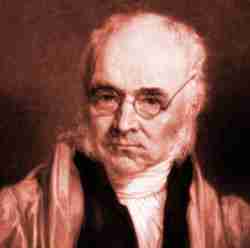
James Ward was an English painter, printmaker and engraver. He began painting landscapes around 1790 after concerning himself before with mezzotints. He then began to paint animals, particularly horses and animal scenes. He was born in London on 23rd October 1769 and died in Cheshunt, Hertfordshire, Britain on 16th November 1859 aged 75.
Major Works
“The Liboya Serpent Seizing its Prey” (1803)
“The Reverend Thomas Levett and his Favourite Dogs, Cock-Shooting” (1811)
“Gordale Scar” (1814-5)
“The Waterloo Allegory” (1815-21)
“Theophilus Levett Hunting at Wychnor, Staffordshire” (1817)
“Self Portrait” (1830)
Biography Timeline
1769: James Ward was born in Thames Street in the City of London. His father was a fruit merchant and his mother was Rachael Goldsmith. He was one of five children and was the younger brother of William Ward the engraver. He did not attend school.
1781: He is apprenticed to an engraver at the age of twelve and he successfully uses mezzotints in his later career.
1790: He begins painting his own compositions and is greatly influenced by his brother-in-law, George Morland.
1794: He marries his first wife Mary Ann Ward (no relation).
1781: He is apprenticed to an engraver at the age of twelve and he successfully uses mezzotints in his later career.
1797: He applies to the Royal Academy Schools but is turned down.
1800: He paints “The Reapers”.
1801: He enrols in an anatomy course by dissection in London.
1802: He publishes a mezzotint, after the artist John Hoppner, of Henry Thornton who is a leading member of the anti-slavery Clapham Sect. He also counts leading abolitionists among his friends and patrons.
1803: He sees “Chateau de Steen” by Peter Paul Rubens, which greatly influences his later style. He becomes known for his studies of the animal world in large scale paintings and is commissioned by many members of the merchant classes. He begins work painting as an allegorical statement on the trade of enslaved Africans.
1804: “The Liboya Serpent Seizing its Prey”, which depicts a serpent wrapped around a Black African man on a white horse, is rejected by the Royal Academy for its Annual (Summer) Exhibition.
1805: He paints “Landscape near Swansea, South Wales”.
1807: He completes “Ryelands Sheep, the King’s Ram, the King’s Ewe and Lord Somerville’s Wether” and “An Overshot Mill”.
1809: He paints “Rough-Coated Collie”.
1810: He begins to specialise in painting horses in landscapes and completes “Heath Ewe and Lambs” and “The Straw Yard”.
1811: He is elected to the Royal Academy as a full member. He now begins to work on landscape, religious and history paintings. He paints “The Reverend Thomas Levett and his Favourite Dogs, Cock-Shooting”.
1814: His work “Gordale Scar”, completed in 1814 or 1815 depicting the place in Yorkshire is considered his masterpiece and a fine example of English Romantic painting.
1815: He begins work on the massive “The Waterloo Allegory” for the British Institution which is completed in around 1821 (now lost). This proved not to be as popular as he hoped.
1817: He paints one of his best-known portraits “Theophilus Levett Hunting at Wychnor, Staffordshire”.
1823: “The Deer Stealer” is commissioned for 500 guineas by his patron Theophilus Levett.
1827: He marries his second wife, Charlotte Fritche on 27th October in Derby, Derbyshire.She was said to be a relative of his deceased first wife.
1830: He moves to Cheshunt in Hertfordshire with his wife but continues to work on religious themes although he still submits animal pictures to the Royal Academy Annual (Summer) Exhibition. He paints his “Self Portrait”.
1852: Due to ill health his work begins to decline in standard as do his earnings.
1855: He suffers a stroke which ends his career.
James Ward died in poverty in November 1859. He was buried at Kensal Green Cemetery, London.
Influences
James Ward was born to a poor family in London. His father was a cider and fruit merchant, who died young leaving his mother destitute. His older brother received a good education and became a leading engraver, but James himself was put to work filling and washing cider bottles rather than being sent to school. He started his apprenticeship as an engraver with John Raphael Smith in 1781 or 1782 alongside his brother William.
During his apprenticeship his talent for drawing became recognised and he was certainly producing plates in his own name from around 1784. This was the time he first met his brother-in-law George Morland, who was at the height of his success. Morland was the single greatest stylistic influence during his early career and guided his focus toward rustic genre scenes, farmyard life and domestic animal scenes. William and James remained good friends with George Morland for some time and this gave James the opportunity to learn to paint in oils although he had to teach himself as Morland refused to be his formal tutor at the end of his apprenticeship. By 1793 he sold some of his original paintings of rustic scenes and published engravings of them.
In about 1793, he had his first four paintings accepted by the Royal Academy of London for exhibition and his paintings and engravings earned him a reasonable income. Soon afterwards Morland fell out with him due to the former’s debts and heavy drinking.
After 1800 his primary influences were the work of Peter Paul Rubens and Sir Anthony van Dyck. He admired Ruben’s intense colours and dynamic movement having seen his “Autumn Landscape with a view of Het Steen” in 1803. He moved away from realism and adopted a dramatic style which can be seen in works such as “Bulls Fighting” of the same year. Later he tried to emulate Van Dyck’s elegant portraiture style when developing his grand Regency animal and gentry commissions.
Another influence was George Stubbs who at the time was the most famous animal painter in the country. Stubbs however painted animals with scientific precision but Ward added emotion to his subjects which aligned closer to the spirit of Romanticism. Nonetheless his experience in etching and printmaking gave him a meticulous grasp of light, shadow and form and he was a lifelong student of human and animal anatomy. His later career was driven more by the Romantic concept of the sublime and natural grandeur which can be clearly seen in his most famous work “Gordale Scar” of 1815.
Nowadays John Constable and JMW Turner are recognised as being the major figures in British painting in the first half of the 1800s but at the time critics would have added the popular, versatile and innovative Ward. He was certainly regarded as one of the great animal painters of his time but also well known for his history paintings, portraits and landscapes and was admitted into the Royal Academy in 1811.
One of his best-known paintings, “The Deer Stealer”, was commissioned in 1823 for the sum of 500 guineas by his patron Theophilus Levett who so admired it that he offered him an extra 100 guineas on top for the finished work. It was not all plain sailing however as his “Man Struggling with a Boa Constrictor” of 1803 was rejected by the Royal Academy despite it being a fine example of his figure painting.
In his turn he influenced major French Romantic painters such as Eugène Delacroix and Théodore Géricault through his dynamic animal forms and dramatic landscapes. Delacroix had admired his dramatic, sublime landscapes and energetic animal compositions when visiting London. Géricault was particularly struck by his emotional intensity. His granddaughter, Henrietta Ward went on to become a notable Victorian painter, and his great-grandson Leslie Ward worked for the magazine “Vanity Fair”as their famous caricaturist “Spy”. His monumental natural scenes, such as “Gordale Scar” were the forerunners of other later Romantic works seen across Europe.
Further Information
Examples of the paintings by Ward.