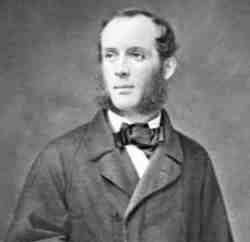
Frederic Edwin Church was an American landscape painter. He was a major figure in the Hudson River School of artists. He was born in Hartford, Connecticut in the United States of America on 4th May 1826 and died in New York on 7th April 1900 aged 73.
Major Works
75 Artworks including
“The Heart of the Andes” (1859)
“Niagara Falls from the American Side” (1867)
“The Parthenon” (1871)
“The Aegean Sea” (1877)
Biography Timeline
1826: Frederic Edwin Church was born on 4th May in Hartford, Connecticut, USA. He was a direct descendant of Richard Church, a Puritan pioneer from England. His father was Joseph Church a silversmith and jeweller and a director at several finance companies. His mother Eliza came from an iron foundry owning family. The Church family were comfortably off and Frederic was encouraged by his mother to become interested in art from an early age.
1844: Church becomes a pupil of Thomas Cole, a landscape artist in Catskill, New York after Thomas Cole, a neighbour (and founder of the Wadsworth Athenaeum in Hartford), introduced them. Cole himself was the founder of the Hudson River School of painters who worked on American landscapes. Church travels widely in New England sketching what he sees for the next two years.
1846: His first recorded sale is a painting depicting Thomas Hooker’s Journey to Connecticut in 1636, to the Wadsworth Athenaeum for $130.
1848: He is elected as the youngest Associate of the National Academy of Design and begins to teach his own students.
1849: Church is made a full member of the National Academy of Design.
1850: He settles in New York.
1851: The painting “New England Scenery” is his first composite landscape using sketches from different directions to build up a larger and more detailed view. He exhibits his work at the American Art Union, the Boston Art Club and the National Academy of Design.
1852: Alexander von Humboldt publishes “Personal Narrative of Travels to the Equinoctial Regions of America” and influences Church greatly.
1853: He makes the first of his two trips to South America and whilst in Ecuador he stays in the house where Humboldt had lived. The trip is paid for by his companion the businessman Cyrus West Field who wanted to use Church’s paintings to encourage investment in his business interests in the region. The two mainly stay in Quito and Church paints views of the Andes Mountains.
1855: He finishes “Andes of Ecuador”.
1857: He makes a second trip to Quito, this time with Louis Remy Mignot an artist. He paints “Niagara”.
1858: He paints “Cayambe”.
1859: “The Heart of the Andes” becomes Church’s most famous painting when it is exhibited in a single-work exhibition in New York City. Thousands pay to view it and it takes up the whole wall at the end of the room. Church eventually sold it for $10,000 the highest price at the time for a living American artist. He later travels with his friend the Reverend Louis Legrand Noble to Newfoundland and Labrador.
1860: He buys a farm near Hudson, New York and marries Isabel Mortimer Carnes who he had met during the exhibition of “The Heart of the Andes”.
1861: Noble publishes “After Icebergs with a Painter” and Church’s painting “The Icebergs” goes on display. During the American Civil War he paints “Our Banner in the Sky” and a lithograph is made of it to benefit families of Union soldiers.
1862: He paints “Cotopaxi”.
1863: He is elected an Associate Fellow of the American Academy of Arts and Sciences.
1865: His two-year-old son Herbert and five-month-old daughter Emma both die of diphtheria in an outbreak in March. The couple lives in Jamaica for six-months to recover and he paints many of the landscapes there.
1866: He and his wife start a new family with the birth of a son, Frederic Joseph the first of four children who would survive into adulthood.
1867: In the autumn he and his family travel to Europe. They pass through London and Paris and take a boat from Marseille, France to Alexandria in Egypt. He is not interested in the pyramids and moves on to Beirut where he stays for four months.
1868: In February Church travels to the city of Petra, Jordan from Jerusalem on a camel. There he sketches the Al Khazneh tomb which he will use in a later painting. Travelling back though southern Europe the family over winter in Rome where they meet other ex-patriot American artists.
1869: In April they visit the Parthenon in Athens, Greece and he is very impressed it. They finally leave Rome in May and arrive back in the USA in late June.
1870: His daughter Louis Palmer is born. Before departing for his trip, he purchased eighteen acres on a hilltop overlooking the Hudson River and the Catskill mountains. He now begins building a home there and is heavily involved in its design which has many Persian inspired features.
1871: His daughter Isabel Charlotte is born.
1872: The house is finally complete and the family move in during the summer.
1874: He paints “El Khasne, Petra”.
1876: He is now suffering from acute rheumatism in his hand and teaches himself to paint with his left hand although this slows him down immensely. He spends most of his winters now in Mexico because of the warmth and continues to teach students there.
1899: His wife Isabel who has been ill for several years dies on 12th May at the home of friend and patron, William H. Osborn on Park Avenue in New York City.
Frederic Edwin Church died on 7th April 1900 at his home Olana in New York City. He was buried next to his wife in Spring Grove Cemetery in Hartford, Connecticut. He was reported to be worth half a million dollars at his death.
Influences
Frederic Edwin Church was born into a mercantile family in Connecticut. His father and uncle had many business ventures including milling and insurance and his father was wealthy and well-connected. He arranged with Daniel Wadsworth, a Connecticut art collector for his son to study under the painter Thomas Cole. The English-born Cole was regarded as the founding figure of the Hudson River School and of American landscape painting. From 1844 to 48 Church became Cole’s favourite pupil.
After his initial training he settled in upstate New York in 1849 where he painted his surroundings but then began to travel more widely in North and South America. He was greatly influenced by the writings of the German naturalist Alexander von Humboldt and adopted a scientific approach to the landscape in many of his paintings. Besides Thomas Cole he worked with Albert Bierstadt in the Hudson River School and they went on sketching expeditions in the Hudson River Valley, the Catskills, the Adirondacks, and the White Mountains.
After 1850 they began documenting the wilderness in the American West, the Far North, and South America.He was a technically proficient draftsman and accurately rendered the flora and fauna of a region and became known for his use of atmospheric effects and use of light and belongs to a subgenre of American painting known as Luminism. He was also particularly interested in the exotic.
Besides the Americas he travelled widely in Europe and the Middle East, where he visited the Holy Land and Greco-Roman ruins including the ancient city of Petra in Jordan. He also loved remote locations such as north of the Arctic Circle. As a member of the second generation of Hudson River School painters his work is less allegorical and symbolic and concentrates on the landscape for its own sake. His early work such as “Morning, Looking East over the Hudson Valley to the Catskill Mountains” of 1849 shows the most influence of Thomas Cole but by “The Heart of the Andes” of 1859 his own large-scale style was very much in evidence as is his readings from von Humboldt’s “Kosmos” which has a vision of the interconnectedness of science, the natural world and spiritual matters.
The only work which shows his political leanings was “Our Banner in the Sky” of 1861 painted at the start of the American Civil War and which shows his support for the North. “Niagara Falls From the American Side” of 1867 shows his landscape painting in the high Sublime style which had originated in England with the work of J.M.W. Turner and others although the critic John Ruskin said of him “He can draw clouds as few men can, though he does not know yet what painting means, and I suppose he never will”.
Despite this he received high praise from other critics and sold his work for high prices. When “The Heart of the Andes” was transported to England for exhibition he insisted that it was insured for up to $10,000, a huge sum of money at the time. He was an astute business man and had much success on both sides of the Atlantic and gained an international following.
He also set about transforming a 126-acre plot with his new wife, planting trees, introducing a dairy herd and building a small house named Cosy Cottage where he could dream away from New York City and later in 1872 he designed their new home with oriental themes called Olana which still stands overlooking the Hudson River today.
Sadly after 1877 he had to abandon painting because of a crippling rheumatism in his hands and his work fell out of fashion with the general public and he was seen to be old fashioned. In his twilight years Mark Twain would visit Olana and read poetry to him and such was his early business acumen that he could afford to buy back some of his work at auction.
After his death he influenced a subsequent generation of American painters, including Edward Hopper, George Bellows Lockwood de Forest, Larry Lederman, Martin Johnson Heade, Erastus Dow Palmer, the Ashcan School and American Impressionists such as Winslow Homer.
His reputation revived with a 1945 exhibition devoted to the Hudson River School at the Art Institute of Chicago and in 1966 the art historian David C. Huntington wrote a large-scale book about him for the National Collection of Fine Arts exploring his influences. Huntington recognised his estate at Olana as his greatest artwork and began an effort to preserve the property. Today the Olana Partnership charity oversees the upkeep of the house and stages regular exhibitions of his work. American museums began to acquire his paintings and in 1979 “The Icebergs” sold for $2.5 million. In 1980 The National Gallery of Art held a major exhibition, “American Light: The Luminist Movement, 1825–1875”.
Further Information
List of paintings by Church.