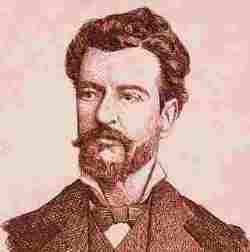
Bernardo Joaquim da Silva Guimarães was a Brazilian poet and novelist. He was born on 15th August 1825 in Ouro Preto, Brazil and died on 10th March 1884 in Ouro Prêto, Brazi aged 58.
Major Works
“O Seminarista” (The Seminarist) (1872)
“A Morte de Gonçalves Dias” (Gonçalves Dias’s Death) (1873)
“A Escrava Isaura” (The Slave Girl Isaura) (1875)
“Novas Poesias” (New Poems) (1876)
Biography Timeline
1825: Bernardo Joaquim da Silva Guimarães was born on 15th August 1825 in Ouro Preto, Minas Gerais state, Brazil. His father was the poet João Joaquim da Silva Guimarães and his mother was Constança Beatriz de Oliveira.
1847: He graduates from the Faculdade de Direito da Universidade de Sao Paulo where he has made friends with the poets Alvares de Azevedo and Aureliano Leesa and led a bohemian life. They found the “Sociedade Epicureia” (Epicurean Society) but their joint collection of poetry called “As Três Liras” (The Three Lyres) is unsuccessful.
1852: He becomes a judge in Catalao in the state of Goias. Which he holds until 1854. He writes “Cantos da Solidão” (Solitude Songs).
1858: He moves to Rio de Janeiro.
1859: He works as a literary critic for the newspaper “Atualidade”.
1861: He becomes a judge in Catalao once more.
1864: He returns again to Rio de Janeiro.
1866: He moves back to Ouor Preto to become a teacher specialising in poetry and rhetoric.
1867: He gets married.
1868: He writes “O Ermitão de Muquém” (The Hermit of Muquém).
1871: He writes “Lendas e Romances” (Legends and Romances).
1872: He publishes “O Seminarista” (The Seminarist), “O Garimpeiro” (The Prospector) and “Histórias da Província de Minas Gerais” (Stories from the Minas Gerais Province).
1873: He teaches Latin and French in Quelez (now Conselheiro Lafaiete) in Minas Gerais. He writes “O Índio Afonso” (Afonso the Indian) and “A Morte de Gonçalves Dias” (Gonçalves Dias’s Death).
1875: He publishes his anti-slavery novel “A Escrava Isaura” (The Slave Girl Isaura).
1876: He publishes his poetry collection “Novas Poesias” (New Poems). He introduces the verso bestialógico to Brazilian poetry (also called pantagruélico) which roughly translates as silly verse or nonsense poems. “O Elixir do Pajé” (The Witchdoctor’s Elixir) and “A Origem do Mênstruo” (The Origin of Menstruation) are examples.
1877: He writes “Maurício, ou; Os Paulistas em São João Del-Rei (Maurício, or; The Paulistas in São João Del-Rei).
1879: He writes “A Ilha Maldita” (The Damned Island) and “O Pão de Ouro” (The Golden Bread).
1881: He is honoured by King Pedro the Second of Brazil.
1883: He writes “Rosaura, a Enjeitada” (Rosaura the Neglected) and “Folhas de Outono” (Autumn Leaves).
Bernardo Joaquim da Silva Guimarães died a poor man on 10th March 1884 in Ouro Prêto, Brazil.
Influences
Bernardo Guimarães graduated from the São Paulo University Faculdade de Direito da USP (Law School) and worked as a magistrate. His legal background and knowledge of Brazil’s civil law system helped influence the plots of his novels such as “Rosaura, a Santinha”. He was heavily inspired by European Romanticism, which emphasised emotional expression, the idealisation of love and individuals in conflict with the constraints of society.
His early poetic work was deeply affected by the work of Lord Byron and “Byronism” with dark, melancholic, and sometimes macabre themes. During his time at law school, he co-founded the “Sociedade Epicureia” (Epicurean Society) with fellow poets like Álvares de Azevedo. The group was heavily influenced by French and English ultra-romanticism and indulged in themes of death, morbidity, and escapism.
His writing style, themes, and literary innovations were shaped by a distinct blend of European Romantic traditions, his legal training, regional folklore and national movements. In particular he was greatly influenced by the work of the French writer François-René de Chateaubriand with his concepts of the “noble savage” and idealised nature.
He wrote during a period of fierce political transition in Imperial Brazil and he is best known for his 1875 anti-slavery novel “A Escrava Isaura” (The Slave Girl Isaura). “Uncle Tom’s Cabin” by Harriet Beecher Stowe was a famous anti-slavery novel at the time and Guimarães adopted a similar melodramatic but socially critical approach in the book. He used a highly sympathetic protagonist to expose the cruelty of the Brazilian slave economy of the period. Most of the other writers at the time focused on high society figures or purely idealised indigenous heroes but he was intent at showing the real life of his home state of Minas Gerais. He incorporated authentic local folklore, superstitions, and oral storytelling traditions of the countryside (sertão) into works such as “O Ermitão do Muquém” (The Hermit of Muquém) and “A Garganta do Inferno”. (The Throat of Hell) named after a spectacular, narrow canyon waterfall located in the Chapada dos Guimarães National Park.
Above all he was searching for a uniquely Brazilian literary style after the independence of the nation and he used detailed regional landscapes to differentiate his work from European writing and he brought a greater realism into Brazilian work. He also introduced the verso bestialógico (silly or nonsense pantagruelic verse) into his poetry. These were metrically perfect but entirely nonsensical, satirical, and often highly explicit or erotic verses inspired by François Rabelais’ character Pantagruel. Some of his poetry was provocative such as “A Origem do Mênstruo” (The Origin of Menstruation) and he subverted and satirised the classical styles of Ovid’s aetiological poetry and Virgil’s “Aeneid”. Most of his work was written in Minas Gerais whilst he worked as a schoolteacher.
He heavily influenced the transition of Brazilian literature from Romanticism toward Realism and Naturalism and had a profound legacy on later regionalist writers, abolitionist thinkers, and subsequent generations of poets. He broke away from the highly idealised, nationalistic “Indianism” of his contemporary José de Alencar and focused on topics such as the rugged Brazilian frontier, gold mining communities, and authentic local customs. “A Esrava Isaura” acted as a powerful piece of anti-slavery propaganda and directly influenced the social rhetoric of contemporary abolitionist writers and campaigns in Brazil.
The Sertanejo/Regionalist Movement developed later nineteenth-century and the Regionalist novels of the 1930s depicting the harsh realities of the Brazilian interior were heavily influenced by his depictions of the Minas Gerais backlands. The literary critic Sílvio Romero stated that his raw and satirical poetry styles served as an early influence on Brazilian Naturalist writers.
His nephew Alphonsus de Guimaraens became one of Brazil’s most celebrated Symbolist poets, deeply inspired by the work of his uncle. His verso bestialógico, originally developed during his time at Law school, influenced student literature, satirical underground publications and later Brazilian modernists who sought to break down traditional, rigid poetic structures. The 1976 television adaptation of “A Escrava Isaura” was very popular and was globally syndicated, influencing broadcast storytelling worldwide.
Further Information
List of works by Guimarães.