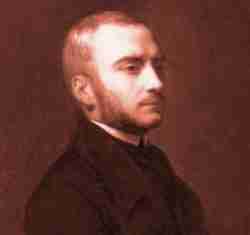
Zygmunt Krasinski: (1812-1859) was a Polish poet and one of that country’s three great bards. He was born in Paris, France on 19th February 1812 and died there on 23rd February 1859 aged 47.
Major Works
“Nie-Boska Komedia” (The Undivine Comedy) (1835)
“Irydion” (1836)
“Przedswit” (The Moment Before Dawn) (1843)
“Psalmy Przyszlosci” (Psalms of the Future) (1845)
Biography Timeline
1812: Napoleon Stanisław Adam Ludwik Zygmunt Krasiński was born on 19th February in Paris, France. His father was Count Wincenty Krasinski, a Brigadier-General in the first Polish Light Cavalry Regiment of the French Imperial Guard. His mother was the Polish-Lithuanian Princess Maria Urszula Radziwiłł. Emperor Napoleon Bonaparte attended his christening and he spends his early years in Chantilly.
1814: his parents move to Warsaw, then ruled by Frederick Augustus the First of Saxony and a client state of France. He was educated by private tutors employed by his father.
1822: On 12th April his mother dies of tuberculosis and he becomes extremely close to his father.
1826: In September he attends the Warsaw Lyceum School which Frederic Chopin had just left.
1827: He leaves school and moves on to the Royal University of Warsaw to study law and administration.
1829: On 9th March, at the urging of his father, he doesn’t attend the funeral of Marshall Piotr Bielinski who is seen as a national hero. On 14th he is publicly criticised by Leon Lubienski, another student, for this act and a bitter argument ensues for which Krasiński is expelled from the university. In May he travels with his father to Vienna and in October he leaves for Geneva to continue his studies, arriving there in November. In Geneva he has an active social life and befriends the English writer Henry Reeve who is there to study philosophy and literature and writes Romantic poetry.
1830: He falls in love with for Henrietta Willan, the daughter of a wealthy English merchant at the beginning of the year. On 11th August he meets the polish poet Adam Mickiewicz and the two become friends and travel together to the Alps. In November he leaves Geneva and travels to Milan, Florence and Rome in Italy. In Rome he hears of the Polish Uprising against the Russian Empire and decides to head back to Poland but his father warns him against it, as he is now a Russian General, and he returns to Geneva. At the time he is finishing his historical novel “Adaj-Han” which tells the story of Tsaritsa Marina Mniszech. The work is heavily influenced by Walter Scott and Lord Byron.
1832: In May he sets out for Poland and visits several cities in Italy including Venice where he seeks treatment for a disease of the eye. He then moves on to Vienna and arrives in Warsaw in August. He reunites with his father and the two travel to St Petersburg where they have an audience with the Russian Tsar Nicholas the First in October. His father has hopes his son will take up a diplomatic career with the Russians but he is not keen.
1833: He leaves Saint Petersburg and returns to Italy where he stays until April 1834. He begins writing his most famous work “Nie-Boska Komedia” (The Undivine Comedy) during the summer which discusses class struggles.
1834: He writes “Irydion” which also explores the class struggle and the fall of the nobility. In Rome he falls in love with the married woman Joanna Bobrowa.
1835: “The Undivine Comedy”, like most of his works, is published anonymously so as not to sully his father’s reputation with the Russian authorities and also allows him to travel freely in Europe. (which led to him being known as the Anonymous Poet of Poland). He leaves Florence in June and meets Bobrowa in Kissingen and then travels with her to Ischl and Trieste.
1836: He reaches Vienna with Bobrowa in January. “Irydion” is published which is the story of a Greek seeking vengeance in Ancient Rome. In May he meets and befriends the Polish Poet Juliusz Slowacki and he meets his father again during the summer in Grafenberg (now Chechia). In November he returns to Vienna where he stays until June 1837.
1838: His health is continuing to decline which prevents him from traveling until May when he again sets of for Poland to the family estate. In September he travels with his father to Italy and meets Juliusz Słowacki once more in Rome. He begins a romance with Countess Delfina Potocka (a friend of Frederic Chopin).
1839: He meets Potocka in Switzerland and they travel together with him writing poems and other works dedicated to her. He also meets his father in Dresden.
1840: His father arranges a marriage for him with Countess Eliza Branicka which takes place on 26th July in Dresden. The couple go on to have four children. He publishes “Trzy Myśli Pozostałe po sp. Henryku Ligenzie Zmarłym w Morreale 12 Kwietnia 1840”. (Three Thoughts Left After Henryk Ligenza, Deceased at Morreale on April 12, 1840). The “found manuscript” consists of a verse poem titled “Syn Cieniów” (Son of The Shadows) and two prose poems, “Sen Cezary” The Dream of Cezara) and “Legenda” (Legend).
1843: He writes his best-known poem, “Przedswit” (The Moment Before Dawn). It describes the partitions of Poland as a sacrifice for the sins of the entire world but predicts Poland’s resurrection and is extremely popular with his compatriots.
1845: He publishes “Psalmy Przyszlosci” (Psalms of the Future), “Psalm Wiary” (Psalm of Faith), “Psalm Nadziei” (Psalm of Hope) and “Psalm Miłości” (Psalm of Love).
1848: In January he meets the struggling Polish poet Cyprian Norwid in Rome and gives him money. He also meets Mickiewicz again and endorses Prince Adam Jerzy Czartoryski, the leader of the Polish Government in exile. He is critical, however, of the revolutions happening elsewhere in Europe known as the Spring of Nations.
1850: His health continues to worsen but doesn’t stop him travelling.
1851: He publishes the epic poem “Resurecturis” (Resurrection).
1856: He attends the funeral of Adam Mickiewicz in Paris, who has died in exile.
1857: An avid letter writer, he writes to many leaders in Europe including the Emperor Napoleon the Third of France (whom he has an audience with) to gain support of the Polish cause. His father dies on 24th November delivering him a severe blow.
Zygmunt Krasiński died on 23rd February 1859 in Paris, France. He was buried in the family crypt at Opinogóra, Poland. “O Stanowisku Polski z Bożych i Ludzkich Względów” (On the Status of Poland in the Divine and Human Regards) was published after his death.
Influences
Zygmunt Krasiński was one of Poland’s Three Bards of the Romantic period. His father, General Wincenty Krasiński was a commander in Napoleon Bonaparte’s army and later loyalist to the Tsar of Russia. His son therefore had a major conflict of duty to his father and also a fierce devotion to Polish independence.
He studied law at Warsaw University before moving to Geneva, Switzerland in 1829. He abandoned his studies in law when he was boycotted by his peers for refusing to participate in a public demonstration under pressure from his father. He lived most of his life abroad, in order to escape his father’s wishes to join the civil service, primarily in Italy and France and published his works anonymously. Most of his works deal with class conflict even though he was of independent means coming from a wealthy family.
He met Adam Mickiewicz in Geneva who had a major influence on his cultural output. He however engaged in serious studies of European literature and philosophy and developed his own views. Major influences were the work of such thinkers as Pierre-Simon Ballanche, Joseph de Maistre, Johann Gotfried Herder and Friedrich Wilhelm von Schelling. Amongst Polish authors it was August Cieszkowski who was nearest to his own views and he praised him to family and friends. His father continued to interfere in his personal life, ending his romantic affairs and ordering him to marry. He remained a staunch conservative, an enemy of revolution and hated armed struggle even in the name of national independence and saw history as a gradual process moving towards the building of the Kingdom of God on earth.
His first literary works were written whilst still in Warsaw and shortly after emigrating he wrote his two most outstanding dramatic works whilst still in his twenties. “Nie-Boska Komedia” (The Un-divine Comedy) of 1835 and “Irydion” in the following year. The former discusses a future struggle between the masses and the privileged classes whilst the second tells of a Greek seeking vengeance on Imperial Rome. “The Un-divine Comedy” is an important example of a Romantic, metaphysical drama. The hero disdains family life, neglecting his young son and wife, who he ultimately drives to insanity and death. He is punished when a tragedy occurs in the family and is brought back onto the righteous path of Evangelical love and service to humankind by the voice of the Guardian Angel. The whole play is flamboyant with multiple dimensions, historical and symbolic, and group scenes intertwine with realism, pathos and the burlesque. “Irydion” is equally rich and multi-dimensioned. The play describes biased historical prerogatives in a contrast against the truth and righteousness inherent in Providence. The main character witnesses a battle in the Roman Colosseum between the Angel and Satan for his soul which Satan wins. The voice of Providence then sends him to Poland so that through martyrdom and death he might achieve redemption.
Krasiński’s nation and class-based work elicited repeated protests from Juliusz Slowacki. The publication of the “Psalmy Przyszłości”(Psalms of the Future) in particular caused the two visionaries to enter into a poetic duel. In his “Odpowiedź na Psalmy Przyszłości” (Response to the Psalms of the Future), Slowacki condemned as unjustified the writer’s fear of the people and his glorification of the aristocracy.
Krasiński’s best-known poem, “Przedświt” (The Moment Before Dawn) of 1843 was an inspiration to his countrymen. It pictures Poland’s partition as a sacrifice for the sins of the entire world but predicts Poland’s resurrection and its emergence as a world leader because of its sacrifice. In his later works, the tragic, historical fatalism of the early dramas is replaced with a mature messianism and belief in Christian Providence.
Following the so-called “Galician Slaughter,” when peasants took up arms against the nobility, he published “Psalm Żalu” (The Psalm of Sorrow) and “Psalm Dobrej Woli” (The Psalm of Good Will).
Adam Mickiewicz devoted much attention to him work in his “Course in Slavic Literatures” although he did not agree with many of his views. He particularly revered “Legend” which depicts the end of the world, awaited by the nations in Saint Peter’s Basilica in Rome and Cyprian Norwid was also an admirer.
Although he was very popular in the mid nineteenth century and still remains an important figure in the history of Polish literature many critics suggest his work is not on a par with Mickiewicz and Słowacki and his poetry in particular has not aged well. Nevertheless, the play “Nie-Boska Komedia” (The Undivine Comedy) is still performed regularly in Poland and has been translated into several other languages. Incidental music for it has been written by such noteworthy composers as Ludomir Różycki, Grażyna Bacewicz and Krysztof Penderecki. He has heavily entered into Polish national consciousness as well as in theatre and drama and has influenced many subsequent generations of European and Polish writers through his philosophical and prophetic works. His ideas have been echoed in avant-garde stagecraft and productions of twentieth-century Polish theatre directors such as Tadeusz Kantor and Jerzy Grotowski. His dark prophecies of class conflict and social upheaval in “The Undivine Comedy” heavily influenced German expressionist playwrights and authors in the early twentieth century such as Ernst Barlach and Ernst Toller. His anti-imperialist and apocalyptic view of Russia as an existential threat to Western civilization has also influenced many people in their attitudes toward Eastern Europe. Not surprisingly his popularity waned under the communist People’s Republic of Poland who disapproved of his conservative religious themes.
Further Information
List of works by Krasiński.