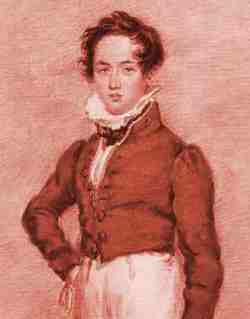
William Sterndale Bennett was an English composer, pianist, conductor and teacher. He was born on 13th April 1816 in Sheffield, England and died on 1st February 1875 in St John’s Wood, London, England aged 58.
Major Works
String Quartet (1831)
Symphony No. 1 (1832)
Symphony No. 4 (1833-1834)
“The Naiades” (1836)
Symphony No. 5 (1835-36)
Piano Concerto (1838)
“The May-Queen” (1858)
“The Woman of Samaria” (1867)
Biography Timeline
1816: William Sterndale Bennett was born on 13th April in Sheffield, Yorkshire, England. His father was Robert Bennett the organist of Sheffield parish church and a conductor, composer and piano teacher. His mother was Elizabeth, nee Don. He was named after the poet William Sterndale.
1818: His mother dies aged 27 and his father remarries.
1819: His father dies and the orphaned children are brought up by their paternal grandfather, John Bennett in Cambridge. John was a professional bass player and a member of the choir at several Cambridge colleges.
1824: He joins the choir at Kings College Chapel, Cambridge in February.
1826: He is accepted, aged ten, by the Royal Academy of Music. The authorities are so impressed with his talent that they waive all his fees. He first studies the violin, which his grandfather wishes him to master, under Paolo Spagnoletti, although after five years there he makes the piano his principal instrument.
1830: He sings in the college production of Mozart’s “Marriage of Figaro” in the role of the page boy Cherubino. The critics are not impressed with his performance.
1832: He completes his First Symphony.
1833: He plays his First Piano Concerto by Royal Command of King William the Fourth and Queen Adelaide at Windsor Castle during April. Felix Mendelssohn is at the first London performance in June and is so impressed he invites him to attend the Lower Rhenish Music Festival in Dusseldorf, Germany.
1834: He is appointed organist of St Ann’s Church in Wandsworth, London. He writes the “Parsina” overture named after a work by Lord Byron.
1835: In May he makes his first appearance at the Philharmonic Society of London in the premiere of his Second Piano Concerto. He supports himself by teaching students privately and in several London schools.
1836: In May he travels to Düsseldorf to attend the Lower Rhenish Music Festival for the first performance of Felix Mendelssohn’s oratorio “St Paul”. He begins work on his overture “The Naiads” when back in London where he finishes as a boarder at the Royal Academy of music. He then returns to Germany in October and plays concerts in Leipzig on several visits up until June 1837, including the premiere of his Third Piano Concerto at the Leipzig Gewandhaus conducted by Mendelssohn himself.
1837: He meets Robert Schumann whilst in Germany and they go on long country walks together and drink in the local taverns. In August Schumann dedicates his “Symphonic Studies” to Bennett who replies with his own “Fantasie”. Schumann also pens an article in the “Neue Zeitschrift fur Musik” magazine in praise of Bennett.
1838: He takes up at teaching post at the Royal Academy of Music. In October he is back in Germany where he plays his Fourth Piano Concerto and the “Wood Nymph’s” overture.
1842: He takes his next trip to Germany where he plays his “Caprice for Piano and Orchestra” in Leipzig and then visits other cities including Kassel, Dresden and Berlin. He returns to the Royal Academy of Music in London in March to continue his teaching duties. He is appointed one of the directors of the Philharmonic Society in London and conducts the London premiere of Mendelssohn’s Third “Scottish” Symphony.
1843: He begins a series concerts of chamber music as he had been impressed by their popularity in Germany.
1844: He marries Mary Anne Wood, the daughter of a naval commander and they go on to have two boys and a girl together in later years. Mendelssohn conducts the last six concerts of the Bach Society’s season which includes his own work as well as those by Bennett.
1847: He is devastated by the death of Felix Mendelssohn.
1848: He attends the opening of Queen’s College London as one of the founding directors and teaches there, as well as at the Royal Academy and also keeping on his private pupils. He writes the thirty “Preludes and Lessons” for students to study and these are published publicly in 1853.
1849: He is one of the founder members of the London Bach Society and its first President. After a dispute with the conducter Michael Costa about the type of music played, he resigns from the Philharmonic Society.
1851: He is appointed a Metropolitan Local Commissioner and superintendent for the music at the opening ceremony of the Great Exhibition in London.
1853: In June he makes his last public appearance as a soloist in his Fourth Piano Concerto with the Orchestral Union. He turns down an invitation to become the conductor of the Leipzig Gewandhaus Orchestra as he feels his duties lie in England with his students.
1854: On 6th April he conducts the first performance in England of the “St Matthew Passion” by Johann Sebastian Bach at the Hanover Square Rooms, for the Bach Society.
1856: On 14th April he conducts Ludwig van Beethoven’s Piano Concerto No.5 “Emperor” with Clara Schumann as the soloist in her first appearance in England. Bennett is made Professor of Music at Cambridge University but still continues teaching at the Royal Academy of Music and Queen’s College.
1858: He writes the pastoral cantata “The May Queen” for the grand opening of Leeds Town Hall.
1862: He writes“Ode” with words by Alfred Lord Tennyson for the opening of the 1862 International Exhibition held in London. At the end of the year his wife Mary dies.
1863: He writes a Symphony in G minor for both the Leipzig Gewandhaus and the Philharmonic Society of London.
1864: The Royal Academy of Music is saved from bankruptcy due to grants from the Chancellor of the Exchequer, William Gladstone, who grants a further sum in 1865.
1865: He visits Leipzig once again for a performance of his symphony.
1866: He becomes the Principal of the Royal Academy of Music after the retirement of Charles Lucas. He is the third choice.
1867: He writes the sacred cantata “The Woman of Samaria” for the Birmingham Triennial Music Festival (England). He receives an honorary degree from the university of Cambridge. The Philharmonic Society award him the Beethoven gold medal.
1868: On 8th June the new College of Organists award him an Honorary Fellowship.
1870: He receives an Honorary degree from the University of Oxford.
1871: He is Knighted by Queen Victoria.
1872: He is given a testimonial concert at St James’s Hall, London to a large audience.
1873: One of his last works was the programmatic piano sonata “Die Jungfrau von Orleans”.
Sir William Sterndale Bennett died on the 1st February 1875 of a “disease of the brain” at his home in St John’s Wood, London. He was buried in the north choir aisle of Westminster Abbey near the graves of Henry Purcell and Sir Charles Villiers Stanford.
Influences
The early major influences on Sir William Sterndale Bennett were Johann Sebastian Bach and Wolfgang Amadeus Mozart. In 1849 he founded the London Bach Society and in 1854 conducted the first performance in England of Bach’s “St. Matthew Passion”. He met Felix Mendelssohn in 1833 after the former had been impressed by his first piano concerto and they became friends. Mendelssohn invited him to Leipzig and introduced him to Robert Schumann in 1836 and both composers were supporters of his works and had a great influence on his later style. His first visit to Germany was sponsored by the piano manufacturers John Broadwood and Sons and he was particularly inspired by a journey up the Rhine. He would later make two other extended visits to Leipzig and Mendelssohn personally conducted his Third Piano Concerto at the Leipzig Gewandhaus. His friendship with Schumann was even greater and the two of them would go on long walks and visit the local taverns together. In August 1837 Schumann dedicated his “Symphonic Studies” to Bennett and wrote an essay in the “Neue Zeitshrift für Musik” praising his works.
He was lauded by many critics for his devotion to the composition of restrained music as opposed to the virtuosic style then prevalent of composers such as Frédéric Chopin and Franz Liszt. His compositions were wide ranging and included symphonies, concertos and overtures as well as chamber music and song cycles. Besides being a composer and conductor, he also took up teaching in the 1840’s and became the Principal of the Royal Academy of Music in 1866 after a spell as professor of music at Cambridge University.
During his lifetime his works enjoyed a great popularity both in England and in Germany although he was often belittled as an imitator of Mendelssohn. He wasn’t impressed at all with the music scene in England. He bemoaned to his German publisher the fact that in everyone was obsessed with the works of Johann Strauss the Younger and that he had not heard a single Symphony or Overture in recent concerts. He was offered the very high honour of Conducting the Leipzig Gewandhaus concerts for the 1853–4 season but turned it down, a decision which he regretted for the rest of his life and which led to him not being as established in Germany as he might have been. He refused to work in the theatre or write popular ballads to make money and his finances were always tight and came mainly from teaching. In the middle period of his life he failed to complete commissions for several works which included an opera and an oratorio leading to one critic stating “Why did Bennett give up being a composer at the age of twenty-eight?” In 1867 however, the oratorio “The Woman of Samaria” was premiered at the Birmingham Triennial Festival and kept its popularity well into the twentieth century.
At the time of his death he was regarded as the head of English music and Grove’s Dictionary described him as the most distinguished English composer of the early Romantic era. Although his reputation in Germany did not survive after the 1840s, many of his English pupils influenced British music later in the nineteenth and early twentieth centuries. These include Sir Arthur Sullivan, Joseph Parry, Hubert Parry, Eaton Fanning, Francis Edward Bache, Alice Mary Smith and William Cusins. A scholarship prize founded in 1872 in his name is still awarded today however, like so many other Victorian artists he was forgotten by the majority, as his dated texts lost their appeal to later audiences, only to be rediscovered a century later.
In a 1975 lecture the poet Sir John Betjeman described Bennett as “Queen Victoria’s senior musical knight” and in the United States the New York Tribune described him as “probably the greatest composer produced by England” with the exception of Henry Purcell”. Of his one hundred and thirty compositions roughly a third have been recorded on CD and in 1996 the Oxford University Press published a comprehensive catalogue of his works, edited by Rosemary Williamson.
Further Information
List of Compositions by Sterndale Bennett.