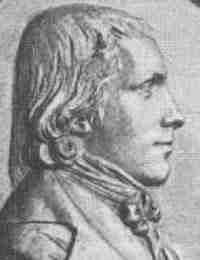
Wilhelm Heinrich Wackenroder was a German writer and jurist who, along with Ludwig Tieck and the Schlegel brothers, co-founded German Romanticism. He was born in Berlin, Germany on 13th July 1773 and died there on 13th February 1798 aged 24.
Major Works
“Herzensergießungen eines Kunstliebenden Klosterbruders” (Outpourings of an Art-Loving Monk) (1797)
Biography Timeline
1773: Wilhelm Heinrich Wackenroder was born on 13th July in Berlin, Germany. His father was a senior civil servant. He was a very shy student at school and only enjoyed listening to music. He met another pupilLudwig Tieck there and the two became lifelong friends.
1793: He enters the University of Erlangen and then moves on to the University of Gottingen.
1794: He returns to Berlin and is forced by his father to get a job with the Prussian civil service. He writes biographies or artists including Albrecht Durer, Leonardo da Vinci Michelangelo Buonarotti, and Raphael. He also writes a fictional biography of his own creation, the musician Joseph Berglinger, who acts as a mouthpiece for his views on art, which he believed should come from the heart not just the head.
1797: Tieck encourages him to get his work published and they appear in “Herzensergiessungen eines Kunstliebenden Klosterbruders” (Outpourings of an Art-Loving Monk). The work praises literary and artistic creations of the Northern Renaissance, a phrase Wackenroder coined to say that they were on a par with the Italian Renaissance and just as emotional. In Germany the “Outpourings” have been given the status similar to that of William Wordsworth and Samuel Taylor Coleridge’s “Lyrical Ballads” in that it marks the beginning of Romanticism in that country. It is thought likely that he contributed sections to Ludwig Tieck’s novel “Franz Sternbalds Wanderungen” (Franz Sternbald’s Wanderings).
Wilhelm Heinrich Wackenroder died of typhoid on 13th February 1798 in Berlin, Germany. He was buried in Kirchhof Jerusalem und Neue Kirche, Kreuzberg, Friedrichshain-Kreuzberg, Berlin. (In 1799 Tieck published the continuation of “Outpourings” entitled “Phantasien über die Kunst” (Fantasies on Art) and added some of his own essays).
Influences
Wilhelm Heinrich Wackenroder was influenced by ideas of the late Enlightenment, the Sturm und Drang (Storm and Stress) movement and his own deeply held religious beliefs. Along with his friend Ludwig Tieck he is seen as a co-founder of German Romanticism. As a boy he was shy and only happy when he was listening to music.
He was also influenced by the art of the Medieval period as well as its literature and also the work of Renaissance artists. He was responsible for increasing the world’s appreciation of the German artist Albrecht Dürer. He believed that high art was a religious experience and that art appreciation could bring about a transcendent truth.
Although he was forced into a job with the civil service by his father when he left university in 1794 his great love was literature. He began translating English novels and writing about the works of Leonardo da Vinci, Michelangelo and Raphael. He introduced the world to his own views on art by writing a fictitious biography of the imaginary musician Joseph Berglinger. His views on art were collected together in 1797 in “Herzensergiessungen eines Kunstliebenden Klosterbruders” (Outpourings of an Art-Loving Friar) published on the advice of Tieck and published anonymously so as not to upset Wackenroder’s disapproving father. Tieck also expanded on this work in 1799 with some of his own essays entitling it “Phantasien über die Kunst” (Fantasies on Art).
Both he and Tieck were impressed by the novelist, antiquarian and Goethe cultist Karl Philipp Moritz whose lectures on art history they both attended at the Berlin Academy of Fine Arts. Moritz taught that art may be felt but not easily comprehended. Painting and music had never been strongly emphasised by the Romantic Jena group such as the brothers August Wilhelm and Friedrich Schlegel and Novalis who believed that poetry was the major art.
Sadly Wackenroder died of typhoid at the age of 24 and much of his work was published posthumously. His aesthetics of instrumental music is outlined in his essay “Das Eigenthümliche Innere Wesen der Tonkunst, und die Seelenlehre der Heutigen Instrumentalmusik” (The Strange Inner Reality of the Musical Art, and the Doctrine of the Soul of Modern Instrumental Music) which was published a year after his death by Tieck in his work “Phantasien über die Kunst für Freunde der Kunst” (Fantasies on Art for Friends of Art). Even if all of his letters and travel notes are included the total of his output amounted to around 500 pages.
Wackenroder’s influence grew steadily and later August Wilhelm and Caroline Schlegel wrote a dialogue called “The Paintings” and recalled his advice to young artists to read Giorgio Vasari’s “The Lives of the Most Excellent Painters, Sculptors, and Architects“. Friedrich Schlegel began to describe paintings in his periodical “Europa” from 1803 onwards and talked about his idea of an all-inclusive work of art in his periodical “Athenäum”. He had a major influence on German thought which included the Romantic feeling for the gothic style and his ideas on the divine source or art.
Not everyone was a fan however and Heinrich Heine included Wackenroder along with the Schlegels, Johann Gottlieb Fichte, Friedrich Willhelm Schelling and Novalis for the rise of German nationalism and authoritarian government which he considered vulgar. He was also less than complimentary about the mystic aspects of his work.
Wackenroder’s work influenced the German “Nazarenes” school of painting in the early nineteenth century and later in England the Pre-Raphaelite Brotherhood as well as a good number of Romantic authors.
Further Information
List of works by Wackenroder.