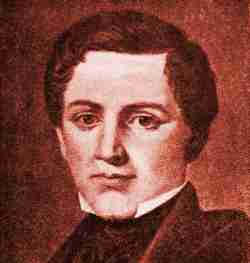
Wilhelm Hauff was a German poet and novelist. He was born in Stuttgart, Germany on 29th November 1802 and died there on 18th November 1827 aged 25.
Major Works
“Die Karawane” (The Caravan) (1825)
“Der Zwerg Nase” (Dwarf Nose) (1826)
“Der kleine Muck” (Little Muck” (1826)
“Lichtenstein: Romantische Saga aus der Wuerttembergerischen Geschichte” (Lichtenstein: Romantic Saga from the History of Württemberg) (1826)
“Mitteilungen aus den Memoiren des Satans” (Pronouncements from the Memoirs of Satan) (1826)
“Phantasien im Bremer Ratskeller” (The Wine-Ghosts of Bremen) (1827)
Biography Timeline
1802: Wilhelm Hauff was born on 29th November in Stuttgart, Württemberg, Germany. His father was August Friedrich Hauff an official in the Württemberg Ministry of Foreign Affairs. His mother was Hedwig Wilhelmine Elsaesser Hauff. He was the second of four children.
1809: His father dies and his mother and her children move in with her father in Tubingen. Wilhelm teaches himself largely through reading in his grandfather’s library.
1818: He is sent to the Klosterschule at Blaubeiren, near the city of Ulm.
1820: He enters the University of Tubingen where he studies philosophy and religious studies.
1824: He passes his university course and gets a position teaching the children of General Baron Ernst Eugen von Hugel, the Minister of War in Württemberg. He beings writing his “Marchen” (Fairy Tales) for the children which would later be published in 1826.
1825: He writes “Der Mann im Mond” (The Man in the Moon) as a parody of the sentimental novels of Heinrich Clauren then popular. Clauren sues him for damages and the following year he replies with the sarcastic comedy “Kontroverspredigt über H. Clauren und den Mann im Mond” (The Controversy of H Clauren and the Man in the Moon).
1826: He begins work on “Mitteilungen aus den Memoiren des Satans” (Pronouncements from the Memoirs of Satan) which is strongly influenced by the works of E.T.A. Hoffman. He travels to France and the Netherlands and writes the second part of “The Memoiren des Satan”. Several of his fairy tales are published in “Märchenalmanach auf das Jahr 1826”. (Fairytale Almanac of 1826). (published as “Tales of the Caravan, Inn, and Palace” in the United States of America). Influenced by the works of Walter Scott he embarks on a historical fantasy novel called “Lichtenstein: Romantische Saga aus der Wuerttembergerischen Geschichte” (Lichtenstein: Romantic Saga from the History of Württemberg) which proves very popular with the public and aristocracy alike. He also writes novellas including “Die Bettlerin vom Pont des Arts” (The True Lover’s Fortune; or, the Beggar of the Pont des Arts). He publishes “Märchenalmanach auf das Jahr 1826” (Fairytale Almanac for the Year 1826).
1827: In January he becomes the Editor of the “Stuttgart Morgenblatt” (Stuttgart Morning Paper) owned by J.F. Cotta. In February he marries his cousin, Luise Hauff. His popular novella “Phantasien im Bremer Ratskeller” (The Wine-Ghosts of Bremen) is published along with “Jud Suss” (Süss the Jew).
Wilhelm Hauff died prematurely of typhoid on 18th November 1827, in Stuttgart, Germany. He was buried in the Hoppenlau-Freidhof (Hoppenlau Cemetery in Stuttgart. His novellas were collected together and published in three volumes in 1828 as “Novellen”. His “Sämtliche Werke” (Collected Works) began to be published in 1830.
Influences
Wilhelm Hauff’s father died early on and his grandparents played a significant role in his early education giving him a love of storytelling. He was educated at the University of Tübingen where he became aware of theology and contemporary literary movements. After that he was appointed as a tutor to the children of Baron von Hügel which may have contributed to his love for fairy tales. He then devoted himself to full time writing where he was influenced by the works of E.T.A. Hoffmann and the historical novels of Sir Walter Scott. His 1826 book “Lichenstein” owes much to the Scottish writer and is a romance set in sixteenth century Württemberg. This work became very popular with the public and even led to the rebuilding of the actual castle itself by Duke Wilhelm of Urach so that people might visit it. He admired Hoffmann’s use of fantastical elements and his fusion of philosophy, the macabre and poetry and this is particularly evident in works such as “Mitteilungen aus den Memoiren des Satans” (Selections from the Memoirs of Satan).
He was an inventive and original writer combining themes from other sources of European literature with his own ideas. Although a major German Romantic figure his sophisticated style was purely his own. Major sources for inspiration were the Arabian Nights (“One Thousand and One Nights”) which had recently had new German translations and tapped into the fashion for things eastern. His fairy tale collections, such as “Die Karawane” (The Caravan) and “Der Scheik von Alessandria und Seine Sklaven” (The Sheik of Alexandria and his Slaves) feature Middle Eastern settings.
Other writers who influenced him where Ludwig Tieck, which is particularly apparent in his short work “Die Bettlerin vom Pont des Arts” (The Beggar Woman from the Pont des Arts) and Voltaire. His story, “Abner, the Jew, who Saw Nothing” was taken almost verbatim from Voltaire’s “Zadig” although he did change names and locations.
Other German writers were known as collectors of folk and fairy tales but he is different in that he is a major writer who composed his own. He married early in 1827 and was in the middle of a successful literary career when typhoid cut short his life tragically early just shy of his twenty-fifth birthday and eight days before the birth of his first child. His lasting fame rests solely on his fairytales and his “Märchen” (Fairy Tales) is as popular with children in the present day as it was when it was published. There were many English editions published and during the reign of Queen Victoria his tales were better known than Hoffmann’s “Nutcracker” or Brentano’s fairytales. Sadly literary historians have tended to pass over this success and concentrated on his adult writings instead.
His legacy endures, influencing both children’s literature and historical fiction and gave rise to the German Ritterroman genre. (chivalric romance). His vivid storytelling and romantic idealism with a social commentary have inspired many subsequent German authors. His novella “Jud Süß” (Süss the Jew) established the image of Joseph Süß Oppenheimer as a historical figure in the public imagination which later influenced Lion Feuchtwanger’s novel and also a notorious Nazi propaganda film in 1940. Many songs have used his poetry such as the Volkslieder “Morgenrot”. There is a Wilhelm-Hauff-Museum in Baiersbronn in the Black Forest region of Baden-Württemberg in southern Germany.
Further Information
List of books by Hauff.