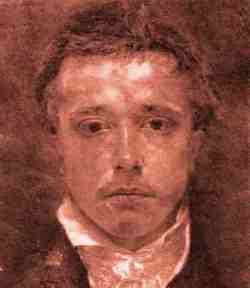
Samuel Palmer was an English landscape painter, etcher and printmaker. He produced pastoral paintings and is seen as a key figure in Romanticism. He was born on 17th January 1805 in London and died in Surrey, England on 24th May 1881 aged 76.
Major Works
“Repose of the Holy Family” (1824)
“Coming for Evening Church” (1830)
“Tintagel Castle” (1848)
Biography Timeline
1805: Samuel Palmer was born on 27th January in Newington, London, England. His father was a bookseller and Baptist Minister. He was educated at the Merchant Taylor’s School in the City of London but had no formal training in art.
1817: He begins painting churches at the suggestion of his father.
1819: At the age of fourteen he has his first landscape paintings exhibited at the Royal Academy of Arts in London.
1821: He becomes interested in High Anglican church services and medieval art which is reflected in his paintings.
1824: In October the painter John Linnel takes Palmer to see William Blake who encourages him to try a more spiritual and mystical direction in his work. He begins painting “Repose of the Holy Family”. He writes the poem “With pipe and rural chaunt along“
1825: He produces a series of sepia drawings.
1826: He visits Shoreham in Kent for the first time. He publishes the prayer “On going to Shoreham, Kent to design from Ruth“.
1827: He moves permanently to live in Shoreham at a run-down cottage which he nicknames “Rat Abbey” and his work becomes more naturalistic but still contains his visionary style. He joins The Ancients, a group of painters in Shoreham including George Richmond and Edward Calvert. He enters his most productive period. He falls in love with the fourteen-year-old Hannah Linnel.
1828: He moves out of “Rat Abbey” and joins his father at the nearby Water House.
1832: He marries Hannah Linnel. He publishes the pamphlet “An address to the Electors of West Kent“.
1834: He returns to London to live in Marylebone after receiving a small legacy and embarks on expeditions to Wales and Italy. His work is now less mystical and more conventional and he sees a chance in London to sell more work and take on pupils as advised by his father in law, John Linnel.
1837: He begins to paint more watercolours which are becoming more fashionable in England. Hannah and he tour Italy for the next two years where he gains ideas for new work.
1854: He becomes a full member of the Water Colour Society and shows regularly at their yearly Exhibitions.
1861: His eldest son, Thomas More Palmer, dies at the age of nineteen which affects him terribly. He publishes “Lives Balance Sheet” an epitaph on death of his son.
1862: Short of money he leaves London where his brother William has pawned his early paintings and he is forced to pay to reclaim them. He moves to Furze Hill House in Redhill in Surrey.
1864: He paints “A Dream in the Apennine” and illustrates poems by John Milton and Virgil.
1879: He creates the etching of “The Lonely Tower”.
Samuel Palmer died on 24th May 1881 at home in Redhill, Surrey and was buried with his wife in St Mary’s, Reigate churchyard. (In 1909, many of his Shoreham works were destroyed by his son Alfred Herbert Palmer, who burnt “a great quantity of father’s handiwork … knowing that no one would be able to make head or tail of what I burnt; I wished to save it from a more humiliating fate”).
Influences
Samuel Palmer showed artistic talent as a young child and exhibited his work at the Royal Academy of Arts in London aged only fourteen. He is known for his visionary, spiritual landscape paintings and etchings of the English countryside and was deeply influenced by William Blake. John Linnell who would eventually become his father-in-law taught him to paint and was the one who originally introduced him to the work of Blake.
In 1824 he met William Blake in person aged nineteen and the artist/poet guided him to see nature in a deeply spiritual and visionary way. He used a wide mix of media including tempera, oil, watercolour and ink building up rich textures through stippling, cross-hatching, and scratchings-out of the paper to recreate effects of light. He also used gum Arabic to further increase the textural surface.
In 1826 he moved to the quiet village of Shoreham in Kent and became a member of “The Ancients”, a small group of young Romantic artists which included George Richmond and Edward Calvert who were also devoted to Blake and preferred an ancient lifestyle to modern life. This was the beginning of his so called his famous “Visionary Years”, with works depicting the English countryside with glowing harvest moons, star lit skies and dense orchards which lasted until 1830.
He was also influenced by the literary works of John Milton and John Bunyan as well as being an avid reader of the Bible.
After leaving Shoreham in 1834 for London his style changed and became more realistic and traditional and he developed his skills as a printmaker. He travelled to Italy and Wales and made detailed etchings and watercolours of the views he saw there. For his prints he worked slowly on copper plates with successive rounds of acid biting, stopping out, and acid biting again, sometimes up to fourteen times in a row. He also used a fine brush to manually paint varnish to create glowing clouds, etc directly onto the plate.
In London he taught art, to make a living but struggled to sell his own work but he was commissioned to illustrate “Pictures from Italy” for the novelist Charles Dickens.
In 1861 his family moved to Surrey as their oldest son was ill and it was thought that the country air would help him recover. Sadly he died aged nineteen and Palmer never really recovered from his grief. He worked on illustrations for two other books, his own translation of the “Eclogues of Virgil” and a volume of poems by John Milton. Neither were published in his lifetime, but he was described by P.G Hamerton in 1868 as being one of the few “really great English etchers”.
After his death, Palmer remained relatively obscure. A retrospective exhibition was held at the end of 1881. F.G Stephens was a non-artistic member of the Pre-Raphaelite Brotherhood and the Keeper of Prints and Drawings at the British Museum. Between 1860 and 1901 he was the chief art critic of the “Athenaeum”magazine and friends with Palmer. He co-wrote the catalogue for the exhibition along with Palmer’s son. In 1909, many of his Shoreham works were destroyed by his surviving son Alfred Herbert Palmer, who burnt “a great quantity of father’s handiwork”. He then took the rest of his works to Canada where he later emigrated.
In the 1920s etching became fashionable and profitable once more and led to a renewed interest in his work after a group of students at Goldsmiths College of Art rediscovered him and this led to a major exhibition being held in London in 1926. Art students who fell under the influence of Palmer included Graham Sutherland, Paul Drury, Robin Tanner, Joseph Webb, Eric Ravilious, John Minton and John Craxton who became known as the Neo-Romantics. In 1988 a “Catalogue Raisonné of the Works of Samuel Palmer” was produced which lists over 700 of his surviving paintings and etchings.
In the twentieth first century he is mainly celebrated for the works of his Shoreham period and is known as a master of Romantic art. In the 1930s, the maximum price reached for a Shoreham period drawing was around £50. In a 2003 auction at Christie’s one was sold for £587,650. During the 1970’s a number of fakes of his Shoreham work appeared, produced by the famous art forger Tom Keating. This brought the real artist more to public attention although trustees at the Cecil Higgins Museum in Bedford complained that there seemed to be more interest in their fake work than there had been when it was thought to actually be by Palmer.
On the bicentenary of the artist’s birth in 2005, a major retrospective displayed a hundred and seventy of his watercolours, drawings, etchings and oils from public and private collections organised by the British Museum and the Metropolitan Museum of Art in New York.
Further Information
Examples of the paintings of Palmer.