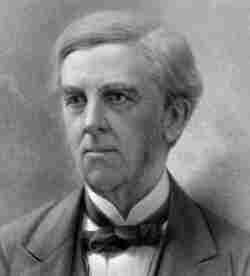
Oliver Wendell Holmes (Senior) was an American physician and romantic poet. He was born on 29th August 1809 in Cambridge, Massachusetts, USA and died on 7th October 1894 in Boston, Massachusetts, USA aged 85.
Major Works
“Old Ironsides” (1830)
“The Chambered Nautilus” (1858)
“Elsie Venner” (1858)
“The Flower of Liberty” (1861)
“The Poet of the Breakfast-Table” (1872)
Biography Timeline
1809: Oliver Wendell Holmes was born on 29th August in Cambridge, Massachusetts, USA. His father was Abiel Holmes, a minister of the First Congregational Church. His mother was Sarah Wendell (Abiel’s second wife) who was the daughter of a wealthy family. He went to school in Cambridgeport “port school” which was a private academy. He began writing comic verse whist still at school.
1817: He takes his five-year-old brother John to witness the last hanging at Cambridge’s Gallows and is punished by his parents.
1822: His first recorded poem, copied down by his father, is written aged thirteen.
1824: He moves to Phillips Academy in Andover, Massachusetts as his father approves of its Calvinist teachings and he hopes he will follow him into the ministry.
1825: He is accepted by Harvard College to study law and lives at home rather than in college. He becomes a member of the “Aristocrats” or “Puffmaniacs”, a discussion and smoking group of students. He is elected to the Hasty Pudding theatrical society where he is Poet and Secretary, and to the Phi Beta Kappa society, the most prestigious in the USA.
1830: He begins writing poetry in earnest and completes about fifty over the year including “The Dorchester Giant”, and “Reflections of a Proud Pedestrian”. Some are published in “The Collegian”, a magazine started by students. He also collaborates with friends on “Poetical Illustrations of the Athenaeum Gallery of Painting”, a collection of satirical poems about the new art gallery in Boston. In September he reads an article in the “Boston Daily Advertiser” about the frigate USS Constitution from 1812 which is about to be dismantled by the navy. This causes him to write “Old Ironsides” which is published in the paper and wins him national acclaim and sympathy for his cause to save the ship. He later writes “The Last Leaf”, a poem about Thomas Melvill, who was one of the native Americans involved in the Boston Tea Party. By now he has become bored with the law and switches to study medicine at Cambridge Medical College.
1831: In November a collection of his essays begin to be published in the “New England Magazine” under the title “The Autocrat of the Breakfast-Table”.
1833: He travels to Paris to further his medical studies where medical practice is ahead of its time. He is one of the first Americans to be trained in the new clinical method at the Ecole de Medecine.
1836: He receives his Doctor of Medicine degree from Harvard after writing his dissertation on acute pericarditis. He publishes his first book of poetry but writes that it is a “one off” as he is now a committed doctor wanting to bring in new ideas to the practice. He joins the Massachusetts Medical Society, the Boston Medical Society, and the Boston Society for Medical Improvement.
1837: He is appointed to the Boston Dispensary, where he is shocked by the poor hygiene standards. He wins the Boylston Prize, for his paper on the benefits of using a stethoscope which was a new device to many doctors at the time. Along with three colleagues he establishes the Tremont Medical School in Boston as he wishes to concentrate on teaching. He gives lectures on pathology alongside his private medical practice.
1838: He lectures for the faculty of Dartmouth Medical School as Professor of anatomy and physiology. He is elected a Fellow of the American Academy of Arts and Sciences.
1840: On 15th June he marries Amelia Lee Jackson at King’s Chapel in Boston. She is the daughter of a former Associate Justice of the Massachusetts Supreme Judicial Court, and the niece of James Jackson, a physician with whom Holmes had studied. Judge Jackson gives the couple a house at 8 Montgomery Place, Boston.
1842: He publishes the essay “Homeopathy and its Kindred Delusions”. He becomes interested in puerperal fever after attending a lecture by Walter Channing.
1843: He publishes the paper “The Contagiousness of Puerperal Fever” in the “New England Quarterly Journal of Medicine and Surgery”. Several distinguished professors dismiss his findings.
1846: He is the first to use the word anaesthesia.
1847: He becomes Parkman Professor of Anatomy and Physiology at Harvard. He is criticised by the all-male student body for wanting to admit a female student and she is asked to withdraw her application.
1848: His wife Amelia Holmes inherits $2,000 and they use the money to build a summer house in Pittsfield, Massachusetts.
1849: Having recently given up his private medical practice, Holmes is able to socialise with other literary figures during the summer and he spends time with Herman Melville and Nathaniel Hawthorne.
1851: He lectures extensively from 1851 to 1856 on a variety of subjects from medicine to English Poets of the Nineteenth Century.
1855: He revises his essay under the new title “Puerperal Fever as a Private Pestilence”.
1856: They sell the house at Pittsfield due to the high cost of maintaining it.
1857: His friend James Russell Lowell creates “The Atlantic Monthly” magazine and he assists by providing material for it along with other writers such as Henry Wadsworth Longfellow. For the first issue, Holmes writes a new version of two of his earlier essays, entitled “The Autocrat at the Breakfast-Table”. (Later published as a book in 1858).
1858: He publishes the poems “The Chambered Nautilus” and “The Deacon’s Masterpiece, or The Wonderful One-Hoss Shay” which has been seen as an attack on Calvinism.
1859: He releases “The Professor at the Breakfast-Table” in instalments. His first novel “Elsie Venner” is published in “The Atlantic” in December. He visits Washington Irving in New York, who is seriously ill, and gives him medication. The Massachusetts Historical Society posthumously award Irving an honorary membership at a tribute meeting held on 15th December and Holmes presents an account of their meeting.
1860: He invents the American Stereoscope, an entertainment device in which pictures are viewed in 3-D. It became very popular but he gave the rights away.
1861: “Elsie Venner” is published as a book. It concerns a neurotic young woman whose mother was bitten by a rattlesnake while pregnant, making her daughter’s personality half-woman, half-snake. At the start of the American Civil War Holmes begins writing pieces such as the patriotic song “A Voice of the Loyal North” in support of the Union cause. Although previously he had criticised the abolitionists, he thought the Union should remain intact. In September he publishes the article “Bread and Newspapers” in “The Atlantic” identifying himself as an ardent Unionist.
1864: Henry Wadsworth Longfellow invites friends to weekly meetings held on Wednesdays. Holmes is part of the group, which becomes known as the “Dante Club” as that is the project Longfellow is working on at the time.
1867: His second novel, “The Guardian Angel” appears in instalments in “The Atlantic” and as a book in November, although sales are half of those for “Elsie Venner.”
1872: He publishes “The Poet of the Breakfast-Table”.
1876: He publishes a biography of John Lothrop Motley.
1877: He publishes a collection of his medical essays and “Pages from an Old Volume of Life”.
1880: He is elected as a member of the American Philosophical Society.
1882: He retires from Harvard Medical School after thirty-five years as a professor.
1884: He publishes a biography of his friend Ralph Waldo Emerson. Later on, in the year he visits Britain with his daughter Amelia. There he meets the writers Henry James and Alfred Lord Tennyson. He is awarded an honorary Doctor of Letters by the University of Cambridge and an honorary Doctor of Law by the University of Edinburgh and a third honorary degree from the university of Oxford. They move on to Paris where they meet Louis Pasteur. He writes about the tour when he returns home in “Our One Hundred Days in Europe”.
1885: In January his third and last novel, “A Mortal Antipathy”, is published in “The Atlantic”.
1886: In June he receives an honorary degree from Yale University Law School.
1888: His wife Amelia dies on 6th February.
1889: His daughter Amelia dies after a brief illness.
1891: He publishes “Over the Teacups”.
1893: His last public appearance is at a reception for the National Education Association in Boston on 23rd February where he reads his poem “To the Teachers of America”.
Oliver Wendell Holmes died after falling asleep on 7th October 7 1894. His funeral was held at King’s Chapel, Boston and he was buried next to his wife in Mount Auburn Cemetery in Cambridge, Massachusetts, USA.
Influences
Oliver Wendell Holmes Senior was a writer, doctor and educator who graduated from Harvard Medical School in 1836 and later became a Professor there. He was known for his witty and entertaining lectures. He became part of the New England based Fireside Poets which included Henry Wadsworth Longfellow, and James Russell Lowell and were the first Americans to become popular in Europe. He was influenced by the works of Jeremey Bentham during his law studies and became so disillusioned with it that he started writing poetry to take his mind off it. Many were published in “The Collegian”, a periodical published by his friends.
In 1856, he began editing the “Atlantic Monthly” edited by his friend Lowell. Articles were contributed by Ralph Waldo Emerson who also became a friend as well as Longfellow and John Lothrop Motley. He produced a new version of “The Autocrat at the Breakfast-Table” for the magazine based on fictional table talk which helped make it a national success. He became best known from then on as a humourist and poet. In 1858 his essays were collected into book form and sold ten thousand copies in just three days. Despite all this he described writing as being a drug and that he was foremost a doctor.
However, during the American Civil War in 1861 he began publishing items in support of the Union including the patriotic song “A Voice of the Loyal North”. Although he had criticised the Abolitionists, he was strongly in favour of keeping the Union at all costs. During his lifetime he was immensely popular and was often asked to produce commemorative for special occasions although he was often called ‘homely’ or ‘provincial’ by critics such as George Warren Arms and ‘attractive’ with a prose style that “made no great demand on the attention of the reader” by William Lawrence Schroeder. He also composed words for several hymns as well as authoring many medical books, however his novels were not particularly popular during his lifetime. The theologian Henry James Senior described him as “intellectually the most alive man I ever knew”. His medical work on puerperal fever and the washing of hands before surgery was called “the most important contribution made in America to the advancement of medicine” at that time.
Sadly during the twentieth century the Fireside poets, once recited aloud by heart in every school, became known as children’s poets. His work in medicine however lives on in the strong emphasis now placed upon hygiene in medical practice even though it was fiercely contested at the time.
Further Information
List of the works of Holmes.