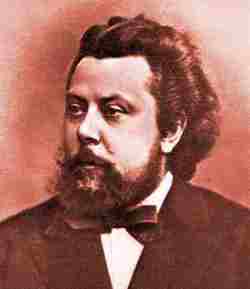
Modest Mussorgsky was a Russian composer, one of the group known as “The Five”. He was born on 21st March 1839 in Karevo, Russia and died on 28th March 1881 in Saint Petersburg, Russia aged 42.
Major Works
“Night on a Bald Mountain” (1867)
“Boris Godunov” (1874)
“Pictures at an Exhibition” (1874)
“Khovanshchina Prelude” (1874)
Biography Timeline
1839: Modest Petrovich Mussorgsky was born on 21st March in Karevo, Toropets Uyezd, Russia. His father was a landowner but earlier generations of his family had been serfs. His mother, Julia Chirikova, was a pianist who taught him how to play piano and the daughter of a nobleman.
1846: At age seven he is able to play pieces by Franz Liszt.
1849: In August his father takes his two sons to St Petersburg and Modest attends the Petrisschule (St. Peter’s School) as a preparation for life in the military. He studies the piano with Anton Gerke.
1852: He enters the School for Cadets of the Guard in St Petersburg. General Sutgof, the Director, is well known for his harsh discipline and despite being only twelve Mussorgsky gets involved with the hard-drinking culture. He is popular with the other students as he plays the piano for them. He publishes a piano piece entitled “Podpraporshchik” (Porte-Enseigne Polka) paid for by his father.
1853: Death of his father.
1856: He graduates from the school as Lieutenant Mussorgsky and joins the aristocratic regiment, the Preobrazhensky Guards. In October he meets Alexander Borodin, a fellow officer at a military hospital in St Petersburg and discovers through him the music of Mikhail Glinka. Another composer, Alexander Dargomyzhsky introduces him to Mily Balakirev.
1858: He begins to study with Balakirev and resigns his commission in the army.
1859: In June he goes to Moscow for the first time and visits the Kremlin. He helps out with a production of Glinka’s opera “A Life for the Tsar” for a singer and her wealthy husband.
1860: He composes a four-hand piano sonata which is his only movement in in sonata form and “Modo Classico” for piano solo.
1861: The “Emancipation of the Serfs” deprives his family of half of its estate and Mussorgsky returns to Karevo trying to prevent their descent into poverty.
1863: He gets a job with the Civil Service, in the Ministry of Communications, in St Petersburg living with five other men in an apartment where they discuss modern writing and ideas. Short of money he resorts to visiting money lenders. He begins an opera, “Salammbo” but never completes it.
1865: When his mother dies he lives with his brother and then shares a small flat with Nikolay Rimsky-Korsakov. He begins to drink to excess. He begins his opera “Khovanshchina” but it is never finished. He befriends a distant relative the poet Arseny Golenishchev-Kutuzov.
1866: He writes a series of songs about ordinary people such as “Darling Savishna”, “The Seminarist” and “Hopak”
1867: He composes the symphonic poem “Ivanova Noch na Lysoy Gore” (Night on Bald Mountain) but Balakirev is highly critical of the work and refuses to conduct it and so it was never performed in Mussorgsky’s lifetime. He is declared “supernumerary” by the Civil Service so is kept on the register but receives no wages. The Russian critic Vladmir Stasov first refers in print to the “Kuchka” (anglicised as “The Five”) for the composers in Balakirev’s circle including Mussorgsky and Rimsky-Korsakov.
1868: He composes and music for the first eleven scenes of “Zhenitba” (The Marriage) by Nikolay Gogol. He sets about writing his next opera “Boris Godunov” about the former Russian Tsar.
1869: “Boris Godunov” with a libretto based on the play by Alexander Pushkin is completed in December but is rejected by the Mariinsky Theatre the following year.
1871: He works for the Forestry Department whilst completely revising “Boris Godunov”.
1872: Rimsky-Korsakov gets married and Mussorgsky has to move out of their shared rooms. His drinking increases as he spends most of the day and each evening in the Maly Yaroslavets tavern in St Petersburg with other bohemian characters. The song cycle “Detskaya” (The Nursery) is first performed.
1874: “Boris Godunov” is finally accepted by the theatre and given its premiere on 8th February and is enthusiastically welcomed by the audience but not the critics. He composes the song cycle “Bez Solntsa” (Sunless), the “Khovanshchina Prelude” and the piano suite “Kartinki s Vystavki” (Pictures at an Exhibition) in memory of his friend, the painter Victor Hartmann, who has recently died. (orchestrated by Maurice Ravel in 1922). He also begins work on a new opera “The Fair at Sorochynsti” based on a work by Gogol.
1875: His physical decline becomes more noticeable.
1877: He composes the song cycle “Songs and Dances of Death”.
1879: He is frequently absent from his Civil Service post due to illness caused by drinking but he is transferred to the Office of Government Control as one of his managers is a music lover. He is allowed to take time off to tour several cities as a singer’s accompanist. He composes “Song of the Flea” based on Mephistopheles words from Johann Wolfgang von Goethe’s “Faust”.
1880: He is finally dismissed from the Civil Service and he has to rely on friends for financial support.
1881: On 24th February he has three attacks of alcoholic epilepsy and his friends take him to hospital. He recovers slightly and has his portrait painted by Ilya Repin.
Modest Petrovich Mussorgsky died on 28th March 1881 in St Petersburg, Russia. He was buried in the Tikhvin Cemetery at the Alexander Nevsky Monastery in the city. His unfinished opera “Khovanshchina” is completed by Rimsky-Korsakov and received its premiere in 1886 in St Petersburg.
Influences
Modest Mussorgsky was primarily influenced by two Russian composers. The older Alexander Dargomïzhsky and the younger Mily Balakirev. The latter was the only one to give him practical lessons in composition. Dargomïzhsky himself was impressed with his ability at the piano. In literature his idol was Alexander Pushkin.
In 1863 he entered the civil service and joined a commune with other young men who believed in “realism” in art which had a powerful influence on his music. He left the commune two years later and was removed from his civil service post in 1867 becoming a loner. He met Alexander Borodin and Nikolai Rimsky-Korsakov but perhaps the biggest influence on him at this period was the critic Vladimir Stasov who had heard him at one of Dargomyzhsky’s soirées. At times this was constructive but at others dismissive and both he and Balakirev thought him dull and an idiot. He worked only intermittently due to violent mood swings and an increasing dependence on alcohol.
Rimsky-Korsakov and Pyotr Tchaikovsky however, both praised his talent but were disappointed with his technique and poor scoring for orchestra. Tchaikovsky thought him the most talented of “The Five” but described him as narrow minded and uncouth and someone who flaunted his illiteracy.
In 1908 with the first performances of his opera “Boris Godunov” he was seen at last in the West as a serious composer after being thought of as an eccentric oddity up until that point. He became known for his original and bold style and for his vivid depictions of Russian life.
He influenced several later composers including Leos Janacek who echoed his rhythms, Dmitri Shostakovich whose late symphonies were influenced by many of his musical devices and Sergei Prokofiev whose operas were owe him a debt. Many of his compositions have remained in the concert repertoire. His appeal broadened even more in the twentieth century when his tone poem “Night on Bald Mountain” was used in the 1940 Disney film “Fantasia” and the Progressive Rock band Emerson, Lake and Palmer recorded an arrangement of “Pictures at an Exhibition” in 1971.
Further Information
Complete works of Mussorgsky.