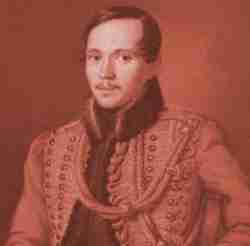
Mikhail Lermontov was a Russian Romantic poet, soldier and writer, sometimes called “The poet of the Caucasus”. He was born in Moscow, Russia on 15th October 1814 and died in Pyatigorsk, Russia on 27th July 1841 aged 26.
Major Works
“The Corsair” (1828)
“The Angel” (1831)
“Tambov Treasurer’s Wife” (1838)
“Demon” (1839)
“A Hero of Our Time” (1840)
Biography Timeline
1814: Mikhail Yuryevich Lermontov was born on 15th October in Moscow, Russia. His father was Yury Petrovich Lermontov, a retired army captain and his mother was Mariya Mikhaylovna, née Arsenyeva, a wealthy heiress.
1817: On 27th February his mother dies of tuberculosis aged 21. Her marriage was an unhappy one and her mother Elizaveta Arsenyeva fights for custody of the young boy from a man she dislikes. She takes him to her estate in Penzenskaya province when it is agreed she can keep him until age 16. In June she takes him to Pensa and dotes on him.
1819: His grandmother takes him to mineral springs in the Caucasus for his health where they stay at her sister E. A. Khasatova’s house.
1821: They return to Tarkhany where she provides him with the best schooling and home comforts.
1825: In August they travel to the Caucasus for the third time and then he begins private tutoring in several European languages.
1827: He moves with his grandmother to Moscow, and attends a boarding school for the nobility run by Moscow University. He begins to writes his first poetry.
1828: He writes the poems “Cherkesy” (Circassians) and “Kavkazsky Plennik” (Prisoner of the Caucasus) which owe a debt to the work of Lord Byron.
1829: In the fifth form of the school his personal tutor is the poet Alexey Merzlyakov. Many of the tutors, including the poet Semyon Rayich, try to move him away from being inspired by Byron but to no avail.
1830: His first published verse is “Vesna” (Spring) which appears in the amateur magazine “Ateneum”. In April the school is turned into an ordinary gymnasium and so he leaves. In August he enters the faculty of philology at Moscow University. He writes the play “Menschen und Ledienschaften” (People and Passions). He meets and falls in love with Natalya Ivanova, the daughter of Fyodor Ivanov a Moscow playwright, however she goes on to marry a richer and older man much which u0sets him greatly.
1831: He writes the play “Stranny Chelovek” (A Strange Man”) which takes pot-shots at the Tsarist regime and is also a part of the Malov scandal where a number of students drive an unpopular professor out of the lecture hall. His father dies of tuberculosis having been affected by his son’s alienation with him.
1832: He leaves the university due to more disputes with his tutors and goes to St Petersburg with his grandmother to finish his studies. On 14th November he enters cadet school. He begins writing the novel “Vadim” about a peasant uprising during the eighteenth century but it is never completed. He also writes the poem “No, I’m not Byron”.
1834: After graduating from cadet school with the rank of subensign he is sent with the Life-Guard Hussar Regiment to Tsarskoye Selo, near St Petersburg. He has plenty of time on his hands and attends the many balls and events in the capital and spends his grandmother’s money liberally. In December he meets another old flame, Yekaterina Sushkova, at a ball and after feigning interest he drops her publicly.
1835: In July his poem “Khadji-Abrek” is published in “Biblioteka Dlya Chteniya” without his consent. The verse play “Masquerade” doesn’t get accepted despite his many alterations. (eventually published in 1842).
1836: He writes another unfinished novel “Princess Ligovskaya”.
1837: He is shaken in January by the death of one of his idols, Aleksandr Pushkin, in a duel. He writes a popular elegy “The Death of a Poet” which denounces the killer and also the Imperial court. Tsar Nicholas the First has him arrested and exiled to a regiment in the Caucasus. There he meets the Decembrists and the poet Alexander Chavchavadze. His poetry begins to appear frequently in the newspapers including “A Song About Tsar Ivan Vasilyevich, His Young Bodyguard, and the Valiant Merchant Kalashnikov” and “Borodino”.
1838: With the help of General Benckendorff he is transferred in February to the Grodno cavalry regiment based at Nizhny Novgorod and then he moves to the St Petersburg based Hussars Guard regiment. He writes the satirical poem “Tambovskaya Kaznacheysha” (The Tambov Paymaster’s Wife) which even ridicules his own Romanticism and “The Thought”. He writes “Demon” and “The Fugitive” both published after his death. He begins working on his major novel “A Hero of Our Time”.
1839: He has now become so popular he is lauded as Pushkin’s successor. The editor of “Otechestvennye Zapiski” magazine asks him to become a regular contributor and parts of “A Hero of Our Time” are published in it including “Bela” and “The Fatalist” with the final parts in 1840.
1840: He writes the Caucasian poems “Mtsyri”. In February he is brought before a military tribunal for his duel with Ernest de Barante, the son of the French ambassador at St. Petersburg. The Tsar sentences him to a new exile in the Caucasus. It takes him a while to meet up with the regiment as he stops off for a month in Moscow where he meets Nikolai Gogol amongst others. He arrives with the troops in June only to find this time they are engaged in military battles and he has to fight at the Battle of the Valerik River in July. He distinguishes himself with great courage. This is the basis for his poem “Valerik”. The final parts of “A Hero of Our Time” are published which is a set of five linked stories.
1841: Due to pestering by his grandmother he is given leave in February and he works on several compositions in St Petersburg such as the poems “Rodina” (Motherland) and “Lyubil i ya v Bylye Gody” (And I Was in Love). He attends several society events where he is generally feted however, he accidentally snubs the Tsar’s two daughters at Countess Alexandra Vorontsova-Dashkova’s ball, upsetting both the Tsar and the military hierarchy. When he reaches his regiment again in May a quarrel breaks out between him and Nikolai Martynov over Lermontov’s teasing of him about affecting the manners of a Romantic hero and belittling the size of his dagger. On 25th July Martynov challenges him to a duel at the foot of Mashuk mountain in the north Caucasus.
Mikhail Lermontov died of a gunshot wound to the heart during a duel, on 27th July 1841 in Pyatigorsk, Russia. He was buried in the municipal cemetery on 30th July without military honours but with a large crowd of people present. In January 1842, the Tsar allowed the coffin to be taken the family cemetery at the Tarkhana estate where he was reburied on 23rd April.
Influences
Mikhail Lermontov was influenced by Russian Romanticism as well as the works of the English Lord Byron whom he tried to emulate often by introducing the Byronic hero archetype and he dedicated an early poem to him. Pechorin who appears in “A Hero of Our Time” is a particular Byronic character. He also read widely the works of Percy Bysshe Shelley.
His austere childhood under the tutelage of a strict grandmother made him an introspective and lonely child which often translated into his later characters. His aristocratic heritage (including original Scottish roots to the legendary poet Thomas the Rhymer) added to his personality. He was also influenced by the popular historical prose of Walter Scott as well as his extensive travels in the Caucasus region as boy and man. The area’s spectacular scenery, the local tribes, and the ongoing Caucasian War left a lasting impression on him and provided inspiration for many of his later works. As a boy he was introduced to the works of Johann Wolfgang von Goethe and Friedrich Schiller and he also read other European authors such as Alphonse de Lamartine, Victor Hugo and Thomas More. He began writing poetry at the age of thirteen. His life in the army also exposed him to exciting experiences and gave him a sense of honour and conflict as well as a sense of disillusionment. Many of his army poems were however censored for being pornographic.
His main oeuvre primarily focused on the romantic’s ideas of emotion, imagination, the natural world and spiritual struggle. He was considered to be Alexander Pushkin’s literary heir and he was heavily influenced by his early works such as “The Prisoner of the Caucasus”. His rise to fame came after writing the elegy “Death of the Poet” following Pushkin’s fatal duel although in his lifetime he only published one small collection of poems in 1840. His legacy, however, of more than thirty long poems, six hundred minor ones, a novel and five dramas was huge for an author whose career only lasted six years.
Much of his writing provides a critique of the rigid structures and moral superficiality of Russian high society during the reign of Tsar Nicholas the First. He was deeply troubled by political events, such as the Decembrist uprising of 1825 and inspired his craving for freedom. Russian critic and historian D. S. Mirsky has stated that “The Angel” of 1831 is the first of his truly great poems, calling it “arguably the finest Romantic verse ever written in Russian”.
His first attempt at prose, the unfinished novel “Vadim” of 1832 tells the story of the 1773–1775 peasant uprising and by his own admission he moved away from Romanticism towards psychological realism which was to have such a profound effect on later Russians such as Leo Tolstoy and Fyodor Dostoevsky. He went onto ridicule Romanticism in “Tambov Treasurer’s Wife” in 1838.
His most famous novel “A Hero of Our Time”, published in 1840, earned him widespread acclaim. His patriotic and pantheistic poems also had an enormous influence on later Russian literature. Boris Pasternak for example dedicated his 1917 poetic collection to the memory of Lermontov’s “Demon”. Ivan Turgenev was a great admirer but Vladimir Nabokov was often dismissive of his abilities famously calling his poetry “banal” and “trite” in 1946. Despite this, however he translated Lermontov’s masterpiece, “A Hero of Our Time”, into English to correct previous, inferior translations.
Dostoevsky actually mentions Lermontov near the beginning of his “Brothers Karamazov” and Anton Chekhov refers to him in “The Three Sisters”. In the twentieth century Soviet composer Maria Semyonova Zavalishina set some of his writing to music as did the Ukrainian Valentina Ramm and the Latvian Lauma Reinholde. He has also been depicted in numerous films and television series. A monument to Lermontov was unveiled in the Scottish village of Earlston on 3 October 2014, due his descent from Thomas the Rhymer.
Further Information
List of works by Lermontov.