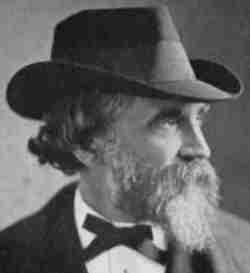
Josiah Gilbert Holland was an American novelist, essayist and poet particularly during the Civil War. He was born on 24th July 1819 in Dwight, Massachusetts, USA and died on 12th October 1881 in New York City, USA aged 62.
Major Works
“Life of Abraham Lincoln” (1866)
“Kathrina: Her Life and Mine, In a Poem” (1867)
“Arthur Bonnicastle: An American Novel” (1873)
“The Mistress and the Manse” (1874)
“The Puritan’s Guest, And Other Poems” (1881)
Biography Timeline
1819: Josiah Gilbert Holland was born on 24th July in Dwight, Belchertown, Massachusetts, USA. His family were poor but deeply religious puritans and moved home frequently. He was the youngest of six children.
1835: He works in a factory to supplement the family’s income and only spends a short time at Northampton High School which he then leaves due to ill health.
1843: Having saved some money he completes a degree in medicine at Berkshire Medical College. He begins a medical practice with a fellow student Dr. Charles Bailey in Springfield, Massachusetts. He then opens a short-lived women’s hospital in the town with Charles Robinson.
1845: He marries Elizabeth Luna Chapin, from an old Springfield family, who becomes great friends with the poet Emily Dickinson.
1847: He begins publishing a newspaper, “The Bay State Weekly Courier” but it never sells well. In it he publishes some of Dickinson’s poetry. He also publishes some of his own work in the “Southern Literary Messenger”. To gain more money he takes up the job of a teacher in Richmond, Virginia and then moves on to Viskburg, Mississippi where he becomes superintendent od schools.
1848: His poetry is published in the New York “Knickerbocker Magazine” and the “Home Journal”.
1849: In April he returns to Western Massachusetts so that his wife can look after her dying mother. He becomes assistant Editor of the “Springfield Daily Republican” under Samuel Bowles. In September the paper publishes his “Three Weeks on a Cotton Plantation” and he writes many stories under the pseudonym Timothy Titcomb. The Republican becomes one of the most widely read small city newspapers in America.
1851: He receives an honorary doctorate from Amherst College.
1855: He publishes the two-volume “History of Western Massachusetts” his first book under his real name.
1857: He publishes the historical novel “The Bay-Path: A Tale of Colonial New England Life” and begins giving lectures along with other speakers such as Oliver Wendell Holmes.
1858: “Titcomb’s Letters to Young People, Single and Married” are collected together. He writes the narrative poem “Bitter-Sweet”.
1859: “Gold-Foil: Hammered from Popular Proverbs” comes out under the Timothy Titcomb pen name.
1860: He publishes his second novel “Miss Gilbert’s Career: An American Story” which is considered one of the first novels leading towards American Realism.
1861: He publishes “Lessons in Life: A Series of Familiar Essays”.
1862: He has a house built in the Italianate style in North Springfield called “Brightwood”. He becomes temporary editor of the “Springfield Republican” whilst Bowles is away in Europe.
1863: He publishes “Letters to the Joneses”.
1866: He publishes his “Life of Abraham Lincoln” not long after the assassination of the President.
1867: He publishes “Kathrina: Her Life and Mine, In a Poem” and “Christ and the Twelve: Or Scenes and Events in the Life of Our Saviour and His Apostles, as Painted by the Poets”.
1870: He becomes editor of “Scribner’s Monthly Magazine” and his writings become widely quoted at the time though are largely forgotten now.
1872: He publishes “The Marble Prophecy, and Other Poems” in New York, where he moves with his family, and “Garnered Sheaves: The Complete Poetical Works”. He also produces “Plain Talks On Familiar Subjects: A Series of Popular Lectures” and an “Illustrated Library of Favorite Song”.
1873: He publishes “Arthur Bonnicastle: An American Novel”.
1874: He publishes “The Mistress of the Manse: A Poem” and by now his books are outselling those by Mark Twain.
1875: He publishes “The Story of Sevenoaks: A Story of To-Day”.
1876: He writes “Nicholas Minturn: A Study in a Story” and “Every-Day Topics: A Book of Briefs”.
1877: He publishes the novel “Nicholas Minturn” and builds himself a summer house in Alexandria Bay, New York State which he names “Bonniecastle” after the hero of his previous book.
1881: He publishes “The Puritan’s Guest, And Other Poems” and “Concerning the Jones Family”.
Josiah Gilbert Holland died of heart failure on 12th October 1881 in New York City, USA. He was buried in Springfield Cemetery in Massachusetts, USA. Many local newspapers in America who had derided his work as mediocre wrote glowing obituaries.
Influences
Josiah Gilbert Holland trained as a doctor but after failing at medicine and publishing, he worked as a schoolteacher in Mississippi. He was born into a society of New England conservatism and spirituality and went on to view personal morality and the salvation of souls as paramount and often treated his writing as a form of pastoral guidance.
On his return to Massachusetts, the newspaper the “Springfield Republican” hired him. He became a household name for half a century with his columns amongst the most widely read in the country. He worked alongside other journalists which gave him a thorough grounding on regional Victorian reform, literature and civic duty. He went on to write essays, histories, novels and poetry. Literary critics panned him for his mawkish moralistic sentimentality, but the public loved him.
He is considered one of the Fireside Poets along with William Cullen Bryant and James Russell Lowell. His work was included in anthologies and included moral messages or focussed on a historical romantic past. He is also categorised as a minor writer of the Transcendental School.
His travels and observations in the South of the United States reinforced a steadfastly conservative social outlook, which included keeping traditional domestic roles for women and cautious views for political reform. He was member of a Springfield church (North Congregationalist) that was attended by slavery abolitionists freed slaves and fugitives although he has never been considered an abolitionist himself.
His work during the middle of the nineteenth century in “Scribner’s Monthly”, which he founded and edited, catered closely to the ethical and domestic values of the rising American middle class which only served to increase his popularity.
He eulogised Abraham Lincoln at his funeral in Illinois and a few months later wrote Lincon’s first biography which became an instant best-seller. His books sold over a half-million copies during his lifetime and made him a millionaire five times over although he was always overlooked by critics in preference to Walt Whitman and Herman Melville. One of his biographers actually called him “the major prophet of the unsophisticated”.
He was a great friend of the poet Emily Dickinson whose reputation again outshone his. Dickinson admired him and said that he was “so simple, so believing” and made God seem “so sunshiny.” He wrote over ninety letters to her discussing everyday life. He had a great turn of phrase and examples which have come down into common parlance were “There is no royal road to anything, one thing at a time, all things in succession” and “That which grows fast, withers as rapidly. That which grows slowly, endures.”
He published the oldest known work of literature written by an African American in North America. The sixteen-year-old Lucy Terry witnessed two white families attacked by Native Americans in 1746 in Deerfield Massachusetts and wrote a poem about it which he published in “The Springfield Daily Republican” and later included in his book “History of Western Massachusetts”. As an associate editor of “The Republican” he was favourable to the novels of Herman Melville but turned down the work of Walt Whitman in “Scribner’s Monthly” branding it immoral.
In his 1860’s novel “Miss Gilbert’s Career” he coined the word Jasm describing it as “If you’ll take thunder and lightning, and a steamboat and a buzz-saw, and mix ’em up, and put ’em into a woman, that’s jasm.” The word later got corrupted in the lively music form Jazz during the twentieth century.
In his essays “The Reconstruction of National Morality” of 1876 and “Falling from High Places” of 1878, he discussed why, in his opinion, so many Americans, including Christian leaders, had succumbed to the temptation of trying to become rich dishonestly after the American Civil War. He also wrote popular advice essays under the pseudonym Timothy Titcomb which helped shape domestic values and manners for Victorian readers.
His narrative poem “Bitter Sweet” became one of his most popular and was described by his biographer Harriette Merrick Plunkett as on a par with the works of Robert Burns and Sir Walter Scott. Thirty years after his death another critic described “Arthur Bonnicastle” as the best of his five novels and undoubtedly his masterpiece. It remained in print until the 1920’s. Despite literary clubs in his honour being formed in towns and cities across the country and being a spiritual mentor to the public and politicians after the Civil War his work fell out of favour in the twentieth century and is rarely read today although in 1920 his novel “Sevenoaks” was adapted into the film “Jes’Call Me Jim”.
Further Information
Gutenberg online works of Holland listed by popularity.