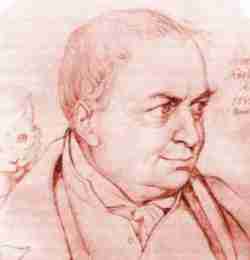
Joseph Anton Koch was an Austrian painter. He first became known as an Austrian neo-classicist landscape painter but then established himself in German Romanticism. He was born in Elbigenalp, Austria on 27th July 1768 and died in Rome, Italy on 12th January 1839 aged 70.
Major Works
“The Death of Oscar” (1804).
“Heroic Landscape with Rainbow” (1805)
“Schmadribach Falls in the Lauterbach Valley” (1811).
“Serpentara Landscape with the Procession of the Magi” (1820).
“Portrait von Johann Michael Wittmer” (1830).
Biography Timeline
1768: Joseph Anton Koch was born on 27th July in Elbigenalp, Austria and grew up in the village of Obergiblenin the Lech Valley of the Austrian Tyrol. His parents were famers and he was responsible for looking after the livestock in the countryside where he used to draw the country scenes. He had ten brothers and sisters and only two sisters and himself reached adulthood.
1785: His mother wanted him to train to be a priest but Bishop Umgelder of Augsburg realises his talent for drawing and suggests he goes to art school instead. He attends the Karlsschule in Stuttgart which is known for its strict discipline. He will spend the next seven years there.
1791: Taken by the idea of the French Revolution and hating the discipline he runs away from his school.
1792: He travels widely in the Swiss Alps producing watercolours and charcoal sketches as he goes.
1795: He receives a scholarship from the English patron Philip Nott and goes to Italy. He is particularly impressed by the Renaissance masters in Florence, so much so that he is banned from the Uffizi gallery due to his enthusiasm. After visiting Salerno and Naples he settles in Rome where he moves in with the painter Asmus Jakob Carstens. He becomes the leading figure of the society of German painters in Rome called the “Deutschrömer”. He also studies the depiction of the human body under Johann Christian Reinhart.
1798: Napoleon Bonaparte takes over in Italy and removes the Pope. Koch now changes his views on the Revolution and holds the French in contempt.
1798: His friend and colleague Carstens dies but he decides to stay on in Rome.
1802: He shares lodgings with the Danish sculptor Thorvaldsen. He completes thirty drawings to illustrate Dante’s “Divina Commedia”.
1803: He travels with Gottlieb Schick in the countryside and hills surrounding Rome and is particularly taken with the village of Olevano Romano where he marries his wife, the daughter of a winegrower. He paints “Landscape with Noah”.
1805: He paints “Heroic Landscape with Rainbow”, the first of his heroic landscapes, and contributes American landscape scenes to Alexander von Humboldt’s writings.
1810: A group of painters called the “Lukasbrüder” arrive in Rome from Vienna having left the academy there and choose Koch as their teacher. He doesn’t join their group however and openly mocks their religious zeal. He publishes twenty prints of Rome but these are not a commercial success and he gives upon the “Römische Ansichten” project.
1811: He paints “Schmadribach Falls in the Lauterbach Valley”.
1812: Not making enough money in Rome he moves to Vienna and is heavily influenced by the Romantic philosopher and writer Friedrich von Schlegel.
1813: He paints “Noah’s Sacrifice”, “View in the Sabine Mountains” and “Grimsel Pass”.
1814: He paints “Monastery of San Francesco di Civitella”.
1815: He returns to Rome where he will stay for the rest of his life. The “Deutschrömer” meet at the Caffè Greco. Ludwig the First of Bavaria is a frequent visitor and buys several works from the group and even buys them the Villa Malta which they use as a studio.
1823: He paints “Grindelwald Glacier in the Alps”.
1825: He becomes interested in fresco painting and is commissioned by the Marchese Massimo to work on a room in the Villa Massimi with scenes of Hell and Purgatory from Dante’s “Divina Commedia”. This will take until 1829 to complete. He also paints “Landscape with Ruth and Boaz”.
1830: He paints “View of Nauplia” and “Landschaft bei Olevano mit Reitendem Mönch” (Landscape near Olevano with a Monk on Horseback).
1834: He writes “Moderne Kunstchronik oder die Rumfordische Suppe Gekocht und Geschrieben”, (Modern Art Chronicle or the Rumfordian Soup and Writings) which is published in Stuttgart as a humorous attempt to counter criticism of his work.
Joseph Anton Koch died in poverty in Rome on 12th January 1839. He was buried in the Teutonic Cemetery next to St Peter’s Basilica in Vatican City, Rome, Italy.
Further Information
Examples of paintings by Koch.