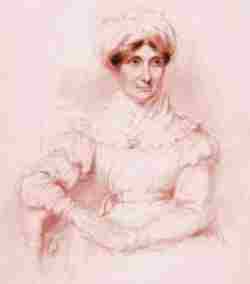
Joanna Baillie was a Scottish poet and verse dramatist. She was born on 11th September 1762 in Bothwell, Scotland and died on 23rd February 1851 in Hampstead, London aged 88.
Major Works
“De Monfort” (1798)
“The Second Marriage” (1802)
“The Family Legend” (1810)
“Fugitive Verses” (1840)
Biography Timeline
1762: Joanna Baillie was born on 11th September in Bothwell, Scotland. Her father was James Baillie a Presbyterian minister and later Professor of Divinity at the Glasgow University. Her mother was Dorothea Hunter, who was a sister of the Scottish physicians William and John Hunter. She was the youngest of three children and her twin died in infancy.
1769: The family move to Hamilton where her father is appointed to the collegiate church.
1772: She enters Miss McDonald’s boarding school in Glasgow and learns to read and write. A visit to the theatre is a revelation to her and from then on she begins to write her own works.
1778: Her father dies leaving them short of money and the family move to Long Calderwood near East Kilbride. Her brother Matthew studies medicine at Balliol College, Oxford.
1783: Her Uncle, Dr William Hunter, dies leaving her brother a house in London and the collection which forms the basis of the Hunterian Museum and Art Gallery in Glasgow.
1784: The family return home and her aunt, a society hostess introduces her to several prominent bluestockings of the day including Fanny Burney, Elizabeth Carter and Elizabeth Montagu.
1790: Her first publication is “Poems: Wherein it is Attempted to Describe Certain Views of Nature and of Rustic Manners”. “Winter Day” describes the area around Long Calderwood. She begins a tragedy, “Arnold” but it is never published. She runs her brother’s house and studies Moliere, Voltaire and Shakespeare amongst other.
1791: Her brother marries and she and her sister move to Colchester where she begins “Plays on the Passions”.
1798: The first volume of “Plays on the Passions” is published anonymously as “A Series of Plays”. Volume One contains “Count Basil”, a tragedy about love, “The Tryal”, a comedy about love, and “De Monfort” a tragedy about hatred.
1800: “De Monfort” is produced at Drury Lane with Sarah Siddons in a leading role. although it runs for eight nights it is not deemed a success. Lord Byron, however is impressed and it inspires his drama “Manford”. He and William Wordsworth become part of her circle of friends.
1802: She and her Agnes sister move to Hampstead after her brother comes into a fortune. They both live there for fifty years and neither marries. The second volume of “Plays on the Passions” is published this time under her own name. This volume contains “The Second Marriage” a comedy about ambition and “Ethwald” a tragedy which she sees as some of her best writing.
1804: She publishes “Miscellaneous Plays” which includes tragedies “Rayner” and “Constantine Paleologus” and a comedy, “The Country Inn”. In her preface she counters claims that her plays are dull and that she has no idea of stagecraft, a criticism which had deeply upset her.
1806: Her mother dies. Joanna and Agnes become close to Walter Scott and visit him in Scotland many times.
1810: Her Scottish-themed play “The Family Legend” is first produced in Edinburgh funded largely by Walter Scott and he writes a prologue to the production. It is a success and she is asked to revive “De Monfort”.
1812: The final volume of “Plays on the Passions” is published which contains “Orra”, “The Dream”, “The Siege” and the musical “The Beacon”.
1815: “The Family Legend” is produced at Drury Lane Theatre in London. Ludwig van Beethoven sets her poem “O Swiftly Glides the Bonny Boat” to music.
1821: She writes “Metrical Legends of Exalted Characters” which includes descriptions of Christopher Columbus and William Wallace. “De Monfort” is performed at Drury Lane with Edmund Kean in the title role. Her next work “Constantine Paleologus” is declined by Drury Lane but is produced at the Surrey Theatre (as “Constantine and Valeria”) and also in Liverpool, Dublin and Edinburgh.
1823: She edits and publishes a collection of poems by many leading writers of the day to help a recently widowed old school friend.
1824: Now well off herself she gives half her earnings to charity. She also supports the campaigner James Montgomery’s bid to help impoverished Sheffield chimney sweeps.
1826: She publishes the tragedy “The Martyr” for reading only.
1831: She publishes the pamphlet “A View of the General Tenour of the New Testament Regarding the Nature and Dignity of Jesus Christ” where she discusses the holy trinity amongst other religious doctrines.
1836: She publishes three volumes of “Dramatic Poetry” and“Miscellaneous Plays” containing nine new works. The critical reviews are all enthusiastic.
1840: After a bout of ill health she recovers and produces “Fugitive Verses” which includes Scottish folk songs.
Joanna Baillie died on 23rd February 1851 in Hampstead, London. She was buried in Hampstead Parish Churchyard next to her mother and Agnes would join her later aged 100.
Influences
Her biggest influence was the work of William Shakespeare and critics and friends constantly reminded her of this point. She also admitted her debt to the Irish warrior-poet Ossian and to Robert Burns. As a Presbyterian minister’s daughter religion was also very important to her.
Initially she was reluctant to publish her works and she told the novelist Walter Scott in a letter that it was her brother who wished her to do it. She and her sister would visit Scott in Scotland on numerous occasions. She was also good friends with Lady Byron and by extension Lord Byron himself. Byron attempted to get one of her plays performed at the Drury Lane theatre but it was never performed. After his split with Lady Byron Baillie sided with her friend and the two writers became more distant.
Her plays were criticised as being reading only and impossible to stage but in 1804 in the Preface to “Miscellaneous Plays” she defends them as acting plays. Her plays were small scale with an attention on the psychological moods of her characters rather than the lavish spectacles which were prevalent at the time.
In 1831 she became embroiled in a public theological debate after publishing her pamphlet “A view of the General Tenour of the New Testament Regarding the Nature and Dignity of Jesus Christ” where she spoke about the Trinity and Arianism. She believed that “no Protestant Christian, regulates, or at least ought to regulate, his faith by anything but what appears to him to be really taught in Scripture”.
Despite the failure of her plays her poems were very popular and made her enough money to live comfortably and she gave half her earnings to philanthropic causes such as campaigning on behalf of chimney sweeps. In 1823, she edited and published a collection of poems by leading writers of the day. The subscriptions from this went to support a widowed friend with a family of daughters to support.
Her style of writing was lyrical and many of her poems explore the natural world and consequently her work appealed to William Wordsworth himself. She was revered by other poets on both sides of the Atlantic Ocean and she was seen as the greatest female poet since Sapho. Many of her works were translated into German. The American critic John Neal in 1866 even went as far as calling her the “female Shakespeare of a later age”. The philosopher John Stuart Mill also declared her “Constantine Paleologus” “one of the most glorious of human compositions and one of the best dramas of the last two centuries”. The lawyer and literary critic Francis Jeffrey panned her “Plays on the Passions” in 1803 in the Edinburgh Review but after a standoff lasting until 1820 the two became firm friends.
Many of her works were set to music such as “Hark! the Cock Crows” and “Once Opon my Cheek” by John Wall Callcott and “O Swiftly Glides the Bonny Boat” by Ludwig van Beethoven in 1815.
After the 1830’s her fame had diminished with the general public and there were no revivals of her plays in the late nineteenth or twentieth centuries. Only later on in the twentieth did critics realise that her descriptions of the human psyche had influenced Romantic literature. Scholars now recognise her importance as a stage innovator and theorist and as an important female writer in her own right.
Further Information
Examples of poetry by Baillie.