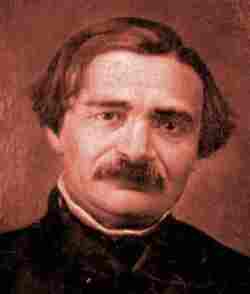
Ion Heliade Rădulescu was a Romanian poet, essayist, short story writer, newspaper editor and politician. He was born in Targoviste, Romania on 6th January 1802 and died in Bucharest, Romania on 27th April 1872 aged 70.
Major Works
“Zburatoruk” (1836)
“Paralelism între Limba Română şi Italiană” (Parallels between the Romanian language and Italian) (1840)
“Măceșul” (The Eglatine) (1844)
“Cântecul Ursului” (The Bear’s Song) (1848)
Biography Timeline
1802: Ion Heliade Rădulescu was born on 6th January in Targoviste, Romania. His fathe,r Ilie Rădulescum, was a wealthy businessman of Greek origin. His mother was Eufrosina Danielopol, a Greek woman. As three of his siblings had died of bubonic plague he was doted upon by his parents. He was tutored in Greek at home but taught himself to read Romanian Cyrillic script with the help of his father’s servants.
1813: He is sent to Gârbovi to escape the plague and thereafter is tutored by the Orthodox monk Naum Ramniceanu where he begins to read popular novels.
1815: He moves to the Greek school at Achitu Magureanu in Bucharest.
1818: He moves to Saint Sava school where he studies with Gheorghe Lazăr.
1820: He graduates and becomes Lazăr’s assistant, teaching arithmetics and geometry. He begins to adopt the surname Heliade.
1821: During the Wallachian Uprising in February the school is forced to close.
1822: He reopens Saint Sava when Gheorghe Lazăr falls ill without being paid. Several intellectuals of will join him later to help out. He opens an art class run by Carol Valstain. The new Prince Grigore the Fourth Ghica who is assigned as ruler by the Ottoman Empire endorses education in Romanian.
1823: He meets Maria Alexandrescu whom he will later marry.
1827: He founds the Soțietatea Literară Românească (the Romanian Literary Society) with Dinicu Golescu which attempts to encourage the establishment of Romanian-language newspapers. He sets about turning Saint Sava into a college.
1828: He proposes that the Romanian Cyrillic Script should be reduced to 27 letters and he supports others who want to unify Romanian variants into a standard language. He publishes his first work, an essay on Romanian Grammar.
1829: On 20th April he begins printing the newspaper “Curierul Romanesc” in Bucharest and he is asked by the new Russian authorities to print the “Monitorul Oficial al României” (Romanian Official Bulletin) at the end of Russo-Turkish War.
1830: In October he opens the first privately owned printing press in the country with his uncle, Nicolae Rădulescu, on his estate at Cișmeaua Mavrogheni. Among the first works he publishes is poetry by Alphonse de Lamartine.
1833: He founds the Societatea Filarmonică (the Philharmonic Society) in Bucharest with several other writers and statesmen and sets about raising money to start a national theatre.
1834: In August he organises the first show by the Soţietatea Filarmonică featuring music by Vincenzo Bellini and his own translation of Voltaire’s “Mahomet”. He becomes Court Poet to the new ruler Prince Alexandru the Second Ghica and teaches at the Soţietatea Filarmonică’s school. He completes his first translations of poems by Lord Byron.
1835: He begins printing the short-lived “Gazeta Teatrului Național” (the official voice of the National Theatre) He translates “Amphitryon” by Moliere into Romanian.
1836: The weekly Curierul Românesc produces a literary supplement, called “Curier de Ambe Sexe”. His poem “Zburatoruk” is published in it and he publishes his first collection of prose and poetry.
1837: He writes an essay on the debate as to whether Homer’s works should be translated into Romanian and encourages Romanian speakers to create new writing. He opens the first permanent exhibit of art works in Wallachia and prints a brochure on drawing and architecture to coincide with it.
1839: He prints a version of “Julie” by Jean-Jacques Rousseau and translates Miguel de Cervante’s “Don Quixote”. Curierul Românesc begins to be issued three or four times a week.
1840: He publishes “Paralelism între Limba Română şi Italiană” (Parallels between the Romanian language and Italian).
1841: He publishes “Paralelism între Dialectele Român şi Italian sau Forma Ori Gramatica Acestor Două Dialecte” (Parallels between the Romanian and Italian Dialects or the Form or Grammar of These Two Dialects”).
1844: He publishes a pamphlet entitled “Măceșul” (The Eglatine) which is critical of Russian influences and sells over 30,000 copies.
1845: He celebrates the late 16th century Wallachian Prince Michael the Brave in his poem “O noapte pe ruinele Târgoviştii” (A Night on the Ruins of Targoviste) and in his epic “Mihaiada”, of which only two sections are completed. (the second in 1859).
1846: His son Ion is born despite his numerous affairs and marital disharmony. He plans work on a “universal library”.
1847: He publishes “Prescurtare de Gramatica Limbei Româno-Italiene (Summary of the Grammar of the Romanian-Italian Language). He translates Lord Byron’s “Don Juan”.
1848: During the spring after the first European revolutions he joins the secret dociety Fratia and sits on its leadership committee. Curierul Românesc ceases printing in April due to lack of finances and he writes the satirical “Cântecul Ursului” (The Bear’s Song) aimed at his enemies. He reads out the Proclamation of Islaz on 21st June for the Wallachian Revolution. He is made Minister of Education in the new regime but the Russians institute a clampdown and their system of government is re-established called the Regulamentul Organic. He escapes to seeks refuge in the British Embassy in Bucharest.
1850: He is allowed to enter Austrian ruled Banat and then goes into exile in France. His wife and children are sent to Turkey. He publishes his memoirs of the Revolution in Paris. He meets the anarchist Pierre-Joseph Proudhon and advances the Romanian cause with him and his staff. He also writes for the newspapers “La Presse” “La Semaine” and “Le Siecle”. He begins to condemn the young radicals for their zealousness amongst the Romanian emigres in Paris.
1851: He reunites with his family on the Greek island of Chios where they stay until 1854.
1856: Following the evacuation of Russian troops from the Danubian Principalities during the Crimean War he is appointed to represent the Romanians in Shumen (modern Bulgaria). Briefly returning to Bucharest he is expelled by the new Austrian authorities and returns to Paris where he writes an analysis of the European situation after the Peace Treaty of 1856.
1858: He publishes “Biblice” (Biblical Writings) as part of a projected four-part Christian history of the world.
1859: He publishes his translation of the Septuagint (Greek Old Testament) called “Biblia Sacră ce Cuprinde Noul şi Vechiul Testament” (The Holy Bible, Comprising the New and Old Testament). He then returns to Bucharest, now the capital of the United Principalities, and adds Rădulescu to his surname. The Romanian Ruler, Cuza, awards him an annual pension.
1866: He is elected as a Deputy for the city of Targoviste in the Chamber of Deputies elections.
1867: He is elected as President of the “Academic Society” (Romanian Academy).
1868: He publishes a textbook on poetics.
Ion Heliade Rădulescu died on 27th April 1872 at home in Polonă Street, Bucharest, Romania. He had a large funeral ceremony filled with admirers and was buried in the courtyard of the Mavrogheni Church in Bucharest.
Influences
Ion Heliade Rădulescu’s Transylvanian teacher Gheorghe Lazăr inspired him to move away from a Greek-dominated early education and to embrace national enlightenment. He became interested in French and Italian culture and literature and was a voracious reader of works by Alphonse de Lamartine, Dante Aligheri, Torquato Tasso, Voltaire, Jean-Jacques Rousseau and François-René de Chateaubriand some of which he translated himself. He was also inspired by the romantic historic ruins of his hometown Târgovişte. The critic George Cǎlinescu called him later “a devourer of books”.
In his early years he was particularly interested in French theatre but later on he developed philological theories where he sought to merge or re-align Romanian with the Italian language due to their shared Latin roots.
He also used Biblical stories in his work as well as traditional folklore of his country such as the the zburător myth where a nocturnal spirit visits young maidens and newlywed women in their sleep.
He was a tireless founder of cultural institutions and nationally important initiatives such as founding the first Romanian newspaper, “Curierul Romanesc”, in Wallachia in 1829, and establishing the Societatea Filarmonică, which later led to the creation of a national theatre in Bucharest. His work contributed to the “national renaissance” movement of identity and culture in Romania. He also established a printing press promoting and encouraging original national literature, as well as Romanian translations of the great classics of the West.
In the late 1820s he created the first of a series of literary groups, the Societatea Literara, which were designed to advocate for political change paid for with help from Dinicu Golescu. His poetic style, influenced from early on by Lamartine, became more classical during his middle age, and thereafter went back to Romanticism.
In 1848 he played a crucial role in the Muntenian Revolution. The Islaz Proclamation was composed and read by him and he was a member of the Provisional Government during June where his conciliatory stance met with suspicion and opposition from the more radical leaders. They especially resented his continued acceptance of the Reglement Organique, the pre-1848 constitution, and his support of the Ottoman rule. After the revolutions failure he went into exile and spent his time defending the Romanian lands against further Russian encroachment. He was in a constant battle with the other principal leaders of the revolution, such as Nicolae Balcescu, the Bratianu brothers, the Golescu brothers, and C. A. Rosetti and his pamphlets only seemed to further the split between the two groups. However he also wrote for major democratic publications in Paris such as “Le Siècle”, “La Semaine”, “La Presse” and “L’Europe et Amerique” which would assist the Romanian cause in future years.
Always egotistical he thought of himself as a Messiah of Romania even after he returned to Muntenia in 1858, but his political influence after 1859 was slight and he became more and more conservative in his politics. He was elected to the Academic Society (the predecessor of the Romanian Academy) and given a substantial national pension by Parliament. At his death he was seen as the “father of the Romanian literature”. He was idolised by many of his contemporaries and by posterity, but also extensively challenged by his enemies including some of his former pupils.
His Romantic poem “Zburǎtoral” has been hailed as a masterpiece based on Romanian mythology and depicts the atmosphere of a Wallachian village. In an 1837 essay he debated the translation of Homer’s works into Romanian and counselled young writers with “Scrieţi, băieţi, orice, numai scrieţi!”, (Write anything, boys, as long as you go on writing!). This famous quote was derided in later decades and thought of as an example of his failure to distinguish between quality and quantity. However, the literary historian Şerban Cioculescu argued that his main goal was to encourage the rapid development of Romanian literature above all else.
His 1858 work, “Biblice” (Biblical Writings), was supposed to form the first of four sections in a Christian history of the world. According to George Călinescu, he attempted to create a parallel to both “The Divine Comedy” and the Bible, with a style influenced by Lamartine and Victor Hugo. Throughout the 1860s his main interest was an investigation into the origin of Romanian history and the early medieval history of the Danubian principalities. Aware of his many detractors he also used satire as a vehicle to criticise social customs of his day, as well as to take part in personal conflicts. He also attacked politicians on both sides of the spectrum including the Prime Minister Ion Ghica. He was also active in favour of women’s rights and against antisemitism.
He influenced several generations of Romanian writers, intellectuals, and revolutionaries, notably the poet and fabulist Grigore Alexandrescu, the writer Vasile Cârlova, who was inspired by his cultural and literary modernisation, and later on the poet and novelist Mihai Eminescu. Eminescu is now seen as the national poet of Romania and his later narrative and lyrical literature develops the main thematic frameworks established by Radulescu. In his 1870 poem “Epigonii” Eminescu paid tribute to early Romanian-language writers and devotes an entire stanza to Radulescu.
He influenced and became a mentor to intellectuals during the 1848 Wallachian Revolution and taught many students at Saint Sava College and helped shape future generations of Romanian academics and philologists in Bucharest. The later critic Titu Maiorescu drew comparisons with him for launching similar satirical attacks.
Further Information
List of works by Rădulescu.