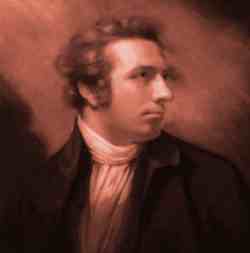
Henry Fuseli was a painter, draughtsman and writer on art. Although Swiss he spent much of his life in Great Britain. He was born in Zurich, Switzerland on 7th February 1741 and died in Putney, London on 16th April 1825 aged 84.
Major Works
“The Nightmare” (1781)
“Christ Disappearing at Emmaus” (1772)
“The Shepherd’s Dream” (1793)
“The Night-Hag Visiting Lapland Witches” (1796)
Biography Timeline
1741: Henry Fuseli (originally Füssli) was born on 7th February in Zurich, Switzerland. He was the son of the portrait painter, Johann Caspar Füssli and was the second of eighteen children. His father intended for him to enter the Zwinglian church and he was educated at the Caroline College of Zürich, where he received a full classical education. He became friends with the future poet Johann Kaspar Lavater.
1761: He takes holy orders but after he and Lavater expose a corrupt Magistrate he is forced to renounce the priesthood and leave the country.
1764: He travels through Germany and in Berlin at the suggestion of the British Ambassador there, who is impressed with his drawings, he moves on to London, England. He works on a translation of Winckelmann’s “Reflections on the Painting and Sculpture of the Greeks”.
1765: In London meets Sir Joshua Reynolds who encourages him to take up painting.
1770: At Reynold’s suggestion he leaves England to study painting in Italy. In Rome he is particularly influenced by the works of Michelangelo Buonarroti. He decides to adopt the more Italian sounding surname Fuseli.
1779: Early in the year he returns to London after a short stay in Zurich.
1781: He paints perhaps his most famous picture “The Nightmare”.
1782: “The Nightmare” is shown at the Summer Exhibition at the Royal Academy in London for the first time and is an instant success. His father dies.
1783: An engraving is made of “The Nightmare” which further popularises the image and encourages him to continue painting variations on a similar theme.
1786: John Boydell asks several artists to contribute works for his proposed Shakespeare Gallery and he is one of the original contributing artists. He paints several pictures including “Macbeth”. The poet, painter and visionary William Blake declares him to be the only painter he can appreciate.
1788: He marries Sophie Rawlins who was originally one of his models. His new wife puts an end to the relationship he had had with the feminist Mary Wollstonecraft whose portrait he had once painted. He writes essays for the “Analytical Review” and is a constant visitor to the home of publisher Joseph Johnson along with Thomas Paine, Joseph Priestley, Erasmus Darwin and Wollstonecraft herself. He is elected an Associate of the Royal Academy.
1789: Boydell’s Shakespeare Gallery opens in London but is not a success with the public.
1790: He is elected as a Full Academician at the Royal Academy offering “Thor Battering the Midgard Serpent” as his diploma work.
1793: He paints “The Shepherd’s Dream”.
1796: He paints “Night-Hag visiting the Lapland Witches.”
1799: He opens a Milton Gallery in Pall Mall in London focussing on the works of the poet John Milton. He exhibits forty-seven of his paintings including “Paradise Lost”. It too is a commercial failure and closes in 1800. He is made Professor of Painting at the Royal Academy.
1801: He begins a series of twelve lectures on art and painting at the Royal Academy which are later printed.
1804: He is appointed Keeper of the Royal Academy and resigns his professorship. His friend William Blake makes engravings of several of his works.

1805: He publishes an edition of Matthew Pilkington’s “Lives of the Painters” but again this does not sell well.
1810: He is again elected as professor of painting at the Royal Academy and amongst his many students are John Constable, Benjamin Haydon and Edwin Landseer.
1817: The Italian painter Antonio Canova, on visiting England, is impressed with Fuseli’s work and when he returns to Rome arranges for him to be elected a member of the First Class in the Accademia di San Lucca.
Henry Fuseli died on 16th April 1825, at the house of the Countess of Guildford on Putney Hill in London, England. He was buried in St Paul’s Cathedral crypt, London next to Sir Joshua Reynolds.
Influences
Henry Fuseli was influenced by the works of William Shakespeare, especially “Macbeth” and “The Tempest”and painted numerous paintings inspired by his plays such as “Hamlet” and “A Midsummer Night’s Dream”. He was also influenced by the poetry of John Milton being an avid reader of “Paradise Lost” and even produced an exhibition of forty-seven paintings known as the “Milton Gallery”. He was fascinated by Gothic fiction such as Horace Walpole’s “The Castle of Otranto” and the Sturm and Drang movement in Germany and this combined in his style which was dramatic and romantic with supernatural imagery but with a classical structure.
One of his first long-term supporters in London was the banker, Thomas Coutts (1735–1822) who financed his studies in Rome. This gave him a grounding in classical art and myths and he was particularly influenced there by the work of Michelangelo Bounarroti, especially his sculptures, and he copied his muscular and highly dramatic figure poses in his work. He was also exposed to Mannerist art in Italy and this influenced him to use of dramatic chiaroscuro (contrasts in light and shade). He became acquainted with the Swedish sculptor Johan Tobias Sergel and they formed an up-and-coming group of young artists.
He had had a through classical education and when he returned to England, he could hold his own amongst the intellectual community in London which included radicals such as William Blake and the bookseller, publisher and anti-slavery campaigner Joseph Johnson (publisher of “The Interesting Narrative of the Life of Olaudah Equiano” (1789)). Discussions would go on long into the night. He had originally showed his paintings to Sir Joshua Reynolds, the President of the Royal Academy, who encouraged him to pursue it as a career.
Much of his work is personal and “The Nightmare” of 1781 is widely believed to be based on his unrequited love for Anna Landolt the niece of his friend Johann Kaspar Lavater. The painting has an unfinished portrait of Landolt on the rear of the canvas. He was also fascinated by the dynamic between the sexes. He was also probably influenced by the emerging theories of sleep disorders, night terrors, and waking dreams then prevalent. This interest in the supernatural and the inner world led many critics and artists themselves to see him as a precursor to the twentieth century Surrealists.
In the late 1790s, he was supported financially by William Roscoe (1753–1831) another anti-slavery campaigner, banker and lawyer who published “The Wrongs of Africa” (1787-8) with profits going to the newly formed Abolition Committee in parliament. Fuseli himself painted “The Negro Avenged” in 1806-7. In all he painted more than two hundred pictures, but exhibited only a small number. He rarely drew figures from life, basing work on a study of the antique styles and Michelangelo.
The early feminist Mary Wollstonecraft whose portrait he had painted, planned a trip with him to Paris but their relationship later soured. In 1788 he married Sophia Rawlins who was one of his models and often explored their erotic side in his art. He was also elected an associate of the Royal Academy, becoming a full academician in 1790. He was twice professor of painting there and appointed keeper of the Academy in 1804.
Two of his famous students at the Royal Academy of Art were William Blake and John Constable and many of his contemporaries such as George Romney, James Barry, John Flaxman and Fortunato Duranti, were also influenced by his style. J.M.W. Turner would have also seen his work at the Royal Academy. Theodor von Holst would later clearly be indebted to him as would the Pre-Raphaelite Dante Gabriel Rossetti.
In literature writers such as Mary Shelley and Edgar Allan Poe where heavily influenced and he is credited with giving rise to the genre of Gothic horror.
The popularity of “The Nightmare” led to its widespread use in political satire by people such as Thomas Rowlandson and James Gillray and it was used to caricature characters as diverse as Napoleon Bonaparte and Charles James Fox.
Further Information
Examples of paintings by Fuseli.