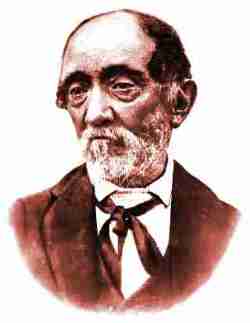
Girolamo de Rada was an Albanian playwright, poet and journalist. He was born on 29th November 1814 in Macchia Albanese, Cosenza, Calabria, Italy and died on 28th February 1903 in Calabria, Italy aged 88.
Major Works
“Këngët e Milosaos” (The Songs of Milosao), (1836)
“Canti Storici Albanesi di Serafina Thopia, Moglie del Principe Nicola Ducagino” (Albanian Historical Songs of Serafina Thopia, Wife of Prince Nicholas Dukagjini) (1839)
“I Numidi” (The Numidians) (1846)
Biography Timeline
1814: Girolamo de Rada (known in Albanian as Jeronim De Rada) was born on 29th November in Macchia Albanese, Cosenza, Calabria, Italy. His father was a parish priest in the Italo-Albanian Catholic church and his ancestors are believed to have migrated from Diber County, Albania. Girolamo studied at the college of St Adrian in San Demetrio Corone which was popular with those of Albanian descent and he began collecting folklore.
1834: In October he travels to Naples to study law at the University to fulfil the wishes of his father but his main interest still lies with folklore and literature.
1836: He publishes his best-known Albanian-language poem, the “Songs of Milosao”, under the Italian title “Poesie Albanesi del Secolo XV. Canti di Milosao, Figlio del Despota di Scutari” (Albanian Poetry from the 15th century. Songs of Milosao, Son of the Despot of Skudara). This long romantic ballad is known in Albanian as “Këngët e Milosaos” and concerns a fictitious young nobleman called Shkodra (Scutari), who has returned home from Thessalonica in Greece. Rada is forced to abandon his studies due to an outbreak of cholera in Naples and returns home.
1839: His second work is “Canti Storici Albanesi di Serafina Thopia, Moglie del Principe Nicola Ducagino” (Albanian Historical Songs of Serafina Thopia, Wife of Prince Nicholas Dukagjini”. It is banned by the Bourbon authorities as he has allegedly become part of conspiratorial groups fighting for the Italian Risorgimento (unification movement). (It is republished under slightly different tiles in 1843 and again in 1897).
1846: He writes his Italian-language historical tragedy “I Numidi” (The Numidians) in Italian which does not prove popular and he revises it in 1892 as “Sofonisba, Dramma Storico”. By now his reputation is as the foremost among Arbëresh (Italian Albanians) writers in the Albanian language.
1848: During the year of revolutions he founds the newspaper “L’Albanese d’Italia” (The Albanians of Italy) which includes articles in Albanian and Italian. It covers politics and literature the first Albanian-language periodical anywhere in the world. His vision of an independent Albania grows stronger as the nineteenth century progresses.
1878: The Albanian League is formed in Prizren to spur Albanians to win independence from the Ottoman Empire (finally occurs in 1912 after his death) and Albanians in exile in Turkey, Romania, Bulgaria and as far away as the United States of America begin to form literary societies. This begins the Rilindja period of Albanian Renaissance and the formation of an Albanian literature.
1881: He outlines his views on Albania’s future with a country divided into three units based upon religion but all within a federal state.
1883: In July he founds the first all Albanian periodical, “Fiámuri Arbërit” (The Albanian Flag) in Consenza, Italy which continues until 1888. It covers Albanian literature, politics and history and becomes very popular.
1886: He opposes proposals by the Greeks of a Balkan federation as he fears any unification with Greece would bring the end of Albanian existence. He then sides with the Ottomans against any insurrections from outside hoping the Ottoman Empire will eventually grant Albanians their socio-political rights.
1895: In October, along with fellow Italo-Albanians, the poet Giuseppe Schiro and the politician and writer Anselmo Lorecchio, he organises a congress on Albanian national self-determination in Corigliano Calabro north of Cosenza.
1897: A second congress is held in Lungro in February.
Girolamo de Rada died on 28th February 1903 in San Demetrio Corone, Calabria, Italy where he was also buried.
Influences
Girolamo de Rada was well read in Greek and Roman culture which he studied at the Italo-Albanian College of Sant’Adriano. He was also influenced by German and English Romanticism particularly Friedrich August Wolf’s “Prolegomena ad Homerum”, as well as the philosophers René Decartes, Immanuel Kant and the Italian Giambattista Vico. Wolf’s views had encouraged him to delve deeper into the narrative aspects and motifs found in pre-Romantic German and English literature.
His own heritage in Calabria was Arbëresh (Albanians in Italy) and he saw Albanians as direct heirs of ancient peoples such as the Epirotes and Macedonians and wanted to see an Albanian Renaissance.
He made great use of folk motifs and Arbëresh folk songs, such as the Frascineto Manuscripts, in his work and was encouraged by the lawyer Raffaele Valentini to do so. He became a key figure in the Rilindja (Renaissance) and used his magazine “Fiamuri Aebërit” (The Albanian Flag) to promote Albanian identity, history, and independence. In some of his work such as “The Songs of Milosao” he combined Arbëresh dialect words with broader European literary styles. In the “Antichità della Nazione Albanese” (Antiquities of the Albanian Nation) he outlines his historical vision of Albanian continuity in a direct line from antiquity.
In his aesthetic works and treatises, he was influenced by several thinkers and writers including Madame de Staël. In 1881 in politics, he envisioned Albania to be split into three areas based on religion all within a federal state and by 1886, he was opposing the proposals by the Greeks of the formation of a Balkan federation wishing to remain separate from Greece as he felt any unification would mean the end of Albanian existence. He maintained a policy of siding with the Ottomans against common enemies and disapproved of any anti-Ottoman insurrection in the hope that the Ottoman Empire would grant Albanians their independent political rights.
His 1866 folklore collection published in Florence attracted the attention of many prominent scholars and writers of Europe of the time and highlighted the culture and national issues of the Albanian people. It was still being discussed by academics in the Twentieth Century and through to today. De Rada himself realised that the traditional songs he had collected in the Arbëresh villages of Calabria were not as he originally thought part of the Albanian national epic of the fifteenth century, but unrelated epic songs, without any thematic unity between them. Some of foreign Albanologists, such as Dozon and Meyer, still believed them to be part of national poem and so De Rada changed the title of his collection to the “National Rhapsody” in the second edition. At the time James Macpherson’s Songs of Ossian were extremely popular and only later did scholars realise that the songs he had allegedly translated from the Gaelic in Scotland were indeed written by himself, nevertheless intellectuals throughout Europe found in Ossian’s Songs a model for the invention of so-called national poems. In Germany, Johann Gottfried von Herder had published the first collection of German folk songs, “Stimmen der Völker” and later Clemens Maria Brentano and Ludwig Achim von Arnim were inspired to publish another folklore collection, “Des Knaben Wunderhorn”. In Italy too, the scholar Niccolò Tommaseo took a keen interest in De Rada’s folklore collection and compiled his own national version.
Many future generations of Albanian writers, intellectuals, and patriots were influenced by him to foster national identity, culture, and the dream of independence, in particular the poet Giuseppe Schirò and the collector of fairy tales Kristina Gentile Mandala. The politician and poet Gabriele Dara the Younger, and the twentieth century poet Domenico Bellizzi, known under the pseudonym of Vorea Ujko were also influenced by him.
The Nobel laureate Ismail Kadare acknowledged De Rada as a foundational figure who kept Albanian poetry and the dream of freedom alive during dark times and a profound shaper of modern Albanian literature. He was also a man who fostered a strong sense of shared history and identity among Albanians in Italy and the Balkans.
Further Information
List of works by de Rada.