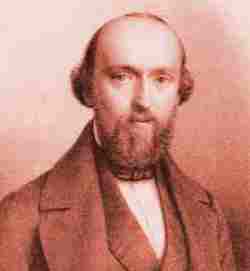
Friedrich Burgmüller was a German pianist and composer during the Romantic period. He was born on 4th December 1806 in Regensburg, Germany and died on 13th February 1874 in Marolles-en-Hurepoix, France aged 67.
Major Works
“Souvenirs de Ratisbonne” (or the “Peasant Pas de Deux”) (1841)
“25 Études Faciles et Progressives” (25 Easy and Progressive Studies) for early intermediate students.
“La Péri” (1843).
Biography/Timeline
1806: Johann Friedrich Franz Burgmüller was born on 4th December in Ratisbon, Regensberg in Germany. His father Friedrich August was a musical theatre director and composer in Weimar, Germany. His mother was Therese von Zandt, a pianist and singer.
1824: His father dies and Friedrich applies unsuccessfully for his job as Director of music in Düsseldorf and so he teaches music in Mühlhausen and plays the cello in Basel, Switzerland.
1829: He moves to Kassel in Germany to study with the composer Ludwig Spohr, a contemporary of Ludwig van Beethoven, and the theorist Moritz Hauptmann.
1830: He appears in his first concert as a pianist on 14th January.
1832: He moves to Paris where he adopts Parisian music and develops a light style of playing the piano. He goes on to write several pieces of Salon music including waltzes, polonaises and nocturns and his popular “Ballade”. He also writes three collections of etudes (studies) for children. Op.100, Op.105 and Op.109 remain as popular today as when they were written. They include such pieces as “Les Perles” (The Pearls) and “L’Orage” (The Storm).
1835: His younger brother Norbert, also a musician, makes plans to join him in Paris however he sadly dies by drowning in a spa in Aachen during an epileptic seizure in 1836. Friedrich champions his brother’s music (which was acclaimed by Robert Schumann and Felix Mendelssohn) for the rest of his life.
1838: He composes “La Cachucha”, Op.36.
1840: He composes “Souvenir de Schönbrunn” Op.32.
1841: He becomes known for his piano pieces and “Souvenirs de Ratisbonne” (or the “Peasant Pas de Deux”) is used in and becomes an integral part of, Adolphe Adam’s ballet “Giselle”. He composes “Corbeille de roses, Op.68”.
1843: His ballet “La Péri”, with choreography by Jean Coralli, is premiered by the Paris Opera Ballet at the Academie Royale de Musique on 17th July. He also composes another ballet “Lady Harriet” at an unknown date.
1844: He now withdraws from public performing and concentrates on teaching his students the piano. (Allegedly these include the children of King Louis Phillippe). He does however continue private playing at Paris salons. He buys a summer residence in Beaulieu, near Fontainebleau to retreat to.
1853: He composes “Murmures du Rhone” Op.66.
1865: He composes “Ay Chiquita”.
Friedrich Burgmüller died on 13th February 1874 in Marolles-en-Hurepoix, to the south of Paris, France and is buried there. He never married or had children.
Influences
Friedrich Burgmüller was influenced by his early teachers Ludwig Spohr and Moritz Hauptmann in Kassel Germany and later by Parisian music from which he developed his own light playing style after he moved there in 1832.
He was quite prolific and composed waltzes and nocturnes to his own piano pieces and even two ballets but never achieved the fame of other composers. His most performed work in the theatre is the “Peasant Pas de Deux” which was used as a part of Adolphe Adam’s ballet “Giselle” premiered in 1841.
To earn a living he wrote pieces that appealed to the burgeoning market for teaching the piano which were still in use a century and a half afterwards. His children’s “25 Études Faciles et Progressives” (Easy and Progressive Studies), Op. 100 and “Characteristic Studies”, Op. 109 are the best known and widely used. He also wrote Op. 105 and 109 for more advanced students. His happy musical tone and extensive use amongst learners in Western Europe have probably given him more influence over musical life than many other more well-known composers.
Further Information
List of compositions by Burgmuller.