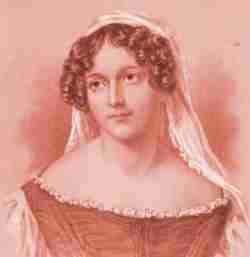
Felicia Dorothea Hemans was an English/Welsh Romantic poet and playwright known for the “The Stately Homes of England”. She was born on 25th September 1793 in Liverpool, England and died on 16th May 1835 in Dublin, Ireland aged 41.
Major Works
“Poems by Felicia Dorthea Browne” (1808)
“Coeur De Lion at The Bier of His Father” (1825)
“Casabianca” (1826)
“The Homes of England” (1827)
“Records of Women” (1828)
Biography Timeline
1793: Felicia Dorothea Hemans was born on 25th September in Liverpool. Her father was George Browne, who worked for his father-in-law’s wine business and later became Consul to the Grand Duchy of Tuscany in Italy. Her mother was Felicity, daughter of Benedict Paul Wagner also a wine importer from Liverpool and Consul for the state of Venice. She was the fourth of six children who survived infancy. Her father’s business meant they soon moved to Gwrych Castle grounds near Abergele, Denbighshire in North Wales a country where she was to spend her youth until she was sixteen and always felt she was more Welsh than English.
1808: She publishes “Poems” written between the ages of eight and thirteen and dedicated to the Prince of Wales. The book catches the eye of Percy Bysshe Shelley who writes to her about it. It is the first in a series of twenty-four volumes of her poetry. Her second book is a narrative poem called “England and Spain, or, Valour and Patriotism”. It describes her brother’s service in the Peninsula War in Spain and calls for an end of the tyranny of Napoleon Bonaparte.
1809: The family move to Bronwylfa, in St Asaph in Flintshire, Wales. She has a broad education and becomes fluent in Welsh, French, German, Italian, Portuguese and Spanish.
1812: On 30th July she marries Captain Alfred Hemans, an Irish army officer who is much older than her. The couple move to Daventry in Northamptonshire and whilst there her poetry helps support a growing family of five sons. She publishes “The Domestic Affections and Other Poems” by Felicia Dorothea Browne.
1816: John Murray, the publisher of Jane Austen, Walter Scott and Lord Byron takes on her works. She publishes “On the Restoration of the Works of Art to Italy” which runs to two editions.
1817: She publishes “Modern Greece”.
1818: She publishes “Translations from Camoens and Other Poets, with Original Poetry”.
1819: She separates from her husband but continues writing as a single parent as she moves in with her mother who looks after the household. She publishes “Tales and Historic Scenes”.
1822: She publishes “Welsh Melodies“.
1823: She publishes her play “The Vespers of Palermo” for which she was paid two hundred guineas but it was not a success even though it appeared in Covent Garden in London and also in Edinburgh. She also produces “The Siege of Valencia”.
1825: She publishes another major poetry collection which includes the popular “The Forest Sanctuary” and “Lays of Many Lands“
1826: In August her famous poem “Casabianca” is published in Volume Two of “The Monthly Magazine”. (It is often known as “The boy stood on the burning deck” due to one of its lines). The ballad is about Captain Luc-Julien-Joseph Casabianca and his thirteen-year-old son, Giocante who both get killed on board the ship the “Orient” during the Battle of the Nile in 1798 when the ship’s magazine explodes.
1827: On 11th January her mother dies and Felicia sends her two oldest boys to join their father in Rome and moves back to Liverpool herself with the rest of her family. She publishes “The Homes of England” which coins the phrase “stately home”.
1828: She begins writing “Records of Women” where she examines the lives of women, both famous and anonymous, who portray heroism, rebellion or resistance. She publishes the pamphlet “The Sceptic” where she asks for an Anglicanism more attuned to other religions and women’s real-life experience. By now she is a literary celebrity, admired by the likes of William Wordsworth and Walter Scott.
1830: She publishes “Records of Woman and Songs of the Affections” which becomes very popular.
1831: She moves to Dublin in Ireland to be near her brother General Browne, Commander of the Forces in Ireland, as her doctors recommend it as a healthier environment than Liverpool. Despite the move her health does not improve.
1834: She publishes her last books “Scenes and Hymns of Life” and “National Lyrics, and Songs for Music”.
Felicia Dorothea Hemans died on 16th May 1835 in Dublin, Ireland. The cause was either scarlet fever, oedema or rheumatic fever according to different medical interpretations and had lost the use of her legs due to a stroke. She was buried in St Ann’s Church, in Dawson Street, Dublin Ireland. At the time of her death she was as popular in the United States of America as in Great Britain. Her sister Harriett edited her complete works in seven volumes in 1839. The five act tragedy “De Chatillon” (The Crusaders) is published posthumously.
Influences
Felicia Hemans was influenced by several aspects of the Romantic movement as well as her own domestic experiences. She read widely in numerous languages under her mother’s tutelage in the family library and developed a passion for the works of William Shakespeare and John Milton by the age six. Her work often explored nature, current and past history, and the emotional lives of women. The two main writers she followed were William Wordsworth whom she wrote the poem “To Wordsworth”, and Lord Byron as well as the seventeenth century poet George Herbert and the Scottish poet Thomas Campbell. Her life was also driven by the need to earn money to support her children due to her husband’s prolonged absence and eventual divorce. Both her husband and brothers saw service in the army during the French Revolutionary and Napoleonic wars and her poems often explored patriotism versus the human cost of war.
She became a literary celebrity publishing nearly four hundred poems during her lifetime, largely through the periodicals of the time and was immensely popular. She was honoured by people of the stature of Sir Walter Scott and won several literary prizes, and was translated into other languages in Europe. Other writers such as Samuel Taylor Coleridge and Percy Shelley admired her work.
During the 1820s she became an ardent feminist and wrote two long poems which railed against the dangers for British families of male patriotic sacrifice. Her 1828 collection “Records of Woman” explores female experiences and she often wrote about women trying to escape from patriarchal control even to the extent of suicide. Her works were published in nineteen individual books during her lifetime, such was her popularity, and many were republished after her death. She was the sole female poet of the Romantic period to appear with male contemporaries in collections in both the nineteenth and twentieth centuries. Several female poets of her age were influenced by her work including Caroline Norton, Letitia Elizabeth Landon, Lydia Sigourney and Frances Harper in England and Amable Tastu in France and Annette von Droste-Hülshoff in Germany. When she died William Wordsworth, among others, wrote a eulogy and songs, poems and biographies were written about her. However, nowadays she is largely known for the 1827 work “The Homes of England” with the lines “The Stately homes of England, how beautiful they stand” and is widely credited with inventing the term stately home. Noël Coward parodied the poem in a song during the twentieth century. Almost as famous and also often parodied is the line “The boy stood on the burning deck” from her poem “Casabianca”. Her stature during her lifetime gradually declined due in part to her popularity and her works were then largely collected in books aimed at children. Schoolchildren in the United States were still learning “The Landing of the Pilgrim Fathers in New England” as late as the middle of the twentieth century.
Her style fell completely out of favour with the rise of modernism in the twentieth century as they were seen to be overly sentimental but in the 1980’s the rise of feminism and historicism brought a revival of interest in her work and many critics have re-evaluated them, particularly in America, and she has again begun to appear in anthologies.
Further Information
Examples of poetry by Felicia Dorothea Hemans.