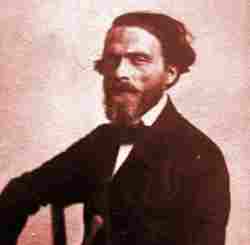
Cyprian Kamil Norwid was a Polish poet, dramatist, painter, and sculptor. He is regarded as one of the second generation of romantic poets in that country. He was born in Gluchy, Poland on 24th September 1821 and died in Paris on 23rd May 1883 aged 61.
Major Works
“Wanda” (1851)
“Poezje” (Poems) (1862)
“Krakus” (1863)
“Milczenie” (Silence). (1882)
Biography
1821: Cyprian Kamil Norwid was born on 24th September in Laskowo-Głuchy, near Warsaw, Poland. His father was a minor government official and a member of the minor polish nobility.
1825: His mother dies when he is aged four.
1835: His father also dies and so Norwid and his brother Ludwik are orphaned and looked after by other members of the family. He is educated at schools in Warsaw.
1836: He enters a private art school and studies under Aleksander Kokular. From then on, he is self-taught in other subjects.
1840: The periodical “Pismiennictwo Krajowe” publishes his poem “Moj Ostatni Sonet”. His early work including a short story are praised and he tours the literary salons in Warsaw where he is seen as a “rising star”.
1841: He begins his travels through Congress (or Russian) Poland with Wladyslaw Wezyk.
1842: He receives an inheritance and a private scholarship and travels to Dresden in Germany and then on to Venice and Florence. He signs up for a sculpture course at the Accedemia di Belle Art di Firenze in Florence. His visit to Verona gives rise to the poem “W Weronie” (In Verona) which is published several years later.
1844: He settles in Rome and breaks with Kamila, his fiancé. He then travels to Berlin and attends several university lectures. He meets Maria Kalergis whom he is besotted with but both his proposals to her and her lady-in-waiting Maria Trebicka come to nothing. He refuses to join the Russian diplomatic service and has his passport taken away and then is arrested and imprisoned in Berlin for trying to cross into Russia without a passport.
1846: He is forced to leave Berlin by the authorities and moves to Brussels, Belgium.
1848: Escaping the 1848 Revolutions in many European countries he lives in Rome where he meets other polish intellectuals including Adam Mickiewicz and Zygmunt Krasinski.
1849: He moves to Paris where he meets fellow Poles Fredric Chopin and Juliusz Slowacki and attends salons given by Emma Herwegh. His sight and his hearing is beginning to fail and he is impoverished as his works are not selling. He publishes “Piesn Spoleczna” (Social Song) and writes for “Goniec Polski”, the Parisian journal in the Polish language.
1851: He writes the play “Zwolon” and a philosophical poem about the nature of art called “Promethidion”. The latter is not well received by the critics. He also puts the finishing touches to his drama “Wanda” and writes the poem “Bema Pamieci Zalobny Rapsod” (A Funeral Rhapsody in Memory of General Bem).
1852: He decides to travel to the United States in the autumn having received sponsorship from a Polish Nobleman, Wladyslaw Zamoyski.
1853: He arrives in New York City on 11th February aboard the liner “Margaret Evans”. He does a number of jobs such as a graphic designer for an album on the Crystal Palace Exhibition in London and the Exhibition of the Industry of all Nations in New York. In the autumn he hears about the Crimean War and decides to return to Europe after being disillusioned with the lack of history in the USA.
1854: He sails to England during April with Prince Marcelli Lubomirksi and lives there for a while and then moves on to Paris where he lives an impoverished life.
1856: His stories are collected as “Czarne Kwiaty” (Black Flowers) and “Biale Kwiaty” (White Flowers) published in the newspaper “Czas” over the next two years.
1857: He publishes the “Quidam Przypowiesc” (Quidam: A Story)
1859: Whilst in America he had become a supporter of the abolitionist movement and he now writes two poems about John Brown “Do Obywatela Johna Brown” (To Citizen John Brown) and “Johna Brown” (John Brown).
1860: He gives six lectures on Juliusz Słowacki which are published the following year.
1862: He publishes his poetry anthology “Poezje” (Poems) in Leipzig.
1863: He writes the play “Krakus” and follows keenly the Polish-Lithuanian uprising against the Russians, although his ill health prevents him from getting physically involved.
1865: “Fortepian Szopena” (Chopin’s Piano) has been seen as his response to the January Uprising which talks about the Russian troops throwing Chopin’s piano put of the window from the music school Norwid once attended. He also writes the play “Za Kulisami” (Behind the Scenes) but it meets with little success.
1866: He completes work on “Vade Mecum” an anthology of verse, but he cannot find a publisher.
1867: He writes the comedy “Aktor. Komediodrama” (Actor. Comedy-drama).
1869: He writes the long poem “Rzecz o Wolnosci Slowa” (A Poem About the Freedom of the Word).
1870: During the Franco-Prussian war Norwid is starving and his health further declines.
1871: He writes “Assunta” a poem about Christian love.
1872: He writes the play “Pierscien Wielkiej Damy” (The Ring of a Grand Lady), although, in common with a lot of his works it is not published or appreciated until the following century.
1877: His cousin Michal Kleczkowski pays for him to move into St Casimir’s Institute Nursing Home, run by Polish nuns, in Ivry on the edge of Paris. He is befriended by the exiled Teodor Jelowicki who provides him with some money.
1880: He writes the comedy “Milosc Czyata u Kapieli Morskich” (Pure Love at Sea Baths)
1881: He begins to write the novels “Ad Leones” and “Stygmat” (Stigmata).
1882: He writes the philosophical treatise “Milczenie” (Silence).
1883: He writes “Tajemnica Lorda Singelworth” (The Secret of Lord Singelworth). Many of his works were not appreciated at the time due to their difficult and idiosyncratic literary style
Cyprian Kamil Norwid died on 23rd May 1883 in Paris of tuberculosis after weeks of being bedridden. The funeral costs were covered by Jełowicki and Kleczkjowski. After fifteen years he was moved to a mass grave of impoverished polish emigrants in Paris’ Montmorency Cemetery as the funds had run out. (On 24th September 2001 an urn of soil from this grave was buried in the “Crypts of the Bards in Wawel Cathedral in Krakow, Poland next to fellow Polish poets Adam Mickiewicz and Juliusz Słowacki).
Influences
Cyprian Norwid had a strong Christian faith which was at the basis of his entire philosophy. He saw poetry as a vehicle for moral education and a search for truth and values. He was also fascinated by Ancient Greek history and the philosophy of Plato which he interwove with his Christian beliefs.
He was well read in early Christian writings and was particularly influenced by the medieval song “Bogurodzica” (The Mother of God). He saw the Church as a resistance against totalitarianism and sought to include his national destiny along with God’s will.
He is considered a second-generation Polish Romantic poet, although his style was often different from other members of the movement and some critics have seen Classicism and the discipline of Parnassianism in his work.
He spent much of his life abroad as part of the Polish “Great Emigration” (Polonia) in Europe. He lived particularly in Paris where the ideas of the French Revolution were still prevalent, as well as Italy, London and Germany and he met a diverse range of European intellectuals and artists who helped further shape his thought. He published many essays that commented on current political events. He was also in contact with key figures of the Polish political and cultural elite also forced to live in other countries, such as Adam Mickiewicz, Frédéric Chopin, Zygmunt Krasiński and Juliusz Słowacki but on the whole was a recluse, particularly as his deafness became more profound. His views have been seen by some critics as similar to the national philosophy of August Cieszkowski with his concept of action as a conscious transformation of social life through the realisation of philosophical ideas in reality and in accordance with divine ordination.
The patron of the arts Maria Kalergis became a significant help to him but despite this his life was marked by poverty, unrequited love, and a lack of recognition for his work during his lifetime. The only selection of his works to be published in his lifetime was “Poezje” (Poems) published 1863 in Leipzig but which gained little response. His poetry is challenging, intellectual, and devoid of the descriptiveness typical of Romantic poetry.
In “Promethidion: Rzecz w Dwoch dDalogach z Epilogiem” (Promethedion – A Work in Two Dialogues with an Epilogue) he presents his programme of “New Prometheanism” which extols labour in general terms and proclaims that labour incessantly produces beauty in daily life. This is in opposition to Romantic Prometheanism, which he describes as an apologia of rebellion, struggle, and extreme action.
Besides being a poet, he was an accomplished painter, sculptor and engraver. He believed in the social and moral responsibility of art, believing it should serve truth and social progress not just beauty and he strove in his work to make the development and modernisation of society his ideal, although he felt it was part of a divine plan. He was also a master of the novella, many of which consist of original content, precise language and build general theories from details, episodes or single objects.
After his death much of his work was forgotten only to be looked at anew during the Young Poland period at the beginning of the twentieth century. He was discovered and popularised by the polish modernist poet and critic Zenon Przesmycki who began saving and republishing his works in his periodical “Chimera”. His “Dzieła Zebrane” (Collected Works) were published in 1966 by the biographer Juliusz Wiktor Gomlicki but the definitive version was published between 1971 and 1976 in eleven volumes as “Pisma Wszystkie” (Complete Works). This included letters and reproductions of his artwork. His “Pisma polityczne i filozoficzne” (Political and Philosophical Writings) were published sometime later.
The philosopher and critic Stanislaw Brzozowski valued his acknowledgement of poverty and the working class as well as the beauty of industrial civilisation. Writers such as Tadeusz Micinski, Stanislaw Wyspiański, Stefan Zeromski and Jan Lechon were influenced by him although he was little known in the English speaking world. The theatre directors Wilam Horzyca, Kazimierz Dejmek, and Kazimierz Braun successfully staged his plays, such as “Noc Tysieczna Druga” (The Thousandth and Second Night) during the mid twentieth century. The Nobel Prize-winning Polish poet and essayist Czesław Miłosz was impressed by his “intense historicism” and philosophical depth and the science fiction writer Stanisław Lem was influenced by his work, as was the Yiddish poet Abraham Sutzkever. The English writers Gerard Manley Hopkins, G.K. Chesterton, J.R.R. Tolkien and C.S. Lewis, have all been compared to Norwid due to their focus on medieval Christian harmony or the spiritual shortcomings of modern society.
In the twentieth century he was often considered the fourth important poet of Polish romanticism, after the three bards (Adam Mickiewicz, Juliusz Slowacki and Zygmunt Krasiński) and some critics have even stated that he was more important than Krasiński and should be considered the third bard instead of fourth. He was the subject of narrative biographies by Hanna Malewska “Żniwo na Sierpie” (The Harvest on the Sickle) in 1947 and again by Lew Kaltenbergh in 1965 with “Dno Czary” (The Bottom of the Goblet).
Further Information
List of books by Norwid.