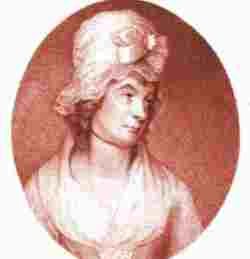
Charlotte Smith was an English poet and novelist linked with the school of sensibility. She was born on 4th May 1749 in London and died on 28th October 1806 in Tilford, Surrey, England aged 57.
Major Works
“Elegiac Sonnets and Other Essays” (1784)
“Emmeline; or, The Orphan of the Castle” (1788)
“Desmond” (1792)
“The Old Manor House” (1793)
“The Young Philosopher” (1798)
“Conversations Introducing Poetry for the Use of Children” (1804)
Biography Timeline
1749: Charlotte Smith (nee Turner) was born on 4th May in London. Her father was the prosperous but high spending Nicholas Turner and her mother was Anna Towers. She was the eldest of three children.
1752: Her mother dies in childbirth and her father goes on his travels leaving the children to be raised by their maternal aunt, Lucy Towers.
1755: She goes to school in Chichester and takes drawing lessons with the artist George Smith.
1757: She moves to London with her aunt and attends a girl’s school in Kensington where she loves to read and write poems. The “Lady’s Magazine” do not accept her poetry for publication.
1765: Her father returns to England and sells some of the family’s possessions. He marries the wealthy Henrietta Meriton. Still poor her father betroths the fifteen-year-old Charlotte to marry and on 23rd February she weds the violent and unfaithful Benjamin Smith (a fact she later describes as prostitution). Smith is the son of Richard, a wealthy West Indian merchant who owns sugar plantations in Barbados. The marriage is unhappy and she hates living in Cheapside and is laughed at by her in-laws due to her book learning
1766: She gives birth to her first child.
1767: She gives birth to Benjamin Berney.
1768: She gives birth to William Towers.
1770: She gives birth to Charlotte Mary Braithwaite.
1771: She gives birth to Nicholas Hankey.
1773: She gives birth to Charles Dyer.
1774: She gives birth to Anna Augusta. She persuades her father-in law Richard to set her son Benjamin up as a gentleman farmer in Hampshire and goes to live with him at Lys Farm, Bramdean until 1783.
1776: She gives birth to Lucy Eleanor. Richard dies but her husband’s inheritance is tied up in chancery for the next forty years.
1778: She gives birth to Lionel.
1782: She gives birth to Harriet.
1783: Benjamin illegally spends some of his inheritance and ends up in a debtor’s prison during December. She moves in with him and begins to write “Elegiac Sonnets”.
1784: “Elegiac Sonnets and Other Essays” is published and is an instant success allowing her to buy her husband out of prison. She signs herself “Charlotte Smith of Bignor Park”. The family move to Dieppe in France to avoid their creditors. Charlotte negotiates with them but fails to receive an agreement and returns to France. She begins translating works from French into English.
1785: The family return to England and move to Woolbeding House in Midhurst. She gives birth to son George.
1786: She is forced to withdraw her translation of “Manon Lescaut” by Antoine Francois Prevost after the work is deemed immoral.
1787: On 15th April she finally leaves her abusive husband and continues writing to support her children. She moves to a town outside Chichester and decides to write novels rather than poetry as they are more lucrative. She publishes “The Romance of Real Life” about the trials of Francois Gayot de Pitaval.
1788: She publishes her first novel“Emmeline; or, The Orphan of the Castle” which is a success selling over a thousand copies.
1789: She publishes “Ethelinde; or, The Recluse of the Lake”.
1791: She publishes“Celestina”. She becomes involved with English radicals whilst living in Brighton and supports the republican principles of the French Revolution. She meets William Wordsworth on his journey to France.
1792: She publishes “Desmond”.
1793: She publishes “The Old Manor House” which is set during the American War of Independence to disguise her unpopular views about French republicanism. It is often deemed her best novel and is praised by Walter Scott. Now famous she becomes a friend of Samuel Taylor Coleridge, Erasmus Darwin and Richard Brinsley Sheridan amongst others and her works are reviewed in several periodicals such as “The Critical Review” and the “Gentleman’s Magazine”.
1794: She publishes “The Wanderings of Warwick” and “The Banished Man”.
1795: She publishes “Montalbert”. Her daughter Anna Augusta dies leaving her distraught. She publishes the children’s book “Rural Walks”.
1796: She publishes the novel “Marchmont” and the children’s book “Rambles Farther”.
1798: She publishes “The Young Philosopher” but her popularity as a novelist has now begun to wane. She publishes the children’s book “Minor Morals”.
1799: The play “What is She?” has been attributed to Smith.
1802: She publishes “Letters of a Solitary Wanderer”.
1803: She is now destitute and suffers from arthritis and is barely able to hold a pen. She sells her 500 books to pay her debts.
1804: She publishes “Conversations Introducing Poetry for the Use of Children”.
1806: She writes the two volume “History of England”. Her husband Benjamin dies in debtor’s prison on 23rd February and she finally receives some money but it is too little too late as she is very ill.
Charlotte Smith died on 28th October 1806 in Tilford, Surrey, England. She was buried at Stoke Church, Stoke Park, Guidlford, Surrey. The poetry collection “Beachy Head” and “A Natural History of Birds” are published posthumously.
Influences
Charlotte Smith was inspired by earlier sentimental and sensibility novels from the period of Jane Austen and Ann Radcliffe especially in her work “Ethelinde”. She was particularly interested in the Romantic Movement and her poetry was deeply personal. Her childhood was happy and she loved reading and wrote poems before she was eight years old however her marriage to Benjamin Smith was extremely difficult. He was violent towards her and her twelve children and was always in debt and this coloured all her writing and in fact her need to earn a living from writing.
She was also a supporter of the French Revolution, at least in its earliest stages, and supported refugees from France at a time when it was unpopular. Her poetry reflects the countryside of Sussex where she lived and celebrated the pleasures she had living there. She had many links to the radical intellectual circle which was cantered around Joseph Johnson, the radical publisher and was friends with the philosopher William Godwin and wrote many times to the novelist Mary Hays. She was also a friend of the poet and novelist William Hayley, who read and corrected her draft poetry.
Her “Elegaic Sonnets” were greatly appreciated by William Wordsworth, Samuel Taylor Coleridge and John Keats and critics have deemed her the first Romantic poet in England. Wordsworth stated that she wrote “with true feeling for rural nature, at a time when nature was not much regarded by English Poets” and he made a point of visiting her in Brighton in the Autumn of 1791 on his way to France. Coleridge, who had also met her, acknowledged her influence in his introduction to his 1796 “Poems” particularly around her use and development of the sonnet form.
She was very popular in her time however by the mid nineteenth century she was largely forgotten as a poet. She was respected for her novels many of which were autobiographical in tone as well as her educational, political and children’s work. Her relationships with her publishers were always strained and she struggled to meet deadlines due to her personal circumstances and would submit final drafts in exchange for “food, lodging, and expenses for her children”. Many were written in the debtor’s prison which she shared with her husband from 1783. Her father-in-law’s will took a long and expensive time to go through the courts and her novel earnings brought in much needed money. Many were popular and Sir Walter Scott later wrote he was a great admirer of her work. She abhorred slavery, but was forced to sell the slaves she inherited from his will in order to support her six surviving children.
All of her work fell out of fashion by the end of the nineteenth century and it was only really at the end of the twentieth century that she underwent a reappraisal when critics began to study women writers in depth. She was also acknowledged to have been the first to include sustained natural descriptions in novels.
In 2008 all her prose was published once again including her novels, children’s stories and her rural walks.
Further Information
List of works by Charlotte Smith.