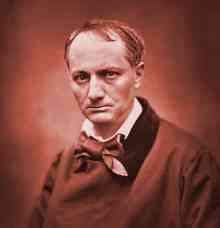
Charles Baudelaire was a French poet, essayist, art critic and translator. He was born in Paris, France on 9th April 1821 and died there on 31st August 1867 aged 46.
Major Works
“Les Fleurs du Mal” (The Flowers of Evil) (1857).
“Les Épaves” (The Wrecks) (1866).
Biography Timeline
1821: Charles Baudelaire was born in Paris, France on 9th April. His father was Joseph-François Baudelaire, a senior civil servant and amateur artist who was 34 years older than his wife. His mother was Caroline (née Dufaÿs), his father’s second wife. Baudelaire was educated in Lyon at a boarding school. He then studied law at the Lycée Louis-le-Grand in Paris but was not a willing student and began to drink heavily and accrue large debts.
1827: His father dies at Rue Hautefeuille, Paris, on 10th February.
1828: His mother marries Lieutenant Colonel Jacques Aupick who would later become an ambassador.
1839: He passes his degree but chooses not to practice law thus upsetting his mother and stepfather in the process. He decides to embark on a literary career.
1841: His stepfather sends him on a voyage to India to try and distract him from writing.
1842: On his return to Paris, Baudelaire becomes friends with other authors and artists and also begins a lifelong relationship with the Haitian actress Jeanne Duval. His parents bitterly disapprove of the relationship and he attempts suicide. He begins to compose some of the poems of “Les Fleurs du Mal”. As he is now 21 years old, he receives an inheritance and begins to squander the money on loose living and dressing in extravagant clothes.
1845: His first published work is an art review of the “Salon of 1845” under the pseudonym Baudelaire Dufaÿs. It attracts much public attention in particular his praising of the work of Eugène Delacroix.
1846: He writes a second art review in which he establishes himself as a great supporter of Romanticism.
1847: He publishes his novella “La Fanfarlo”.
1848: During the Revolutions of 1848 he writes for a revolutionary newspaper although he was soon to tire of politics.
1850: His health is now poor and he has many debts and moves lodgings several times to escape from his creditors. To try and earn some money he translates some stories by Edgar Allan Poe into French.
1855: Some of the poems for “Les Fleurs du Mal” appear in the “Revue des Deux Mondes” (Review of Two Worlds) published by Baudelaire’s friend Auguste Poulet-Malassis and, although they reach a small positive audience, mainstream critics condemn them for being unwholesome.
1857: He eventually publishes his first volume of poems, “Les Fleurs du Mal” (“The Flowers of Evil”). The themes of sex and death cause a public scandal and he, his publisher and the book’s printer are prosecuted for creating an offence against public morality. Six of the poems are suppressed altogether. Many admirers such as Gustave Flaubert and Victor Hugo come out in support to condemn this action. They are all fined but not imprisoned. His stepfather dies and Baudelaire receives nothing from his will but hopes to mend relations with his mother. Still short of money he translates “Confessions of an English Opium Eater” by Thomas de Quincey and articles in “L’Artiste” such as a study on Gustave Flaubert and he begins working on “Petits Poemes en Prose” (Small Prose Poems) which are not published until after his death in 1869.
1858: He publishes a review on Theophile Gautier in the “Revue Contemporaine” in September.
1859: By now he is suffering from a number of chronic health conditions, brought on by stress and a long-term use of laudanum. Besides his relationship with Jeanne Duval he also spends time with the actress Marie Daubrun and the prostitute Apollonie Sabatier. His mother relents and agrees to let him live with her at the seaside town of Honfleur where he begins writing the poem “Le Voyage”.
1860: He writes various articles for “Poètes Français” and publishes “Les Paradis Articiels”. He becomes known as a supporter of the music of Richard Wagner.
1861: A new edition of “Les Fleurs du Mal”, still without the six banned poems but with new poems added is published. His publisher, Poulet Malassis, declares bankruptcy thus adding to Baudelaire’s financial woes.
1864: Financial difficulties mean he has to leave his home and he goes to Belgium hoping to raise money to pay off his debts by selling the rights of his works and giving lectures. He begins to smoke opium in Brussels and also to drink to excess.
1866: He sufferes a massive stroke and he lives the final months of his life in a semi-paralysed state both in Brussels sanatoriums and after a return to Paris. “Les Épaves” (The Wrecks) is published in Brussels.
Charles Baudelaire died on 31st August 1867 and was buried in the Montparnasse Cemetery in Paris. Many of his works were published posthumously allowing his mother to pay off his debts and appreciate his fame.
Influences
Baudelaire was influenced by thinkers such as Emanuel Swedenborg, François Marie Charles Fourier and Félicité Lamennais and in literature he adopted the alexandrine verse formerly used by Pierre Corneille and Jean Racine in his “Fleurs du Mal”. He became associated with the school of highly rational French neo-classicism which often seemed at odds with his grotesque or violent subject matter.
His subject matter owes a debt to Edgar Allan Poe whose work he discovered in 1847 and he saw in him a kindred spirit. He began to translate his works which gave him a steady supply of income. He also wrote about art and the alienation of the artist and found most human behaviour to be irrational. Although he was accepted as a poet during his lifetime, his status with contemporary critics was not high and he did not sell particularly well. Many articles in the press exaggerated his eccentricities to a ridiculous extent. Writers were more sympathetic and people such as Stephane Mallarme, Paul Verlaine and Arthur Rimbaud sang his praises. Rimbaud called him “génie, un voyant” (genius, a visionary) and “The King of Poets” and in the winter of 1865 Verlaine in the journal “L’Artin” claimed he wrote poetry about modern man.
He is seen as a crucial link between Romanticism and Modernism. His work had a major influence on modernism and symbolism and in particular the poems of T.S. Eliot, Paul Valery and Rainer Maria Rilke. He became influential in Britain when the critic Arthur Symons introduced his work and where Eliot saw it and then passed it on to the USA. Eliot in 1930 stated that he had not yet received a “just appreciation” even in France and that he had a “technical mastery which can hardly be overpraised”. In 1948, he also said “I am an English poet of American origin who learnt his art under the aegis of Baudelaire and the Baudelairian lineage of poets”. In “The Waste Land” he quotes the last line of Baudelaire’s “Au Lecteur” at the end of Section I. Many books have been written about him and Vanderbilt University established the “W.T. Bandy Center for Baudelaire Studies”.
In France Marcel Proust published the influential “A propos de Baudelaire” (On the Subject of Baudelaire) in 1922 and declared him “the greatest poet of the nineteenth century” and his star began to rise again. By the 1940’s his work was regularly used in school studies.
Further Information
Books for sale of many of the works of Baudelaire.