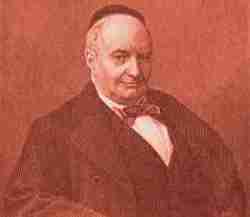
Charles Augustin Sainte-Beuve was a French poet, novelist, literary critic and politician. He was born 23rd December 1804, Boulogne-sur-Mer France and died on 13th October 1869 in Paris, France aged 64.
Major Works
“Volupté” (1834)
“Portraits Contemporains” (1846)
“Port-Royal” (1837–1859)
“Chateaubriand et son Groupe Littéraire” (1861)
“Poésies Complètes” (1863)
Biography Timeline
1804: Charles Augustin Sainte-Beuve was born on 23rd December 1804 in Boulogne, France. His father was a tax collector who died before he was born. He was educated at schools in the city.
1824: He studies medicine at the College Charlemagne until 1827.
1825: He begins contributing literary articles to the “Globe” liberal newspaper, edited by Paul Dubois, one of his former teachers.
1827: He reviews “Odes et Ballades” by Victor Hugo and meets with the author and his group of Romantics called Cenacle.
1828: During the year he serves in the St Louis Hospital. He publishes his first book, the two volume “Tableau Historique et Critique de la Poésie Française et du Théâtre Français au XVIe siècle (Historical and Critical Description of French Poetry and Theatre in the Sixteenth Century). He goes on a short visit to England where he is impressed with the poetry of William Wordsworth and Samuel Taylor Coleridge, who are both little known on the continent at the time.
1829: He publishes “Vie, Poésies et Pensées de Joseph Delorme” (The Life, Poetry, and Thought of Joseph Delorme).
1830: He publishes “Les Consolations” which becomes quite popular. A Saint-Simonian faction takes over “The Globe” who believe that the feudal society should be swept away to make way for a new industrial age. Sainte-Beuve is given the task of writing their manifesto.
1831: He writes articles for the “Revue des Deux Mondes”. He also becomes interested in the work of Felicite Robert de Lamennais and looks to him for religious guidance. Lamennais also guides Victor Hugo’s wife Adele and she and Saint-Beuve become very close friends much to the annoyance of Hugo himself.
1832: He is disgusted by the handling of the riots of 1832 by King Louis-Phillippe and refuses several posts at universities.
1834: He publishes the semi-autobiographical novel “Volupté” which also angers Hugo.
1836: Francois Guizot, the Minister of Education, invites him to become secretary of a government commission studying the nation’s literary heritage.
1837: He accepts a one year visiting professorship at the University of Lausanne in Switzerland to lecture on the famous seventeenth century convent Port-Royal and its links with Jansenism.
1839: Several of his articles are collected together in “Critiques et Portraits Littéraires”. He publishes “Madame de Pontivy” and “Christel”.
1840: He returns to Paris and takes up a post in the Mazarine Library of the French Institute.
1843: He publishes the poems “Livre d’Amour” (Leaves of Love).
1845: He is made a member of the Academie Francaise and, in a twist of irony, the duty of giving the reception speech falls to Victor Hugo.
1846: He collects together essays in “Portraits Contemporains” and frequents the soirees given by Madame Recamier and Francois-Rene de Chateaubriand.
1848: He is unfairly accused in the republican press of accepting secret government funds for the repair of a chimney in his home and he resigns from the library in protest and moves to the University of Liege in Belgium.
1849: He returns to Paris after the 1848 revolutions and becomes editor of the newspaper “Le Constitutionel”. He writes biographical essays for them called “Causeries du Lundi” (Monday Chats) which are published in book form in 1851.
1852: When Louis Napoleon becomes Emperor Napoleon the Third Sainte-Beuve is made Professor of Latin Poetry at the College de France but is forced to resign by anti-Imperialist students.
1857: His intended lectures at the College are published as “Étude sur Virgile” (Studies of Virgil).
1858: He has a temporary post teaching literature at the École Normale Supérieure.
1859: His lectures “Port-Royal 1837–1859” are published in final form and seen as his masterpiece.
1861: He publishes “Chateaubriand et son Groupe Littéraire” (Chateaubriand and his literary Group).
1863: He publishes “Poésies Complètes”.
1865: He is made a Senator by decree of the Emperor but his speeches to the Senate become unpopular due to his liberal views.
1867: He speaks in the Senate in support of public libraries and of freedom of thought.
1868: He speaks in the Senate in support of liberty of education. “Le Moniteur” is taken over by the government and for the first time they try to edit one of his articles. He withdraws the whole article and offers it to “Le Temps” instead.
Charles Augustin Sainte-Beuve died on 13th October 1869 in Paris, France after unsuccessful bladder stone operations. He was buried in Montparnasse Cemetery in the city. Several of his works were published posthumously such as the final volumes of “Portraits de Femmes” (1870) “Portraits Contemporains” (1871) “Chroniques Parisiennes” (1876) and “Portraits Littéraires” (1878).
Influences
Charles Augustin Sainte-Beuve, the only child of a tax collector, completed a classical education in Paris and then began to study medicine but abandoned it after one year. In 1825 his former teacher Paul Dubois now editor of the journal “La Globe” gave him a job writing reviews. His first essays were on the poetry of Victor Hugo whom he met and became a member of his literary group. Hugo guided his early poetry and Romantic viewpoint although a later affair with Hugo’s wife put a strain on their relationship. It was in this group that he was introduced to German thought and in particular the writings of Johann Wolfgang von Goethe.
In 1828 a visit to England awakened his fascination with the poetry of William Wordworth and Samuel Taylor Coleridge who were at the time little known on the continent of Europe. He developed a taste for their introspection. He also read the works of William Cowper and George Crabbe which had an influence on his style at the time.
Back in France his work took a spiritual turn. He became associated with a group of reformers based on the doctrines of Claude-Henri de Rouvroy, Comte de Saint-Simon. They believed that feudal and military systems should be replaced by industrial managers, and scientists, rather than the church, should become spiritual leaders. He was asked to draft two manifestos, or “professions of faith”, but soon became disillusioned by the sentimental excesses and intemperance of the leaders of the group. Next he became inspired by the religious reformer and political writer Félicité Robert de Lamennais, the spiritual adviser of Adèle the wife of Victor Hugo.
Besides writing for “Le Globe” he contributed articles to another new the “Revue des Deux Mondes”. In it he wrote portraits of contemporary writers not only studying their work but including much biographical material.
During the reign of King Louis-Philippe he became angered by the regime and in particular the severe handling of the 1832 riots. He refused several academic posts at the time despite the fact that he needed the money. However, his studies of French literature from the Renaissance to the nineteenth century later made him one of the most-respected and most-powerful literary critics in the country. He became a member of the group led by Madame Récamier, the famous hostess, and the writer and politician Francois-René de Chateaubriand. Chateaubriand in particular introduced him to aristocratic circles and inspired his biographical focus on literary groups. He was an enthusiastic supporter of Chateaubriand’s memoirs although this cooled somewhat by the time he wrote his study in 1861 “Chateaubriand et son Groupe Littéraire sous l’Empire” (Chateaubriand and his literary group under the Empire”).
After his views on King Louis-Philippe’s regime softened in 1836 he was invited by the Minister of Education François Guizot to become secretary of a government commission studying the nation’s literary heritage. This in turn led to a major piece of work entitled “Port Royal” and a visiting professorship at the University of Lausanne lecturing on it. Port-Royal was the convent famous in the seventeenth century for advancing a highly controversial view of the doctrine of Catholic grace, loosely called known as Jansenism. He would revise the work over the next two decades and it covers the religious and literary history of France from the period.
Back in Paris he continued writing whilst working at the French Institute’s Mazarine Library. He was elected to the French Academy in 1844. Around this period he broke free from his links with the Romantics and became a critic of them now preferring highly structured classicism such as works by Molière.
After the overthrow in 1848 of King Louis-Philippe he was unfairly accused in the republican press of accepting secret government funds for the repair of a chimney in his apartment. He resigned his library job and moved for a year to the University of Liège in Belgium.
In 1849, he was asked by Louis Véron, editor of the newspaper “Le Constitutionnel”, to write a weekly article on literary topics current and past which later became the famous collection of studies called “Causeries du Lundi” (Monday Chats).
With the rise of Emperor Napoleon the Third he was appointed to the chair of Latin at the Collège de France but was forced to discontinue his lectures due to student protests at his support of the Emperor. He now sustained himself by freelance writing and visiting the literary salon led by Napoleon the Third’s cousin, the Princess Mathilde.
In 1865 he was made a senator by imperial decree but was unpopular due to his liberal views. According to some critics he was the greatest literary critic of his time, but he managed to anger many writers from Gustave Flaubert and Marcel Proust through to Vladimir Nabokov. Chief accusation was that he praised some mediocre writers and did not give enough praise to some of genius. Whilst dining at the famous Parisian restaurant Magny’s the brothers Goncourt surreptitiously wrote down the conversation as a mark of his fame in literary circles.
The critic Ernst Robert Curtius thought that Sainte-Beuve’s long critical career had given French literature a coherence and a continuity that were absent from German literature because no comparable figure to him existed however this was far from universal and Proust himself, despite engaging with his methods, spent most of his life (and “À La Recherche du Temps Perdu”) criticising him. For example he wrote a collection of essays “Contre Sainte-Beuve” to argue against his critical focus on biography over the subconscious self of an artist. Friedrich Nietzsche, who was also not a fan, nonetheless asked Ida Oberbeck the wife of his friend Franz to translate the “Causeries du Lundi” into German and loved the result but it was largely ignored by the wider German literary world.
Sainte-Beuve is important in establishing French literary criticism as an independent genre and as the first to use the biographical method and building a foundational framework for modern academic criticism. Henry James admired him greatly however he was disappointing when writing about Charles Baudelaire and understated the works of Gustave Flaubert, Stendhal, and especially Honoré de Balzac.
Further Information
List of works by Sainte-Beuve.