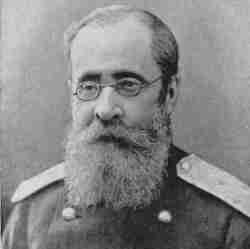
César Cui was a Russian composer and music critic and member of “The Five”. He was born on 18th January 1835 in Vilnius, Lithuania and died on 26th March 1918 in Saint Petersburg, Russia aged 83.
Major Works
“William Ratcliff” (1869)
“A Feast in Time of Plague” (1900)
“Mademoiselle Fifi” (1903)
“Puss in Boots” (1913)
Biography Timeline
1835: Cesarius-Benjaminus Cui was born on 18th January in Vilna (Vilnius), Lithuania, Russian Empire. His father, Antoine (Anton Leonardovich) Cui, was a member of Napoleon Bonaparte’s army who had invaded Russia and never returned having been wounded at the Battle of Smolensk. His mother was a local noble woman called Julia Gucewicz.
1850: He goes to the local Gymnasium (secondary school) in Vilna and has music lessons from the Polish composer Stanislaw Moniuszko who lives in the town. In particular he studies music by Frederic Chopin.
1851: He enters the school of engineering in St. Petersburg aged 16.
1855: After graduating he engages in advanced studies at the Nikolaevsky Engineering Academy.
1856: He meets Mily Balakirev and begins to get seriously interested in musical composition.
1857: He becomes a lecturer in fortifications at the Engineering Academy where he goes on to teach notable members of the Royal family including the future Tsar Nicholas the Second. He begins writing his first opera “The Prisoner of the Caucasus” which is not completed until 1883.
1858: He marries Malvina Rafailovna Bamberg whom he had met at the home of Alexander Dargomyzhsky whilst she was having singing lessons. They go on to have two children together, Lidiya and Aleksandr.
1859: His orchestral Scherzo, Op. 1, is the first work to be publicly performed at the Russian Musical Society.
1864: He becomes music critic of the “St. Peterburgskiye Vedomosti” (St. Petersburg News).
1869: The first public performance of one of his opera “William Ratcliff” takes place in St Petersburg, based on a tragedy by Heinrich Heine. It only has a limited success even though it is highly praised by Franz Liszt.
1874: He becomes known for the severe and often sarcastic reviews in the newspapers and his piece about the premiere of Modest Mussorgsky’s“Boris Godunov” is particularly damning despite him being one of his friends.
1876: He reviews the original production of Richard Wagner’s “Der Ring des Nibelungen” in Bayreuth, Germany which is later produced as a monograph. Because of his military status articles have to be under a pseudonym which in his case is three asterixs. ***.
1877: He works on the fortifications for the Russo-Turkish War.
1878: He returns to being a teacher of fortifications. He composes the one-act comic opera “The Manadarin’s Son” which is premiered on 7th December at the Artist’s Club in St Petersburg.
1880: He is appointed to the rank of professor.
1881: He publishes “La Musique en Russie” in France and Belgium.
1883: He composes the three-act opera “Prisoner of the Caucasus” based on a text by Aleksandr Pushkin. He resigns his post on the opera selection committee at the Mariinsky Theatre along with Rimsky-Korsakov in protest of their rejection of Mussorgsky’s “Khovanshchina”.
1885: In Belgium the Comtesse de Mercy-Argenteau helps him get the “Prisoner of the Causcasus” staged in Liege in 1886.
1894: His “Le Filibustier” is premiered at the Opera-Comique in Paris on 22nd February but only runs for four performances. Nevertheless, he is elected as a corresponding member of the Academie Francaise and awarded the cross of the Legion d’honneur.
1896: He becomes director of the St Petersburg branch of the Russian Musical Society. He is made a member of the Belgian Royal Academy of Literature and Art.
1897: He writes a very critical review of Sergei Rachmaninoff’s First Symphony.
1899: His wife Malvina dies.
1900: He gives up being a music critic for newspapers. He composes the one act opera “A Feast in Time of Plague” based on one of the four “Little Tragedies” by Aleksandr Pushkin. It is premiered the following year.
1903: “Mademoiselle Fifi”, based on a work by Guy de Maupassant, is premiered in Moscow.
1907: He works on his last opera, the four-act “The Captain’s Daughter”, based on Pushkin’s novel of the same name.
1911: “The Captain’s Daughter” is premiered in St. Petersburg.
1906: He attains the military rank of Lieutenant-General.
1915: The children’s opera “Puss in Boots” is premiered in Rome, Italy.
1916: He becomes blind, although he is still able to dictate new musical pieces.
César Cui died on 13th March 1918 of cerebral apoplexy in Petrograd (St. Petersburg), Russia. He was buried next to his wife to at the Smolemnsky Lutheran cemetery in Petrograd. In 1939 his body was reinterred in the Tikhvin Cemetery at the Alexander Nevsky Monastery, next to other members of “The Five” (Aleksandr Borodin, Mily Balakirev, Modest Mussorgsky and Nikolai Rimsky-Korsakov).
Influences
Cesar Cui was the son of a French officer who had remained in Russia after the retreat of Napoleon in 1812. As a young man growing up in Vilnius he received early music lessons from the Polish composer and conductor Stanisław Moniuszko. He entered the Engineering School at St Petersburg in 1851 and graduated at the Academy of Military Engineering and was appointed lecturer in 1877. He even held the rank of Lieutenant General until the end of his life. However music was his greater calling.
His musical mentor, after they met in 1856, was Mily Balakirev who helped him with the composition and the orchestration of his early operas.
He is important as co-founder with Balakirev of “The Five” otherwise known as the “Mighty Handful”, a group of Russian nationalist composers. Less well known than some of the other members nowadays, at the time he also had a long career as critic and writer and became the group’s main publicist. He leaned more towards Western European Romantic models than some of the others such as Modest Mussorgsky and Nikolai Rimsky-Korsakov who used authentic Russian folk idioms. He excused himself by saying “Although born a Russian, I am half French, half Lithuanian and have not a drop of Russian blood in my veins”.
In his smaller piano miniatures the influence of Robert Schumann and Frédéric Chopin can clearly be seen as well as his occasional use of musical cipher signatures. The Russian composer Alexander Dargomyzhsky gave him stylistic inspiration for his larger works such as nationalist opera and vocal writing. He even went on to marry one of Dargomyzhsky’s vocal pupils and completed his unfinished opera “The Stone Guest”.
Of his ten substantial operas only the first “The Prisoner in the Caucasus” takes on a Russian theme being based on a work by Aleksandr Pushkin. Others show a range of literary inspiration from “William Ratcliff” based on Heinrich Heine, to other works by Alexandre Dumas and Guy de Maupassant. “William Ratcliff” was praised by some of his colleagues and is perhaps his most successful work but many believed it had an awkward orchestration and other technical failings and it is now not in the repertoire.
He was a prolific composer and his miniatures, songs and instrumental pieces, often written for children or amateurs, were extremely popular during his lifetime but again have fallen out of favour. Even his last four operas were based on fairy tales largely due to his association with early music education proponent and librettist Nadezhda Dolomanova.
Rimsky-Korsakov was particularly dismissive of his musical abilities and there was a long running feud between Cui and Pyotr Ilyich Tchaikovsky. Despite all this his work as a critic shaped Western European public opinion on Russian music with the enthusiastic backing of Tsar Nicholas the Second. His 1881 book “La Musique en Russie” promoted Russian compositions in France and Belgium and thence to the wider European world. In particular the Belgian patron Comtesse de Mercy-Argenteau was inspired to champion the music and financed the staging of Russian nationalist operas abroad.
More of Cui’s music has been made available in recent years through recordings and sheet music but this hasn’t permeated through to today’s repertoire. An exception is his opera “Puss in Boots”, based on the work by the seventeenth century French author Charles Perrault, which has gained wide popularity in Germany.
Further Information
List of works by Cui.