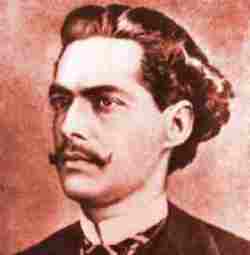
Antônio Frederico de Castro Alves was a Brazilian poet and playwright famous for his abolitionist and republican poems. He was born on 14th March 1847 in Castro Alves, Brazil and died on 6th July 1871 in Salvador, Brazil aged 24 years.
Major Works
“Espumas Flutuantes” (Floating Foam) (1870)
“A Cachoeira de Paulo Afonso (The Paulo Alfonso Falls) (pub 1876)
“Osescravos” (The Slaves) (pub 1883)
“Hinos do Equador” (Hymns of Ecuador) (pub 1921)
Biography Timeline
1847: Antônio Frederico de Castro Alves was born on 14th March in Castro Alves, Brazil. His father was the medical doctor Antônio José Alves. His mother was Clélia Brasília da Silva Castro. He was looked after by the family maid, Leopoldina, who told him stories and legends. He went to primary school in Sao Felix with his brother.
1854: The family move to the provincial capital and live in a house where Júlia Fetal had been murdered and he hears ghost stories about it. He studies at the Colégio Sebrão.
1858: He moves with his brothers to the Ginásio Baiano school run by Abílio César Borges, the Baron of Macaúbas.
1859: He starts writing his first verses. His mother dies of lung cancer and his brother José Antônio threatens suicide by trying to throw himself out of a window.
1861: He publishes poetry in several newspapers honouring Archbishop Antônio de Macedo Costa, who had recently died.
1862: His father remarries, to Maria Ramos Guimarães, and on 25th January Alves moves to the city of Recife with his older brother to enrol in a course at the law school. They live in the Convent of São Francisco and he continues to send works to newspapers.
1863: He publishes “A Canção do Africano” (The Song of the African) in the first issue of the newspaper “Primavera”. In March he takes the college entrance exam but fails on geometry. He also writes the poems“Pesadelo” (Nightmare) and “Meu Segredo” (My Secret). He sees the Portuguese actress Eugena Infante da Camara perform in the play “Dalila” at the Sao Joao Theatre in Salvador and falls in love with her.
1864: On 9th February his brother José Antônio suffering from mental health problems commits suicide and the poet returns to Bahia.
1865: He returns to Recife in March with the poet Fagundes Varela and, aged only sixteen, he begins writing his verse for “Os Escravos” (The Slaves). Amongst his influences are the romantic writers Victor Hugo, Lord Byron, Alphonse de Lamartine, Alfred de Musset-Pathay and Heinrich Heine. On 10th August he recites “O Sábio” (The Wise Man) at the Law School and then tries to enlist in a volunteer academic battalion of the army to fight in the war against Paraguay but fails his medical. He goes to live with his new lover Idalina but the relationship is short lived and he returns to Bahia with Varella on 16th December.
1866: His broken-hearted father dies on 24th January. Now short of money to pay his rent his landlord writes in the newspaper “Diario de Pernambuco” that he owes him money. He falls in love with two Jewish sisters, Ester and Simmy and writes the poem “A Hebreia” (The Hebrew) for them. He joins Bernardo Guimarães and others in founding a society for the abolition of slavery in Brazil. His friend Tobias Barreto falls in love with Adelaide Amaral, an actress who works with Eugênia Câmara and the two men begin to bicker about who is the greater actress and their friends even boo their rivals during performances. Eventually Eugênia leaves the wealthy bookkeeper Verissimo Chaves and moves in to live with the poet in Jaboateo where he writes the play “Gonzaga, ou A Revolução de Minas” (Gonzaga, or the Revolution of Minas) based on the life of Brazilian Neoclassic poet Tomás António Gonzaga and begins a novel (since lost).
1867: The couple move to Salvador in May and stay in a hotel. Eugênia wishes to return to the stage and they move to Quinta da Boa Vista where his father’s hospital was and live in his old house. She performs at the São João Theatre on 20th June and they both recite poetry to much acclaim. On 7th September “Gonzaga” is premiered, with Eugênia in the lead role, which is also a great success.
1868: In February they board a steamer to Rio de Janeiro where he introduces himself to the famous poet José de Alencar and reads him “A Cascata de Paulo Afonso” (Paulo Afonso’s Waterfall). Alencar is impressed and recommends him to Joaquim Machado de Assis as a member of the Condoreira (Condor) school of poets. In March they move on to Sao Paulo where he becomes part of the “Bucha Paulista” a secret legal society created to support students in precarious financial situations. He is successful in the city but he and Eugenia move apart and she looks for other lovers. In November his tuberculosis worsens and he goes to the countryside to seek fresh air. Unfortunately, when he jumps a ditch, his shotgun goes off and hits him in his left foot. He drags himself to the house of a friend who fetches a doctor but the wound does not get better.
1869: On 19th March he travels to Rio de Janiero with a friend to seek medical help and writes a letter of thanks to his friends in Sao Paolo in the “Correio Paulistano” newspaper. He arrives in Rio on 21st March where the surgeons Andrade Pertence and Mateus de Andrade amputate his left lower limb without the aid of an anaesthetic. In November, still in love with Eugenia, he writes “Adeus” (Goodbye! Forever Goodbye) and sails for Bahia. On the boat he has the idea for his book “Espumas Flutuantes” (Floating Foams). A prothesis is made for him and he is able to move around with the aid of a walking stick.
1870: On 14th October, weakened by tuberculosis, he asks his friend José Joaquim da Palma to recite the verses of “Deusa Incruenta – A Imprensa as Antithesis to Terribilis Dea” (Unbloody Goddess – The Antithesis to Terribilis Dea” by Pedro Luís Pereira de Sousa against the war. The following day he is strong enough to recite at the São João Theatre and receives a standing ovation from the audience. In November “Espumas Flutuantes” (Floating Foam) is finally published and contains some of his most brilliant love lyrics according to critics.
1871: On 9th February, he dedicates the verses of “No Meeting du Comité du Pain” (At the Meeting of the Comité du Pain) to the campaign that is being carried out in the capital of Bahia to raise funds for French orphans and widows of the Franco-Prussian war. In Salvador his sister Adelaide introduces him to the Italian singer Agnese Trinci Murri. He declares his love for her on 21st March at a soiree and she reciprocates. They ride horses to Barra Lighthouse in Salvador in May which he writes about in “Noite de Maio” (May Night).
Antônio Frederico de Castro Alves died of tuberculosis on 6th July 1871 in Salvador, Brazil. He was buried in the Campo Santo Cemetery in the city. In 1874 his remains were transferred to the mausoleum at block 1 belonging to his stepmother, Maria Ramos Guimarães. On 6th July 1971 the Mayor arranged for his remains to be transferred to his monument at Praça Castro Alves despite complaints from his family. “A Cachoeira de Paulo Afonso (The Paulo Alfonso Falls) is finally published in 1876 and “Osescravos” (The Slaves) about a slave girl raped by her master’s son along with other abolitionist poems was published in 1883.
Influences
Castro Alves has become known as the “Poet of the Slaves”. His abolitionist, “Condoreira” poetry, of which he was the major exponent, was influenced by Brazilian abolitionist campaigns, his life in Recife and the social injustices of slavery. He sought to merge emotions of liberty with political action.
He was profoundly influenced by European Romanticism and in particular the works of Victor Hugo and Lord Byron. He admired the former’s social activism and the latter’s passionate style. Other European writers who were to influence him were Alphonse de Lamartine, Alfred de Musset and Heinrich Heine and he was a great believer in the ideas of freedom and democratic ideals of the late Social Romantic era.
In 1853, he was sent to study in the Colégio Sebrão where he would meet and befriend Ruy Barbosa. Whilst studying in Recife and São Paulo he met many intellectuals including Tobias Barreto and José Bonifácio. A fellow student, Barreto influenced his writing style and philosophical outlook. His early work received praise from writers such as José de Alencar, who was an early champion of his work and Machado de Assis. Much of his work and especially “Os Escravos” (The Slaves) and “O Navio Negreiro” (The Slave Ship) was designed to provoke a public outcry against slavery.
His relationship with the Portuguese actress Eugênia Câmara inspired much of his passionate love poetry, such as “Espumas Flutuantes” (Floating Foam). A hunting accident with a shotgun which led to the eventual amputation of his foot all added to his heroic “Byronic” image.
His early years growing up in the Bahian hinterlands (sertão) left a major impression on him and fuelled the vivid, naturalistic imagery in his poetry. His work is also often characterised by a strong sense of national identity which also emphasises the Brazilian landscape.
In 1870, Alves published the poetry book “Espumas Flutuantes“, the only work he would publish during his lifetime. During his life however, the literary historian José Marques da Cruz pointed out his poetry “O Navio Negreiro” was memorised by many and was recited in many theatres and halls and contributed much to abolitionism. His work inspired later writers who were also abolitionists and the Condoreirismo school, a group of poets known for their high-minded social concerns and elevated style. In particular he influenced Raimundo Correia, Tobias Barreto and José Bonifácio and the “Cordel” literature, popular poetry in the northeast of Brazil. His influence was noted by Pablo Neruda in 1950, who recognised him as one of the great voices of the Americas and his work remains a cornerstone of Brazilian literature and political activism. Afrânio Peixoto stated that he “left a work without equal in our literatures”. He compared him to Ruy Barbosa, Joaquim Nabuco, Rodrigues Alves and Alfonso Pena and said that if they had all died aged only 24 like him they would not now be known.
Nowadays he is one of the best-known poets in the country, lending his name to public places, educational and cultural establishments, associations and even companies and it also used by cigarette and match brands. He is also referred to in the work of popular authors such as Rogaciano Leite, Bule-Bule and Rodolfo Coelho Cavalcante. He has been portrayed in several films such as the 1999 film “Castro Alves – Retrato Falado do Poeta”, (Portrait of the Poet) where he is portrayed in his fights for the Republic and for abolition and many biographies of him havebeen written. He has also inspired many musicians and even samba schools.
In 1881 ten years after his death the Largo do Teatro, one of the main squares in Salvador, was renamed after him. In 1919 a statue was commissioned from the Italian sculptor Pasquale de Chirico and inaugurated there on 6th July 1923. In 1900, his hometown was renamed “Castro Alves” in his honour. On 4th March 1967 the Teatro Castro Alves was finally opened in Bahia after a mysterious fire had almost destroyed the building several years before. In 1971 the governor of the state of Bahia inaugurated the Castro Alves Historical Park in the city of Cabaceiras do Paraguaçu as part of events for the centenary of his death.
Further Information
List of works by Alves.