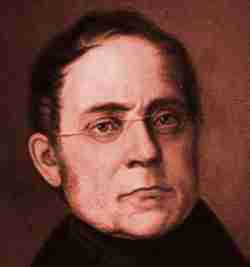
Carl Czerny was an Austrian composer, teacher, and pianist of Czech origin whose music spanned the late Classical and early Romantic eras. He was one of Beethoven’s best-known pupils. He was born on 21st February 1791 in Vienna, Austria and died there on 15th July 1857 aged 66.
Major Works
He wrote over one thousand pieces including symphonies, concertos and chamber music but is best known now for his etudes such as “The School of Velocity” and “The Art of Finger Dexterity”.
“On the Proper performance of all Beethoven’s Works for Piano” (1846).
Biography Timeline
1781: Carl Czerny was born on 21st February in Leopoldstadt, Vienna, Austria. His father Wenzel, was an oboist, organist and pianist of Czech origin. His mother was Moravian. He was taught the piano by his father.
1781: His father gets a job as a piano teacher at a Polish manor and the family move to Poland.
1788: He begins composing at age seven.
1795: His family return to Vienna due to the Third Partition of Poland.
1796: He begins teaching the piano aged fifteen in Vienna. He taches up to twelve lessons a day in the homes of the nobility.
1800: He makes his first public performance playing Mozart’s Piano Concerto No 24 in C Minor.
1801: The Czech musician Wenzel Krumpholz presents Czerny at the home of Ludwig van Beethoven where he plays the “Pathetique” Sonata. Beethoven is greatly impressed with the boy and takes him on as his pupil. Besides the master he is influenced by the work of Muzio Clemenzi and Johann Nepomuk Hummel.
1804: He has his last lesson with Beethoven but is asked to play his music at Prince Lichnowsky’s palace every week.
1806: Beethoven personally selects Czerny to play the premiere of his Piano Concerto No.1.
1812: Aged just twenty-one he plays the Vienna premiere of Beethoven’s Piano Concerto No 5 “The Emperor” in February.
1819: Franz Liszt’s father brings his son for lessons and he becomes Czerny’s most famous pupil. He is later to introduce the music of Czerny at his Paris recitals.
1823: On 13th April shortly before Liszt’s last concert of the season Czerny introduces him to Beethoven who is impressed with his performance.
1837: He visits France with the assistance of Liszt. He hardly leaves Vienna except for other short trips to Italy and England. He is a contributor to the compendium set of variations for piano, called the “Hexameron”.
1840: From now on he devotes himself to composition. His complete works run to over one thousand pieces. These include not only piano music such as études, nocturnes and sonatas but also choral music, symphonies, concertos, and a wide variety of chamber music. He becomes largely known for his piano studies such as “The School of Velocity”, “The Art of Finger Dexterity” and the “School of the Left Hand”. He edits his edition of the Sonatas of Domenico Scarlatti.
1842: He publishes his autobiography “Erinnerungen aus Meinem Leben” (Memories from My Life).
1846: He publishes “On the Proper Performance of all Beethoven’s Works for Piano”.
1852: Franz Liszt dedicates his “Etudes d’Execution Transcendente” to Czerny.
Carl Czerny died unmarried and childless on 15th July 1857 in Vienna, Austria. His fortune went to several charities including those for the deaf and his works were sent to the Society of Friends of Music in Vienna. He was buried in the Zentralfriedhof (Central Cemetery) in the city.
Influences
Carl Czerny’s father Wenzel gave him his first piano lessons and introduced in him a strong work ethic and sense of discipline from an early age. He publicly performed many of Wolfgang Amadeus Mozart’s piano concertos before the age of nine.
From around 1801 he studied with his most famous teacher Ludwig van Beethoven and adopted many of the master’s piano techniques blending his earlier classical learning with a more Romantic style. In later life he would tirelessly promote and chronicle Beethoven’s work and famously memorised all of Beethoven’s keyboard works.
In Vienna he met Muzio Clementi and Johann Nepomuk Hummel and was influenced by elements of their brilliant playing styles and thus developed his own personal style. He also received instruction from Antonio Salieri who helped him expand his musical education in terms of composition and theory.
Much later, around 1822, he was a teacher himself and taught Franz Liszt piano for about fourteen months. Despite the fact that he thought Liszt a bit chaotic in performance with a poor fingering style he was nevertheless so impressed by the young prodigy that he refused to charge for the lessons. He managed very briefly to make the young pupil focus on scales and exercises to fix his technique.
He first met Frédéric Chopin in Vienna in 1828 and the Polish pianist would visit several times thereafter. The two became good friends and played two-piano arrangements together at Czerny’s house. They both also collaborated alongside Liszt and Sigismond Thalberg on the collaborative piano set “Hexameron” in 1837. Chopin famously described him as “a good man, but nothing more”.
Czerny became known during his lifetime for his influential piano exercise books and etudes (graded musical studies) which are still in use today. He wrote thousands of technical exercises such as “The School of Velocity” and “The School of Virtuosity” which were designed to build finger dexterity and strength. Although his fame as a composer has now waned, he composed nearly one thousand works, bridging the late Classical and early Romantic musical eras. He was also aware of contemporary composers and frequently arranged and varied works by Gioachino Rossini and others. He held an influential role in defining the most important works for the piano repertoire. In 1847 Volume 4 of his “Theoretico-Practical Piano School” listed piano works of the previous eighty years, including works by Mozart, Clementi, Chopin, Schumann, Liszt, Schubert and Mendelssohn, as well as works of his own.
Johannes Brahms wrote to Clara Schumann about Czerny’s essay “On the Proper Performance of all Beethoven’s Works for Piano” of 1846 that it was worthy of study particularly for the fingering and that he thought “people today ought to have more respect for this excellent man”
The influential Polish pianist and teacher Theodor Leschetizky studied with him before becoming a major pedagogue himself and Sigismond Thalberg the famous Austrian rival to Liszt was another notable pupil. His influence through his direct pupils and through his published works has been immense. In 1927 the US music magazine “The Etude” showed how he could be considered the father of modern piano technique and the basis of an entire generation of pianists. It used a diagram of his pupils who went on to teach other pupils and they in turn became teachers and the list goes right through from the German Theodor Kullak to modern exponents of the keyboard such as Sergei Rachmaninoff, Artur Schnabel and Daniel Barenboim.
His reputation as a composer fell after his death and even Robert Schumann aired negative views in the “Neue Zeitschrift für Musik” (New Musical Gazette). Later the American musicologist Arthur Loesser described his music as “without depth, intensity, or wit, but always smooth and pretty and rather ear-tickling when played fast … endless variety of patterns and endless monotony of import”. Nevertheless, some others in the twentieth century began to review his work and Igor Stravinsky was typical in saying “As to Czerny, I have been appreciating the full-blooded musician in him more than the remarkable pedagogue”.
Further Information
List of compositions by Czerny.